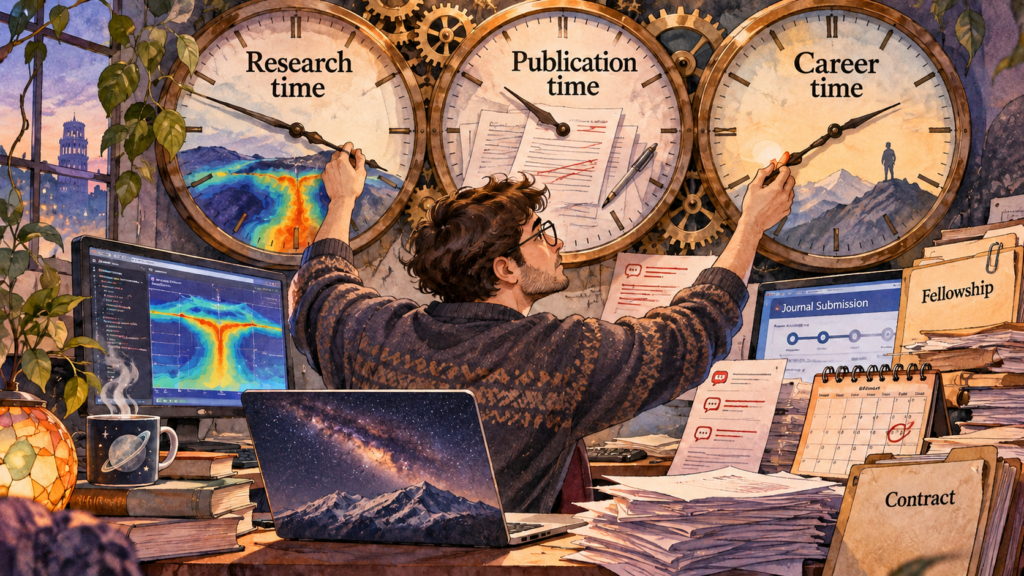
On Thursday evening, Ethan, an early-career researcher, was about to submit his revised manuscript to The Journal of Nevermind. One co-author had returned detailed comments a week earlier. Another had asked to see the draft once everyone else was finished. At 11:47 p.m., the last set of comments arrived. The first one asked whether he could rerun the simulations. The revision was due on Friday. The previous runs had taken more than nine days. The suggestion was worth taking seriously. What frustrated Ethan was having to work out, overnight, what it meant for a deadline he had spent weeks trying to keep. He had sent reminders, reconciled conflicting edits and checked that the methods matched the simulations he had actually run. To one colleague, Friday was the last day to send feedback. To Ethan, it was the day by which he was supposed to have dealt with it. This week, Katherine Villavicencio (University of Pisa) explores the roots of that frustration: coordinating co-authors who work at different paces, navigating months of editorial uncertainty, and managing the pressure of looming fellowship and contract deadlines..
What everyone meant by “almost done”
A co-author can read the manuscript carefully, raise a good scientific question and still underestimate how much work their suggestion creates. “Could we test a different value?” fits on one line. Answering it may mean rerunning the control, checking whether the comparison still holds and rewriting a conclusion that everyone had already agreed on. The person leaving the comment might have set aside an afternoon for the paper. The person answering it may have to rearrange the next two weeks.
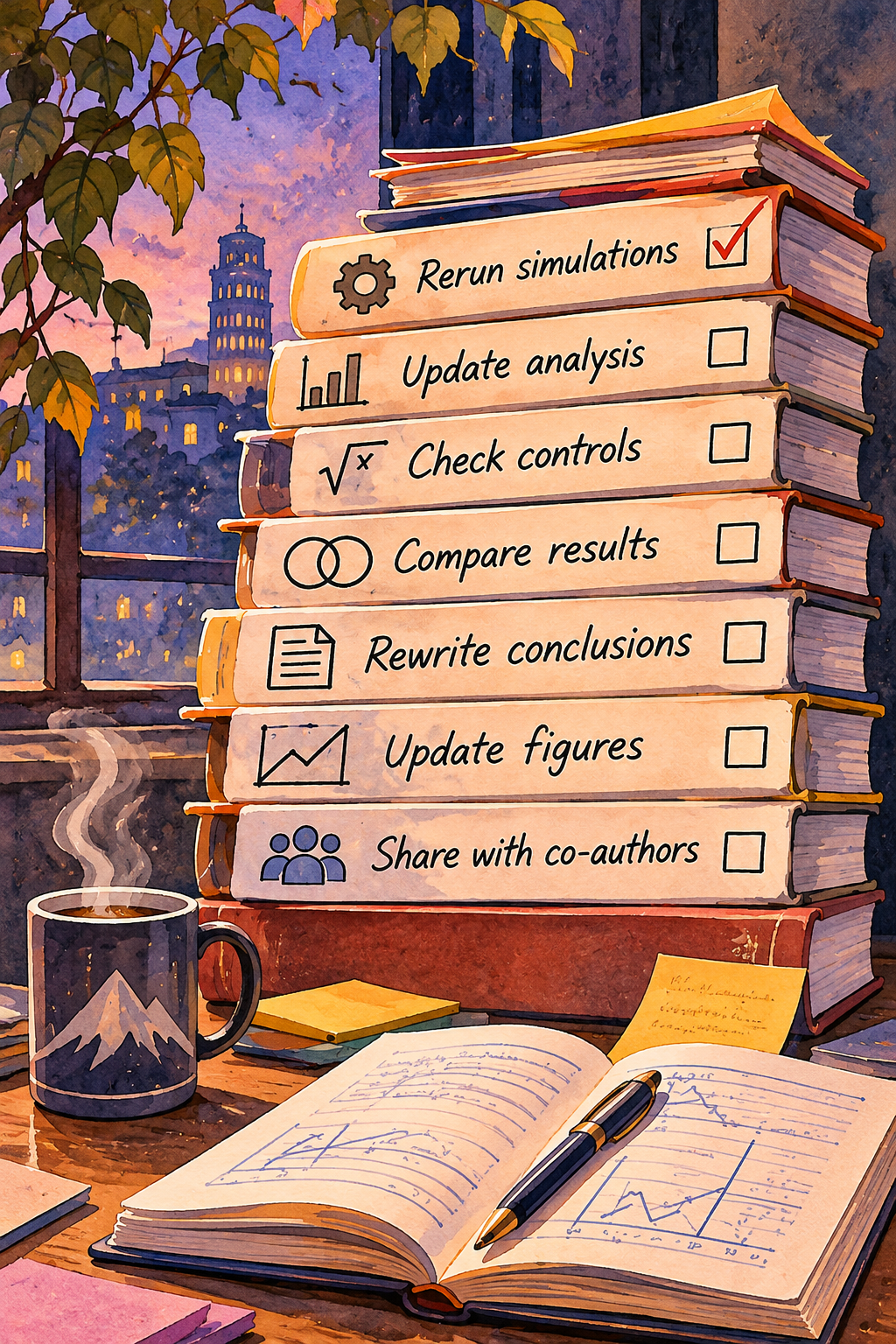
Figure 2: The hidden workload behind manuscript revisions: every scientific suggestion can trigger a cascade of additional tasks. (AI-edited.)
The challenges of coordinating scientific work extend well beyond manuscript preparation. In their study of 491 research collaborations funded by the US National Science Foundation, Cummings and Kiesler (2007) found that the way researchers distributed responsibilities and exchanged knowledge was closely associated with scientific outcomes, including the generation of new knowledge, the development of research tools and the training of students. Collaborations involving more universities tended to have fewer coordination activities and poorer project outcomes, with insufficient coordination emerging as a key factor explaining this relationship. Bringing together researchers with complementary expertise can therefore enrich a scientific project, but the benefits of collaboration also depend on how effectively people organise the work that connects their individual contributions.
In a more recent geoscience preprint, Wiekenkamp et al. (2026) analysed 151 survey responses from a German research network. Early-career researchers reported that differences in working pace, terminology and publication strategies complicated interdisciplinary work. Those differences can stay invisible for months, especially when everyone agrees that the paper is a priority but has a different idea of what that means this week. There is also the awkwardness of asking for the work. A postdoc may be responsible for getting the manuscript out while depending on more senior colleagues for feedback, references or future collaborations. After the second unanswered email, even a simple reminder can take time to write. How direct can you be with someone whose approval you need? If a co-author wants another analysis, can you ask them to help run it? The frustration builds when responsibility for the deadline is clear and responsibility for the work needed to meet it is still up for discussion.
Waiting for a first decision
Before Ethan had a revision deadline, he spent months waiting to find out whether he would have one. That first decision has a particular importance. A rejection lets the authors decide where to submit next. A revision gives them something concrete to assess and plan. While the manuscript is pending, the lead author has to make room for a response that could require anything from a few edits to a redesign of the study. Starting the next project, booking time on a computing cluster or promising a co-author a date all become harder to plan.
This uncertainty is not simply a matter of how long reviewers take to evaluate a manuscript. Drawing on 3,500 author-reported publishing experiences, Huisman and Smits (2017) found substantial differences in review duration across scientific disciplines. Particularly striking was the finding that, in approximately one-sixth of desk rejection cases, authors waited more than four weeks for a decision, even though their manuscripts had never been sent for external review. The study suggests that editorial inefficiencies, alongside the time required for peer review itself, can contribute to publication delays. Finding reviewers presents an additional challenge, as highlighted by the AGU Editorial Network (2024) in its discussion of the growing pressures on scientific publishing in the Earth and space sciences. In 2023, a quarter of the manuscripts sent for external review across AGU journals required contacting at least eight potential reviewers. For an editor, that can mean sending another round of invitations. For an author looking at the submission portal, it may look exactly the same as it did a month ago.
The hardest part of the wait can be deciding what to do with it. If you’re told the journal is still looking for a reviewer, you have some basis for deciding whether to wait or discuss withdrawing the manuscript with your co-authors. If all you see is With Editor, withdrawing can feel like giving up months of progress, even though you have no way to tell how far the paper has moved. And when the first decision is a rejection without external review, the team may be back to choosing a journal with very little new information about the science. The same decision delivered early would have left time to act on it.
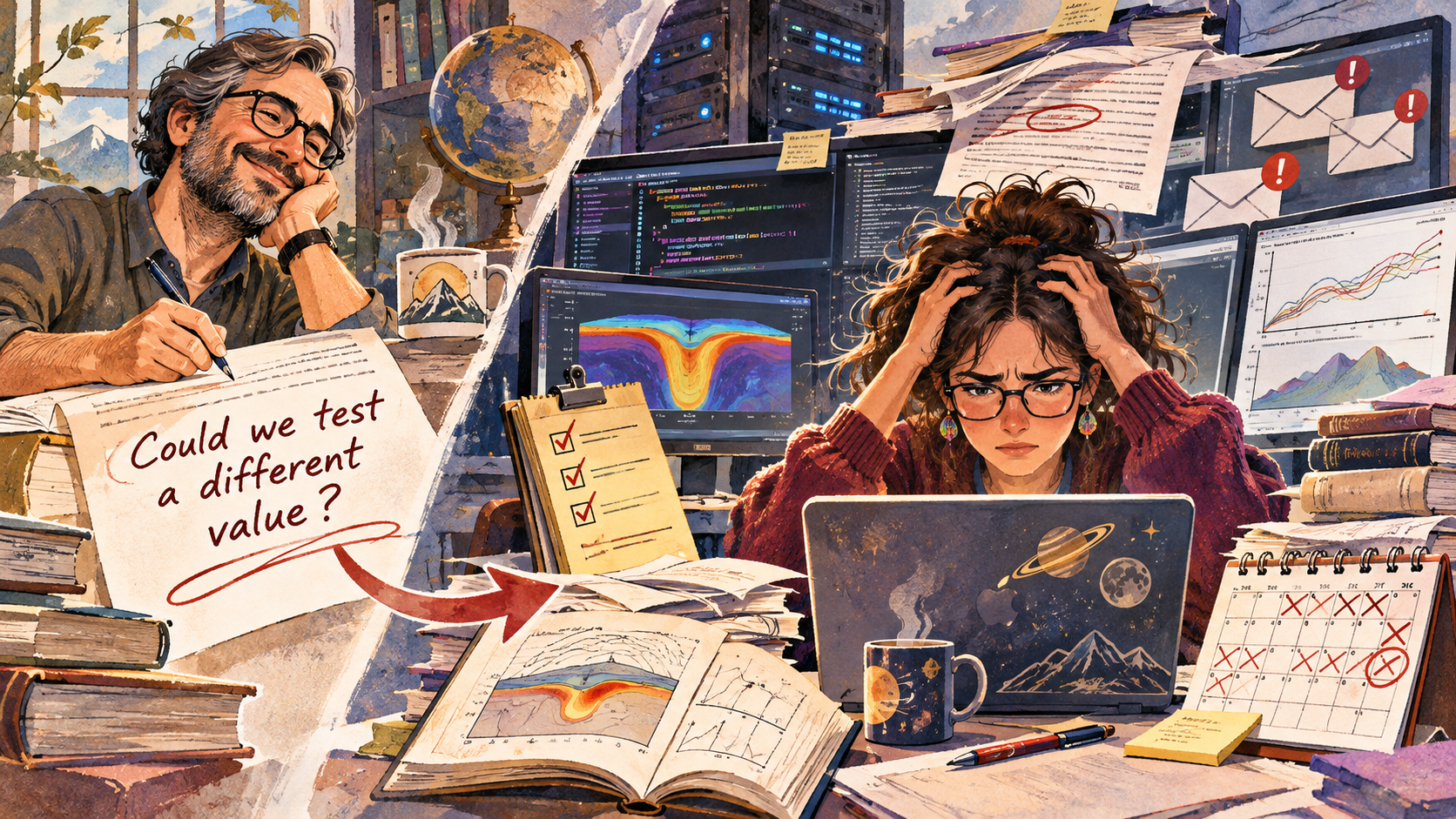
Figure 3: A one-line suggestion, weeks of work: the often invisible costs of scientific collaboration. (AI-edited.)
When publication timelines collide with career deadlines
The uncertainty surrounding scientific publishing is not experienced equally at every stage of an academic career. In a survey of 1,073 researchers across four Amsterdam institutions, Haven et al. (2019) found that postdocs and assistant professors experienced significantly greater publication stress than doctoral students and more senior academics. They also expressed the most negative attitudes towards the prevailing publication culture. The pressures behind these experiences extend beyond institutional expectations. Drawing on surveys of 1,133 recent PhD graduates and 225 postdoctoral researchers in the Netherlands, Waaijer et al. (2018) found that most respondents considered publication and funding pressures excessive. Importantly, the study highlighted how competition for academic positions can lead researchers to internalise these pressures, imposing expectations on themselves as they attempt to secure their professional futures. Together, these findings help explain why the timing of an editorial decision matters. A manuscript can be moving through a perfectly ordinary review process while the person who led it runs out of time to include the outcome in a fellowship application.
These professional pressures can also influence how researchers experience rejection. Using interviews and a participatory photographic method known as photovoice, Argan et al. (2024) explored the emotional experiences of 27 academics across 15 universities. Participants described feelings of disappointment, frustration, helplessness and discouragement, with some experiencing particularly intense negative emotions when their manuscripts were rejected after multiple rounds of revision. The interviews also revealed that emotional responses were shaped by previous publishing experience, the author’s contribution to the study and the importance of the manuscript for academic advancement. Having to begin the submission process again was itself a source of distress for some participants. The same decision goes to every co-author, but it can take up a very different amount of space in each person’s life. One colleague may be able to say, “We’ll try somewhere else,” and mean it as encouragement. The lead author may hear it and immediately start working out whether there’s time to do that before their contract ends. Both are thinking about the future of the paper. Only one may be wondering where they’ll be working when it comes out.
What stays with me about Ethan’s story is that he wants to run the simulation. He wants to know whether it will change the result. He also wants to know whether he’ll have time to finish it, whether the colleague who suggested it can help interpret it and whether the journal can give him an extra week. Those are reasonable questions to ask about a piece of work. On his fellowship application, there’s only one question about the paper, and he can answer it in two words: under review.
References

Cummings, J. N., & Kiesler, S. (2007). Coordination costs and project outcomes in multi-university collaborations. Research Policy, 36(10), 1620–1634. 10.1016/j.respol.2007.09.001

Wiekenkamp, I., et al. (2026). Interdisciplinary research in geosciences: A view from early career scientists. EGUsphere [Preprint]. 10.5194/egusphere-2026-1858

Huisman, J., & Smits, J. (2017). Duration and quality of the peer review process: The author’s perspective. Scientometrics, 113(1), 633–650. 10.1007/s11192-017-2310-5

AGU journal and book editors. (2024). Challenges facing scientific publishing in the field of Earth & space sciences. AGU Advances [Editorial]. 10.1029/2024AV001334

Haven, T. L., Bouter, L. M., Smulders, Y. M., & Tijdink, J. K. (2019). Perceived publication pressure in Amsterdam: Survey of all disciplinary fields and academic ranks. PLOS ONE, 14(6), e0217931. 10.1371/journal.pone.0217931

Waaijer, C. J. F., Teelken, C., Wouters, P. F., & van der Weijden, I. C. M. (2018). Competition in science: Links between publication pressure, grant pressure and the academic job market. Higher Education Policy, 31(2), 225–243. 10.1057/s41307-017-0051-y

Argan, M., Dinç, H., Tokay Argan, M., & Özer, A. (2024). What does rejection look like? A photovoice study on emotions and coping regarding manuscript rejection. Current Psychology, 43, 15983–16001. 10.1007/s12144-023-04253-5