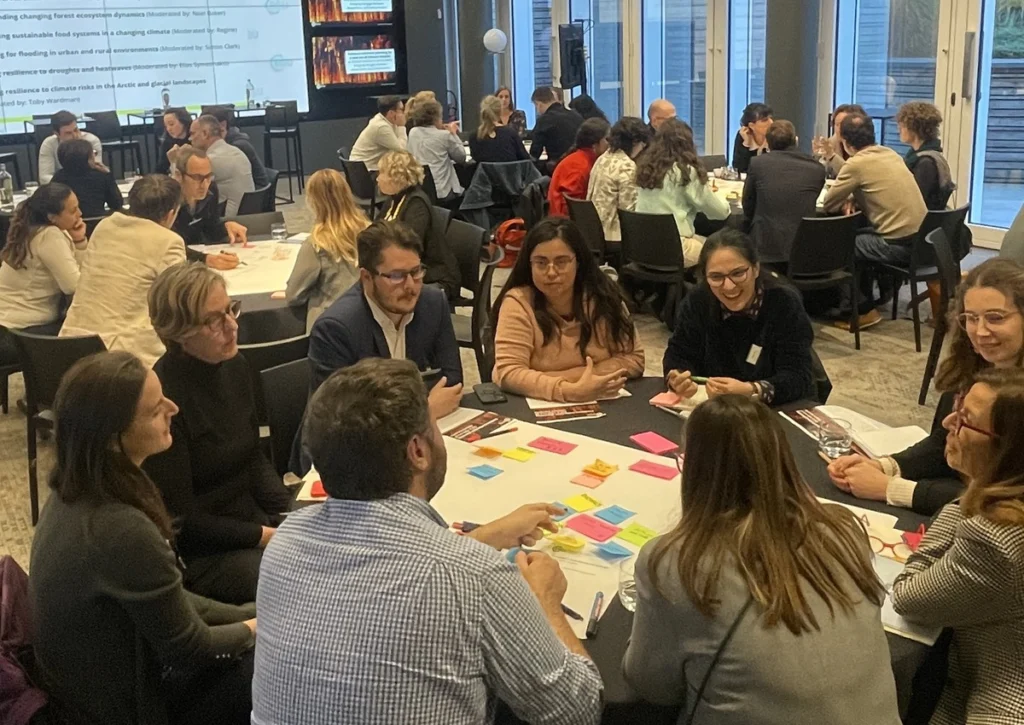

Esta entrada de blog forma parte de nuestra serie «Destacados», para la que aceptamos colaboraciones. Póngase en contacto con uno de los editores del blog de GM, Emily (eb2043@cam.ac.uk) o Emma (elodes@asu.edu), si desea contribuir sobre este tema u otros. Por: Rebekah Harries, investigadora postdoctoral, Universidad de Durham, Reino Unido Correo electrónico: rebekah.m.harries@durham.ac.uk Con contribuciones …[Read More]
Latest posts
GeoLog
GeoTalk: Meet Viktor Bruckman, interdisciplinary researcher, EGU Division President, and EGU Biodiversity Task Force
Viktor, welcome to GeoTalk! Can you tell us a bit about your current research focus? My current research is on the defossilization of our energy system with a strong focus on the roles of forests and soils in this context. I was originally trained in forestry and my research is still tightly connected with this …[Read More]
Hydrological Sciences
NOW HIRING: Our next EGU HS Early Career Scientist Representative and ECS Team Members
With the General Assembly of the European Geosciences Union (EGU) in Vienna (April 27-May 2) approaching fast, it’s time to assemble the new team to represent Early Career Scientists (ECS) of the Hydrological Sciences Division! We’re looking for a new ECS representative, as well as team members, to coordinate social media, our newsletter, online campfires, …[Read More]
Geodynamics
The Sassy Scientist – Academic survivor Ep.987
Is it a good day to have a meltdown? It’s cold and there is sun outside, neh maybe not. Procrastinating even having a meltdown. But this audience doesn’t even let me do that. Today, we’re answering Kai’s question: Why do we consider leaving academia a failure? Dear Kai, Sorry, the question ended up in my …[Read More]
GeoLog
How to make a personal change this year: part 1 – the approach
Developing a new skill. Building a routine. At the turn of the new year, the resolution to make such changes burns strong in many. Yet good intentions often recede under the draw of familiar habits and with the waning of motivation. It’s a common sight: gyms flourish with new members in January, only for their …[Read More]
GeoLog
GeoPolicy: Your guide to EGU’s 2025 science for policy activities
The EGU’s Science for Policy Programme is continually developing and expanding to help provide EGU members with opportunities to engage with policymaking processes and to support European policymakers in making evidence-informed decisions. This GeoPolicy blog post kicks-off the New Year by outlining a few of the key science for policy activities that you can look forward …[Read More]
GeoLog
Geochemists between Academia and Industry: How to turn your research into real-world impact
Have you ever thought “what if I could take my geochemistry research further?” Imagine founding a company, patenting your invention, or collaborating with peers to transform your work into a tangible product or service that benefits society. If you did, then this blog post might change the course of your career! Geochemistry is a powerful …[Read More]
GeoLog
A 12-meter sediment core reveals secrets of the Arctic’s past climate
Extracted from a depth of 2,500 meters, a giant 12-meter long marine sediment core from the Fram Strait, between Svalbard and Greenland, preserves a climate record spanning up to 400,000 years. Its sediment layers offer crucial insights into the Arctic’s past, helping Dr Jochen Knies and his research team answer two important question: Was the …[Read More]
Geodynamics
How numerical modeling helps decipher the dynamics and evolution of Venus
Earth’s sister, Venus, is a planet whose evolution is drastically different from our own. Unravelling the hidden mysteries behind the divergent evolution of these two planets could hold the key to understanding what makes a planet habitable. Using numerical modelling, Diogo Lourenço and Cédric Gillmann unveil the dynamics of Venus while linking them to observations. …[Read More]
GeoLog
Space debris: Borrowing the planet from our children- Why we need to mitigate space desecration
On December 11, 2024, while taking part in AGU’s 2024 Annual Meeting, I attended a press conference hosted by experts from the University of Colorado Boulder and the University of Michigan that focuses on the serious risks posed by space debris in Low Earth Orbit (LEO). As we are heading towards an increasingly crowded space …[Read More]