Michael Baidu
Hello Michael! Thankyou for agreeing to this interview. Could you briefly introduce yourself and your background?
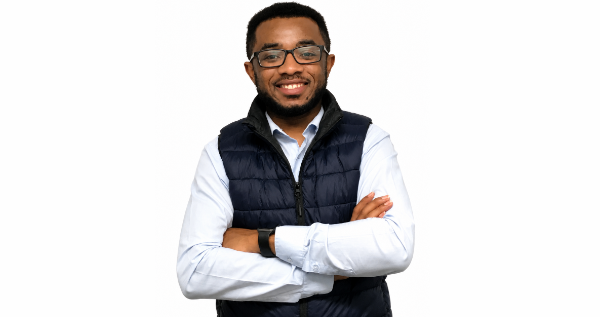
Hi, I am Michael Baidu, a Research Fellow at the University of Leeds, currently working on the Developing Capacity for storms early warnings for Ghana’s energy sector (EW4Energy) project. I have also worked as a Data Scientist at the Leeds Institute for Data Analytics (LIDA) at the University of Leeds.
I have a PhD in Atmospheric Science from the University of Leeds and a Postgraduate Diploma in Earth System physics from the Abdul Salam International Centre for Theoretical Physics (ICTP), Trieste – Italy. My Bachelors degree was also in Meteorology and Climate Science from the Kwame Nkrumah University of Science and Technology (KNUST), in Ghana.
You are part of a team looking to improve short-term weather forecasting (nowcasting) over West Africa. How did you manage to get such a project off the ground?
I have been involved in projects that seeks to improve weather forecasting in Africa such as the Global Challenges Research Fund African SWIFT (Science for Weather Information and Forecasting Techniques) programme, EW4Energy and the Advancing Nowcasting with Deep Learning (ANDeL); ANDeL is a project that seeks to improve nowcasting over Africa.
The first challenge to deal with during collaboration is building a trusted relationship.
This project started with a one year cloud account offered by Oracle for research. This project has mainly been hosted in the KNUST, in Ghana, since this is where I had my first training. There has also been a long standing relationship between the University of Leeds and KNUST through projects like, SWIFT, the FASTA (Forecasting African Storms Application) tool, EW4Energy etc. We later obtained support from Google to employ Masters students to work on the project.
Why was West Africa selected in particular?
West Africa is dominated by convective storms. These storms are complex and very difficult to predict by Numerical Weather Prediction (NWP) models. High resolution models are needed to represent the detailed physical processes of these convective storms.
African Met Centers and Universities are better aware of the local terrain
However, the computational cost of such high-resolution models is too high, especially for African Meteorological Centers which mainly rely on the global north for model outputs. The advent of Artificial Intelligence/machine learning models presents a great opportunity to address this problem, since AI models can be trained on model outputs, satellites and other observational datasets with less computational cost.
Accurately modelling the development of short-term, fast-moving weather is famously difficult, with the data accompanied by broad uncertainties. How is ANDeL reconciling these challenges?
The first version of ANDeL was based on Convolutional Neural Network Long Short-Term Memory algorithm. This combines the spatial-feature of Convolutional Neural Network with the temporal-memory capabilities of Long Short-Term Memory network. Integrated Multi-satellite Retrievals for Global Precipitation Measurement rainfall data was used to train this model. By training the model with enough datasets, the model is able predict the storms with good accuracy, especially within the first 2 hours.
[…]summer schools with African Universities help to train students with both the UK and local exposure needed to better identify solutions[…]
The first model training was achieved through the cloud account from Oracle within the first year. The work was then moved to Google Colab for the next few months. We now currently have GPU access in KNUST which is being used for the work.
You can check out the ANDeL Nowcasting portal, here: https://andel-nowcasting-portal.netlify.app/
What challenges do data scientists like yourself face when collaborating across our current research landscape?
The first challenge to deal with during collaboration is building a trusted relationship with research partners. This sometimes takes time to establish. In my case, I leveraged on my relationship with KNUST, my alma mater and the long standing relationship the University of Leeds has with KNUST. I also worked at the Ghana Meteorological Agency, and have contact with other forecasters in Africa through the GCRF African SWIFT project.
The next challenge is access to computational facilities. By collaborating with the University of Leeds, students and researchers in Ghana are able to access computing facilities in the UK for the project.
What advice to you have for researchers engaging in data sharing and collaboration?
I will advise that researchers engaging in data sharing and collaboration to take the bold step. African Met Centers and Universities are better aware of the local terrain, the research challenges and have better ideas for sustainable solutions tailed for their needs. They are happy to collaborate to see long standing problems solved.
The second thing that guarantees project success is coproduction. Involve local researchers and Met Centers at the inception of the project. Involving them during the proposal writing helps them to take ownership of the project. Also, creating a collaboration between industries and African Universities ensures the sustainability of the project as the Universities continues to train students who replaces industry workers. Some previous projects outcomes were not sustainable because some industry staff who were trained through the project later retired or vacated their posts.
Finally, exchange programmes and summer schools with African Universities help to train students with both the UK and local exposure needed to better identify solutions and build lasting collaborations. My relationship with KNUST and other forecasters from African Met Centers makes it easy to work on projects together.