Hello Christina! Welcome to GeoTalk. Before we dive in, could you introduce yourself to our readers?
Hey everyone! I’m a researcher at the Institut de Recherche pour le Développement (IRD) in Montpellier in the South of France. For my work, I specialise in remote sensing and hydrological modelling, with study areas in Cambodia, Tunisia, and France.
At EGU, I’m also the outgoing Early Career Scientist (ECS) representative of the Hydrological Sciences (HS) division and help lead the ECS Network’s task group on Communication and Outreach. At the International Association of Hydrological Sciences (IAHS), I co-coordinate the working group on Science Communication, Outreach, and Promoting the Digital Water Globe. In fact, we just published a community paper on best-practice science communication in hydrology!
Hydrological landscapes develop in tandem with the people who inhabit them, their processes changed in reaction to local, traditional practices up to large-scale engineering projects. How does adopting historic and eco-cultural perspectives help us better understand such environments?
I’ve been lucky enough to work with a lot of interdisciplinary colleagues at IRD, EGU and IAHS – many of them sociohydrologists, human geographers, or anthropologists. IAHS even has an entire scientific decade, Panta Rhei, dedicated to the co-evolution of human-water systems – check out the EGU HydroTalks podcast episode about it! Working with these experts, I’ve learned the value of taking into account a multiplicity of perspectives in understanding hydrological processes; the expertise of local actors is invaluable in understanding coupled human-water systems, especially if you’re starting work in a new study area.
Similarly, looking into the past evolution of hydrosystems can help us understand current challenges. For my PhD, for example, I worked on an eco-hydrological model looking at infrastructure rehabilitation in the Cambodian Mekong Delta. It helped me immensely to do some research in the archives of the French colonial administration, which first built these infrastructure elements, to understand the logic behind them – you read more about this in our paper.
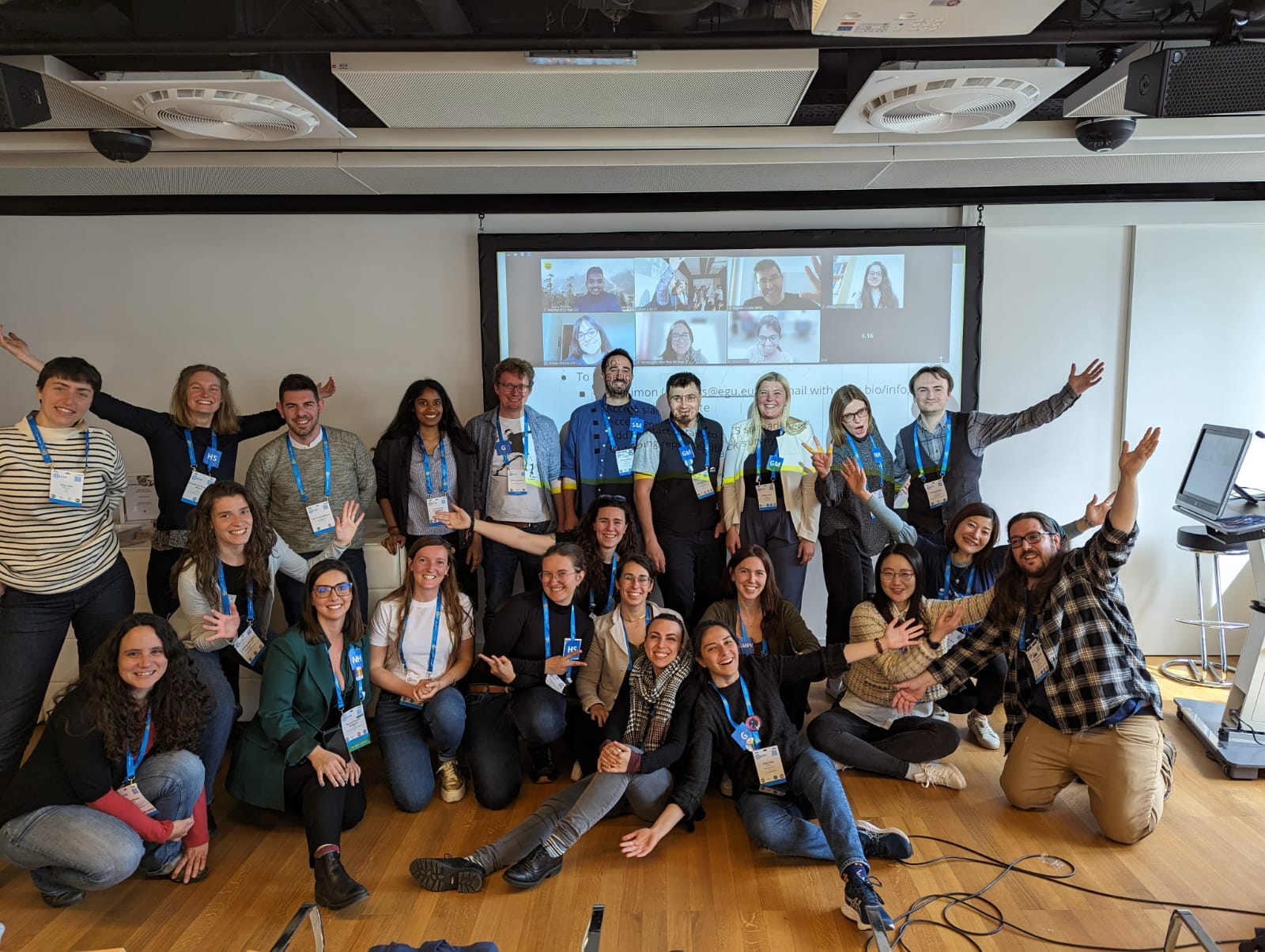
Early Career Scientist Representatives – 2024
You’re also engaged in science communication, both in research and in facilitating training, such as the Short Course on sci-comm fundamentals at the EGU26 General Assembly. What advice do you have for researchers looking to engage in science communication?
For anyone who wants to get started in science communication, I can really recommend keeping an eye out for free training opportunities offered by organisations such as EGU or – for hydrologists – IAHS. The Short Course we offer on science communication fundamentals at the upcoming General Assembly in Vienna is just one of several that can give participants a solid basis in different sci-comm skills.
Beyond that, EGU also offers a wide range of online webinars and workshops, many of which are also recorded and available on the Union’s YouTube channel playlist. There is even the fantastic science-media toolkit.
Apart from training opportunities, I also recommend getting some hands-on experience by getting involved in your communities. The EGU division blogs, for example, typically welcome guest posts – all you have to do is reach out to the editors and pitch a topic.
Plus, many EGU Scientific Divisions also welcome new team members to contribute to sci-comm tasks and building a community. So if you’re interested in getting involved with managing or editing a blog, running seminar-style online “Campfires”, keeping people up to date through ta division newsletter, recording a podcast, or engaging people through social media, all are great ways to get started.
As a volunteer for EGU, you have also taken on numerous roles within the Union, such as a blog editor and as one of the Early Career Scientist representatives for the Hydrological Sciences division. What drew you to work with EGU?
The EGU bug bit me during my first in-person General Assembly in Vienna – after two years of online conferences during Covid. I attended one of the Short Courses on how to navigate EGU, co-produced by the ECS reps, and I was incredibly impressed by this open and welcoming network of international researchers. I joined the blog team of the HS division that year and then applied for the role of HS ECS rep and was selected.
Since then, it has been so enriching to become part of this community, contribute to existing initiatives, launch new projects, and attend online and in-person meetings to help organise the GA and events throughout the year. It’s been fantastic to connect with senior researchers in my field and from other EGU divisions. But the best bit has been making friends within the ECS network! I’ve come to know – and love! – people in more places across the world than I ever would have dreamed of when I started my PhD. Working together with them in the geoscience community has been extremely fulfilling, and a great deal of fun!
Finally, as someone experienced in EGU general assemblies, what advice do you have for people attending EGU26?
Keep an eye on your division’s blogs and social media, both in advance of the General Assembly and during it. You’ll get the inside scoop on all the latest highlights and networking events. EGU also runs a webinar ahead of the General Assembly to help you get prepared.
I can really recommend the “personal programme” function in the EGU26 app, which is released a month ahead of the GA. It will let you highlight the sessions you want to see and stay on top of things during a week that can otherwise get pretty overwhelming.
If you’re already an experienced attendee, you can help new attendees and share your insights by signing up for the General Assembly peer-support programme!
Most of all, though, you need to schedule in some downtime, otherwise, conference fatigue will hit you hard and fast. Vienna is an amazing city, so plan in some time to visit a museum, stroll around, meet colleagues for some cake in one of the traditional coffee houses, or catch a concert in the evening!