Talking to people about their work is always an EGU highlight for me. Being able to nerd out about rivers, rocks, big research vessels crossing the Arctic, maps, mountains anywhere in the solar system, or even beyond? Yes, please! However, while those topics are the things of dreams for me (and I dare to say many other EGU-goers), that enthusiasm isn’t always a given once we leave the conference halls. Convincing the broader public, or even stakeholders, that the things we love are just as exciting as we think they are can be a major challenge. Thankfully, outreach, education, and engagement are at the core of EGU. This year, the General Assembly highlights two areas that can bridge that gap: Art and Education.
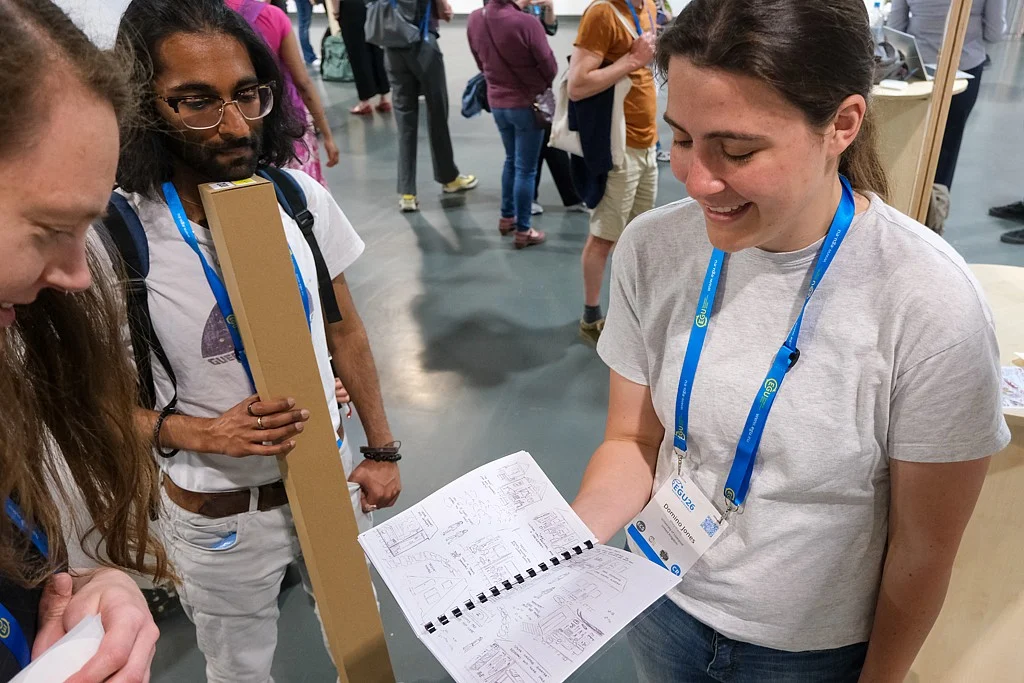
Domino Jones shows drawings for the ‘Arctic Flowers’ science communication graphic novel during EGU26.
Recurring themes are avoiding specialized jargon, showing the human side of science, and using attractive visuals. Lore Vanhooren, who presented the talk “Science animations to bridge communication obstacles to laymen and experts – a story of struggles and solutions,” shared how creativity deployed for outreach can find its way back into scientific practice.
“Doing art made me more productive in science.”
—Lore Vanhooren
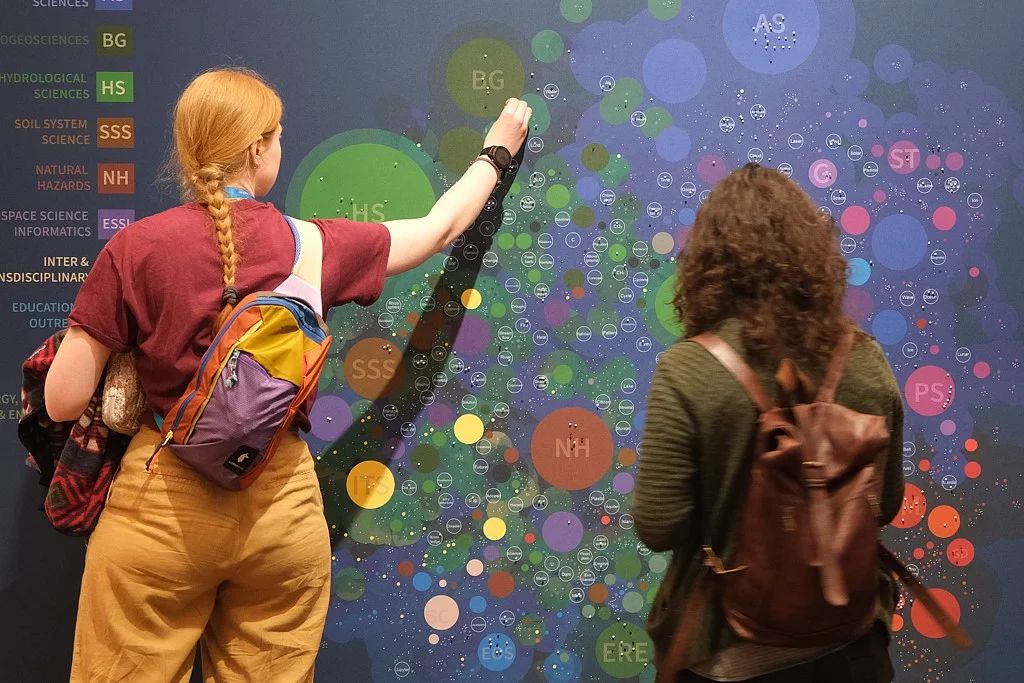
Science inherently requires creativity and curiosity, which are also the essence of art. As such, it only makes sense to bridge those two worlds. The EGU facilitates interactions between the worlds of science and art through an artist-in-residence program: this year’s artist is Núria Altimir. By reviewing the cognitive science behind visual perception and attention, Núria teaches us how to use beauty as a gateway into complex ideas. It is not about decoration; it is about using design to command attention and guide the viewer through dense data with purpose. At her stand, participants are becoming part of it rather than mere watchers. Her large-scale participatory artworks examine networks and uncertainty in real-time, allowing attendees to become the data points themselves. It is a masterclass in how beautifying science can make it more accessible to the human brain. Núria also held a course titled: The why and how of beauty as a tool for effective science communication.
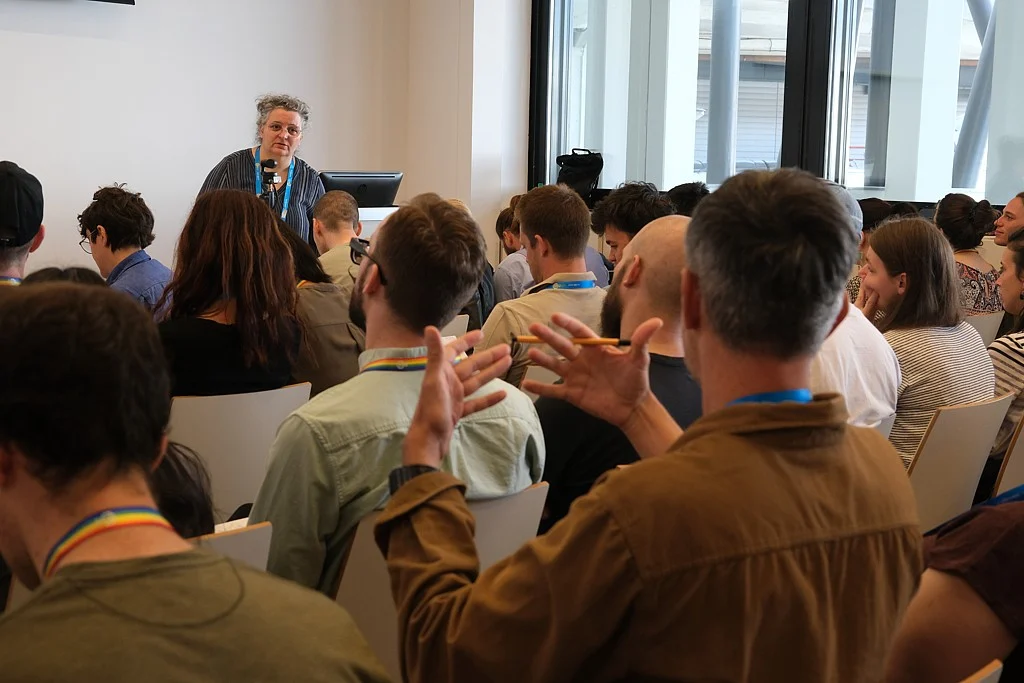
Nuria Altimir interacts with the audience during her course at EGU26.
If you haven’t yet, make sure to visit Núria’s stand in the Foyer D of Level -2. In the same space, the General Assembly also features a gallery showcasing the work of some of the previous EGU artists:
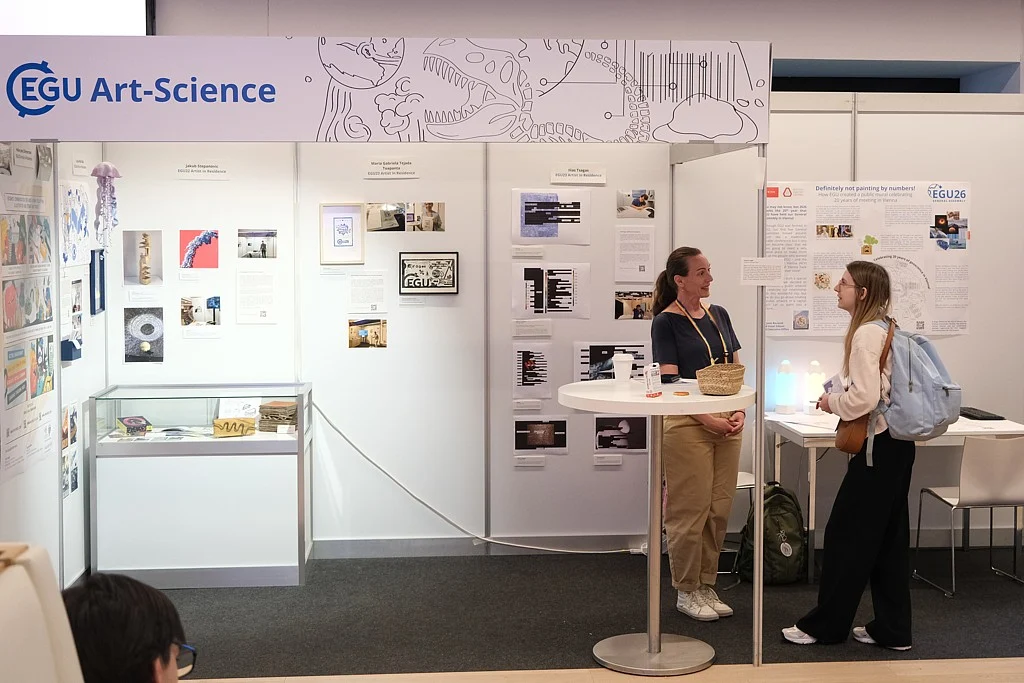
Heike Jane Zimmermann, an EGU23 Artist in Residence, engages with an attendee during EGU26.
Whether you stop by for a conversation or just a short break, it gives a space to reflect on that science is a human endeavor that deserves to be beautiful. You can follow the journey online using the hashtag #EGUart.
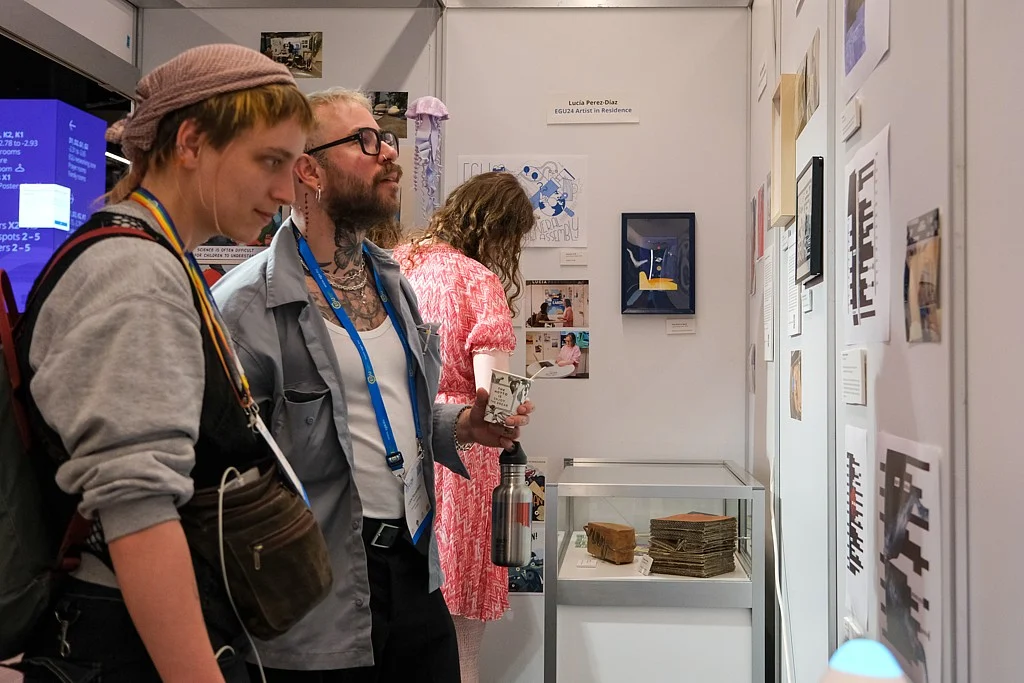
If art provides the visual gateway to science, the field of education provides the map. The General Assembly continues to be a vital space where educators and researchers swap expertise. Scientists can gain insight into class management, the learner’s perspective, and techniques to measure communication effectiveness, while educators get a front-row seat to the latest discoveries. Thomas Schubatzky reflected on this productive exchange during his poster session on TRACE, a project that links climate literacy with individual and collective action.
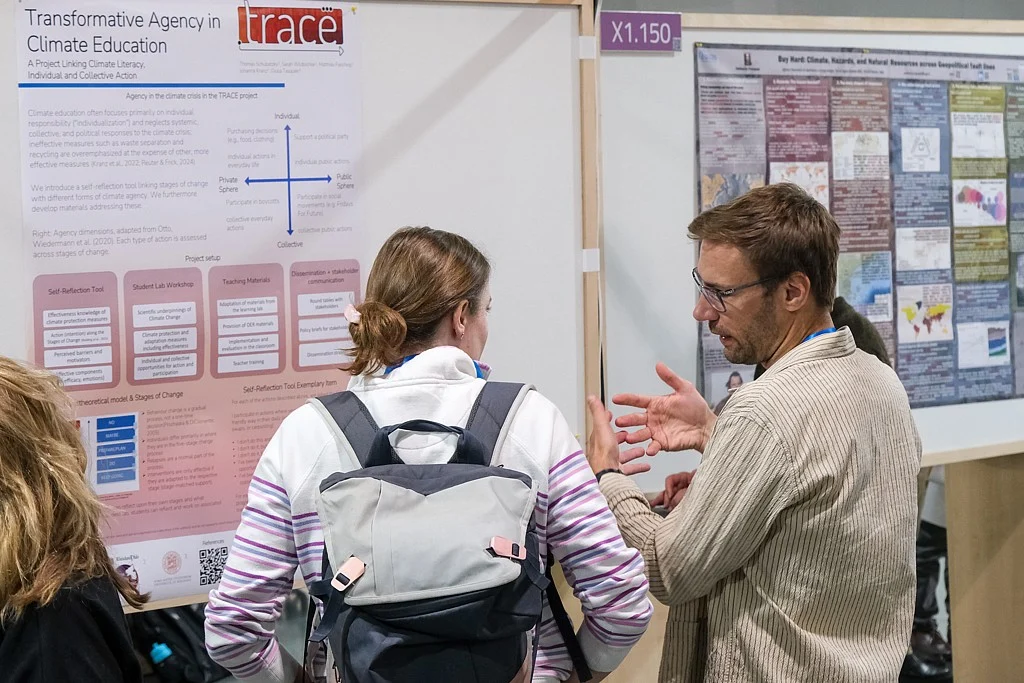
Thomas Schubatzky discusses TRACE project.
In the end, whether it is through a comic book or a cognitive approach to design, EGU26 is proving that beauty and education are the very tools that make our science stick.