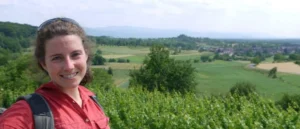
Dr. Marta López-Saavedra (Natural Risks Assessment and Management Service (NRAMS)) represented EGU’s Science for Policy Climate Hazard and Risk External Advisory Group at the CCEC Symposium on European and Global Wildfires, Budapest, September 2026. This blog represents Marta’s reflections of the event, of Europe’s current landscape of wildfire risk, and how research can be integrated into European policymaking.
For decades, Europe’s wildfire problem was largely associated with a relatively defined geographical area: the Mediterranean region. The Intergovernmental Panel on Climate Change (IPCC) estimates that around 85% of the European Union’s burned area has historically been concentrated in Southern Europe where fire-weather conditions have been most pronounced. The “fire season” was generally understood as a period of increased risk during the summer months. But is this picture still accurate?
Understanding a wildfire requires more than studying its ignition or spread.
This was the starting point of my presentation, “European Fires: Past and Present”, delivered at the CCEC Symposium on European and Global Wildfires in Budapest on 18 September 2026, organised by the International Union of Geodesy and Geophysics (IUGG). Representing the EGU Climate Hazard and Risk Task Force’s External Advisory Group, I explored how the European wildfire risk landscape is changing—and why understanding these changes requires us to look beyond burned area alone.
Less fire does not necessarily mean less risk
Central was the apparent paradox between declining or highly variable fire activity and increasing fire potential. Long-term data from the Mediterranean region do not show a uniformly increasing trend in burned area, with substantial interannual variability, according to the Joint Research Centre (JRC) of the European Commission.
In some areas, improved prevention and suppression capabilities have helped contain fire occurrence and reduce the extent of many events. Evidence from several decades of wildfire activity in countries such as Spain also indicates reductions in fire density and burned-area ratios across different exposure regimes.
At the same time, this decline in overall fire activity has not prevented an increasing contribution of extreme, very large fires, with recent events showing the capacity of a small number of extreme wildfires to account for a substantial share of the total area burned. This illustrates why declining fire activity does not necessarily mean that the underlying risk is decreasing.

Marta López-Saavedra
Fire-conducive weather conditions—including heat, drought, low humidity and strong winds—are increasing in frequency, duration or geographical extent in many parts of Europe. The IPCC has documented increases in fire-hazard conditions across Europe since 1980, including significant increases in Southern and Western Central Europe. More recently, the JRC has reported an expansion of Europe’s traditional fire season, with serious wildfires occurring both earlier and later in the year.
This distinction is essential. Suppression can reduce the impacts of individual fires, but it does not eliminate the underlying hazard. As fire-weather conditions intensify, emergency response and suppression systems may face increasing pressure and diminishing returns.
Assessing wildfire risk reduction requires more than considering how many fires occur or how much land burns, but the conditions under which fires develop, their potential size and behaviour, and the exposure and vulnerability of the territories they affect. This is consistent with the United Nations Office for Disaster Risk Reduction (UNDRR) risk framework, which defines disaster risk as a function of hazard, exposure, vulnerability and capacity.
A changing geography—and a changing season
The most significant change may not be how much land burns, but where, when and under what conditions it burns. Recent events have challenged the traditional geographical and seasonal boundaries of wildfire risk in Europe. The symposium’s broader focus reinforced this concern: lessons from regions with a long history of catastrophic wildfires are becoming increasingly relevant to areas where such events have historically been rare.
The programme raised the question of whether regions such as Hungary could be approaching a tipping point, where catastrophic wildfires may become more frequent as climate conditions change. This is an important question for European risk governance. How prepared are regions without a strong institutional memory of large wildfires? Do they have the necessary prevention strategies, emergency planning, institutional coordination and public awareness?
The role of science is not to replace political decision-making, but to help ensure that decisions are informed by the best available evidence […]
The IPCC has already identified the potential emergence of new fire-prone regions in Europe, particularly in Western and Northern Central Europe, where wildfires have historically been less common and fire-management capacity is still developing.
Climate change is an important part of this picture. Europe is warming faster than the global average, while fire-danger conditions are changing unevenly across the continent. Demographic and land-use changes, including rural depopulation, are also reshaping landscapes and influencing vegetation management, ignition patterns and exposure.
The challenge is therefore not only to respond to fires where they have traditionally occurred, but also to anticipate how wildfire risk may emerge in new locations and during periods previously considered less hazardous.
From fighting fires to managing risk
The symposium brought together perspectives on meteorology and atmospheric effects, forestry, fire behaviour, wildfire science and international experiences. This range of contributions highlighted the inherently interdisciplinary nature of wildfire risk.
Understanding a wildfire requires more than studying its ignition or spread. Catastrophic events can exceed the capacity of local firefighting services, creating consequences that extend beyond the immediate emergency.

Delegates of the CCEC Symposium
The symposium itself highlighted how lessons from Australia and other regions are becoming increasingly relevant as catastrophic fires affect larger areas and more people. Firefighting, rescue and recovery are essential, but they must be considered alongside secondary and longer-term impacts on communities, ecosystems, infrastructure, health and economies.
This reinforces the need to move from a reactive approach towards integrated risk management. The JRC has similarly highlighted the need to complement reactive fire suppression with proactive measures, including integrated wildfire risk management, landscape management and approaches that reduce vulnerability to wildfire.
Suppression remains fundamental, but it must be complemented by long-term prevention, landscape management, land-use planning, climate adaptation and the reduction of social vulnerability.
[…]declining fire activity does not necessarily mean that the underlying risk is decreasing.
Wildfire disasters do not result from hazard alone. They emerge when hazardous conditions interact with exposed populations, infrastructure, vulnerable ecosystems and limited preparedness or response capacity. This broader picture is reflected in the UNDRR Sendai Framework approach which places understanding risk—including hazard, exposure, vulnerability and capacity—at the centre of disaster risk reduction.
Cooperation across administrative and national borders is equally important. Fires do not follow political boundaries, and simultaneous events in different regions can place considerable pressure on shared response capacities. Knowledge exchange can help institutions anticipate emerging risks and strengthen coordinated action.
Connecting science, policy and practice
These challenges are closely connected to the work of the EGU Climate Hazard and Risk Task Force. Established in 2025, the Task Force aims to support the transfer of scientific knowledge into policy and practice, strengthen communication between researchers and policymakers, and contribute evidence to discussions on climate-related hazards and risks.
[…] wildfire risk reduction requires more than considering how many fires occur or how much land burns, but the conditions under which fires develop […]
Wildfires illustrate why this connection is necessary. Scientific research can identify changing hazard patterns, improve risk assessments and explore future scenarios. However, this knowledge must also be translated into planning, investment, preparedness and adaptation measures. The role of science is not to replace political decision-making, but to help ensure that decisions are informed by the best available evidence, while recognising uncertainty, interconnected risks and different societal needs.
The symposium also demonstrated the value of international experience. Lessons learned in one part of the world can inform preparedness elsewhere, but they must be adapted to local environmental, institutional and social contexts. There is no single solution to wildfire risk.
Are our risk-management systems changing fast enough?
Europe has made important progress in wildfire monitoring, prevention, suppression and emergency coordination. Nevertheless, the changing geography of fire risk, the increasing potential for extreme events and the interaction between climate, land-use and demographic changes create new challenges. The question is therefore not only whether Europe is experiencing more fires. It is whether our risk-management systems are adapting quickly enough to a changing hazard landscape.
Answering this question will require sustained collaboration across disciplines, institutions and borders. It will also require a shift from reacting to individual events towards anticipating changing risks, strengthening prevention and ensuring that scientific knowledge becomes accessible and useful for decision-makers and communities.
The future of wildfire risk management in Europe will depend not only on how effectively we fight fires, but also on how well we understand and manage the conditions that allow them to become disasters.