Many people exhibit a strong visual orientation, as a significant portion of human neurobiology is dedicated to processing light; however, this reliance is usually as much a product of our visually-centered environments as it is our biology. Science, however, reminds us that important information can come from different senses as well: sound, smell and tactile information all have something to say. Let’s see a few examples fresh from the EGU Press Conference Room.
Have you ever heard of Geerat Vermeij?
If you have, I am going to guess that you either love paleontology or you have grabbed a coffee with my good friend Martina, who loves recommending his work to people (that’s how I learned about him). If you don’t know what we are talking about, no problem, let’s fill you in!
Geerat Vermeij is a well-renowned paleoecologist and marine biologist. His work on how predator-prey interactions shaped the evolution of shells is brilliant, and he is one of the most knowledgeable people in the world on the subject. Yet, when he was in school, teachers heavily discouraged him from pursuing a career in science on the basis that he couldn’t see. He lost his sight at age three, due to a glaucoma. Luckily, he decided to not put up with their ableist -although maybe well intentioned- advice and went on to land a scholarship in Yale. He studies his favorite subjects, shells, by relying on touch instead of vision. This has led to him noticing things that might not have been as apparent if you were just looking at those same specimens.
If we widen the frame to science as a whole, we should already know that sight is not the sole ruler. The world is full of questions that can’t be answered by looking, no matter how high-resolution your microscopes or telescopes are. Think about earthquakes. You can see the ground shaking, you can witness the collapse od building of natural structures, you can observe their effects but it is impossible to see them per se. This is when other “data senses” can come in.
Yesterday at EGU26, I attended a Press Conference which highlighted four different discoveries in three completely different fields, all made possible by collecting non-visual data. One of those discoveries hit close to home, as speaker Christian Hübscher explained how his team uses a multibeam method -which he described as similar to a doctor’s ultrasound- to map the floor of the Aegean Sea, looking for active volcanos. I come from a highly volcanic area as well called the Phlegraean Fields, in the south of Italy. He agrees with me that it is a super cool place, constantly studied albeit still full of mysteries which could be in part unveiled with the methods he showed. Which would be great, considering that more than 500.000 people live in our high-risk area.
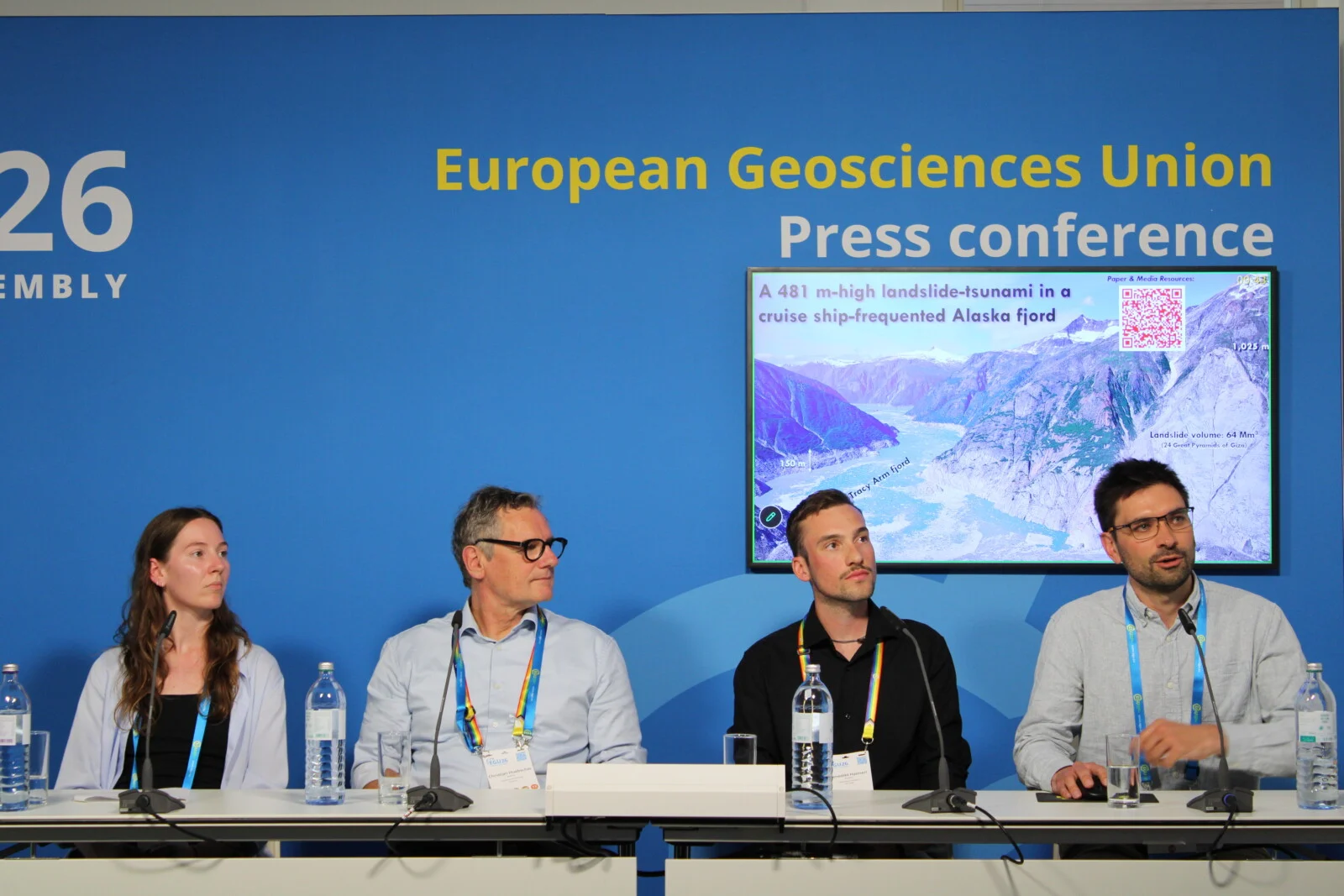
Speakers at the press conference. From left to right: Eva Goblot (Dalhousie University), Christian Hübscher (University of Hamburg), Benedikt Haimerl (University of Hamburg), Stephen Hicks (University College London).
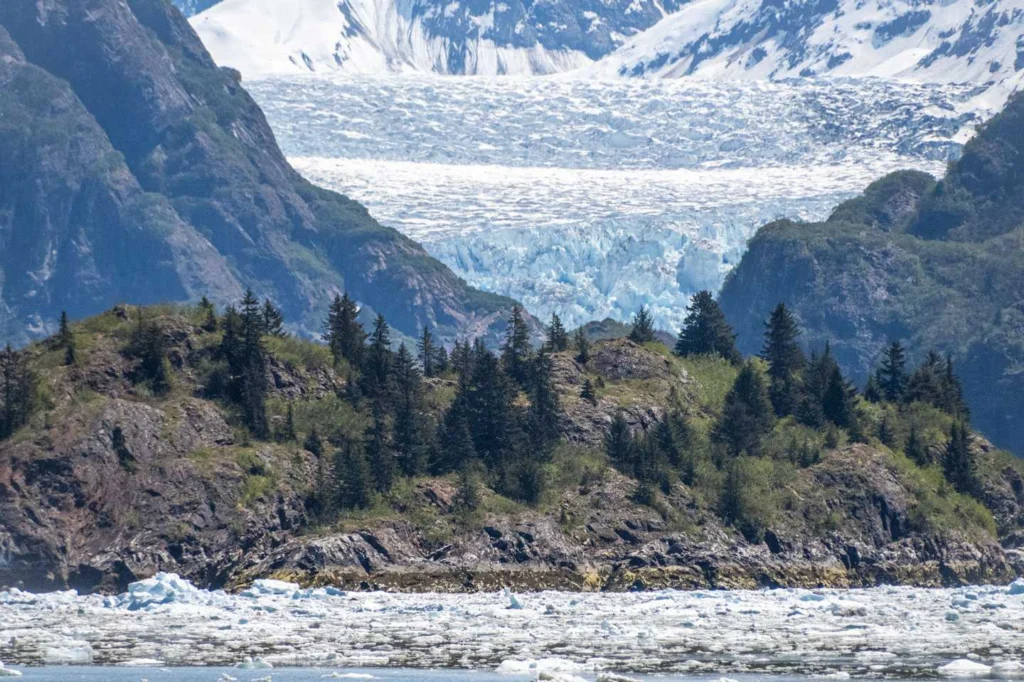
Seismic waves, as well as sound waves, can help tackle other urgent questions related to rick management, as the other speakers highlighted. Stephen Hicks, for instance, played some sonified recordings of the earthquakes that triggered the infamous Tracy Arm Alaskan tsunami of 2025, which reached an extremely impressive run up of 481 meters -more than ten times the height of the Austria Center Vienna. He hopes that analyzing those signals will allow for the prevention of similar disasters in the future. We are not the only animals that can benefit from seismic wave studies, as Eva Goblot highlighted. By combining different receivers -both underwater microphones and seismographers- their team was able to capture unique whale vocalizations from a distance of up to 150 km in the Gulf of Saint Lawrence in Canada. Those whale songs’ captures might be crucial for cetacean conservation and again, it would be impossible to spot a whale that far by sight.
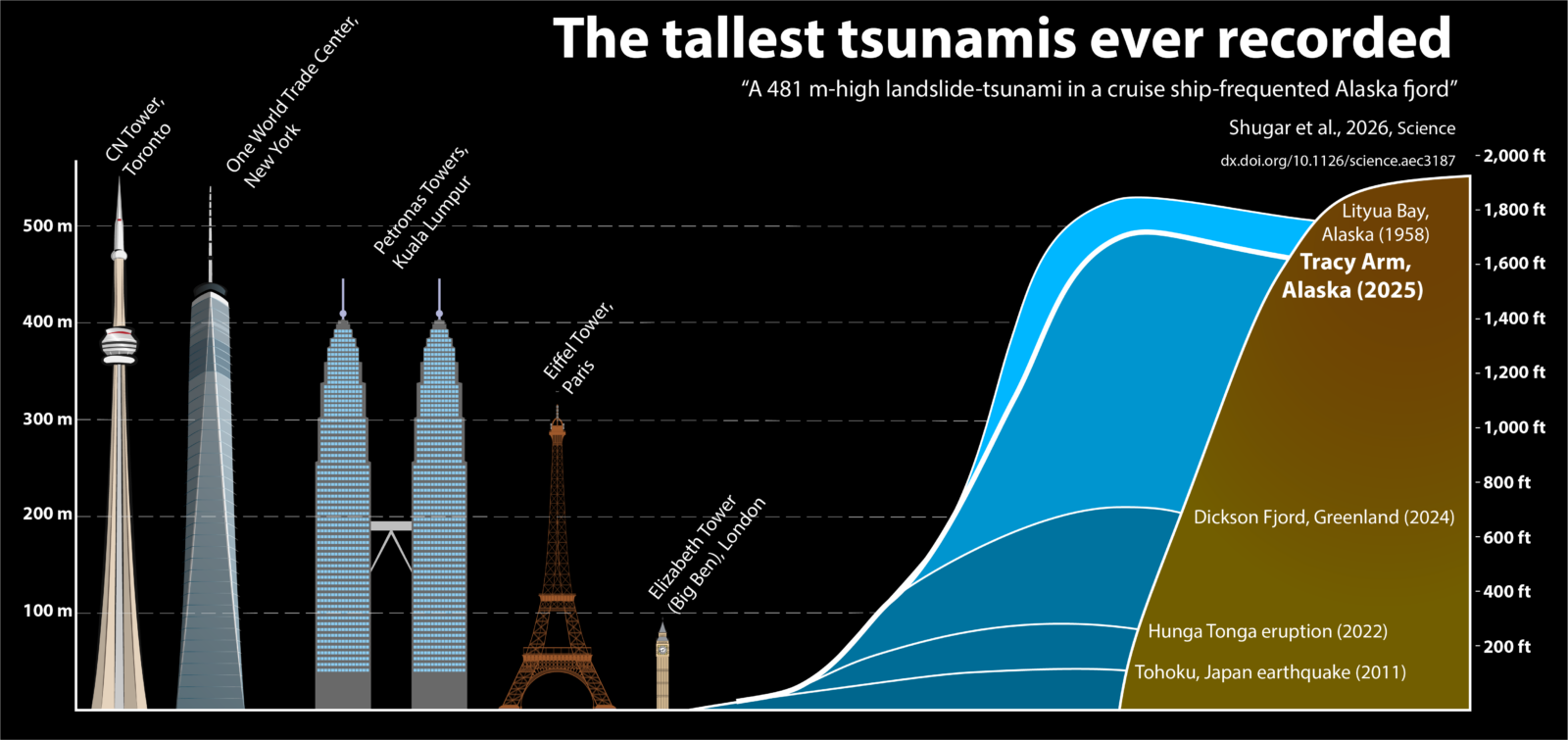
Comparison between some of the world’s most famous buildings and the height of massive megatsunamis.
If you are intrigued by these perspectives and you agree that we can discover way more than meets the eye, you should check out the full presentations’ reconding on the EGU Youtube channel. You’ll also get to know the intriguing story of the world largest waterfall, presented by Benedikt Haimerl.