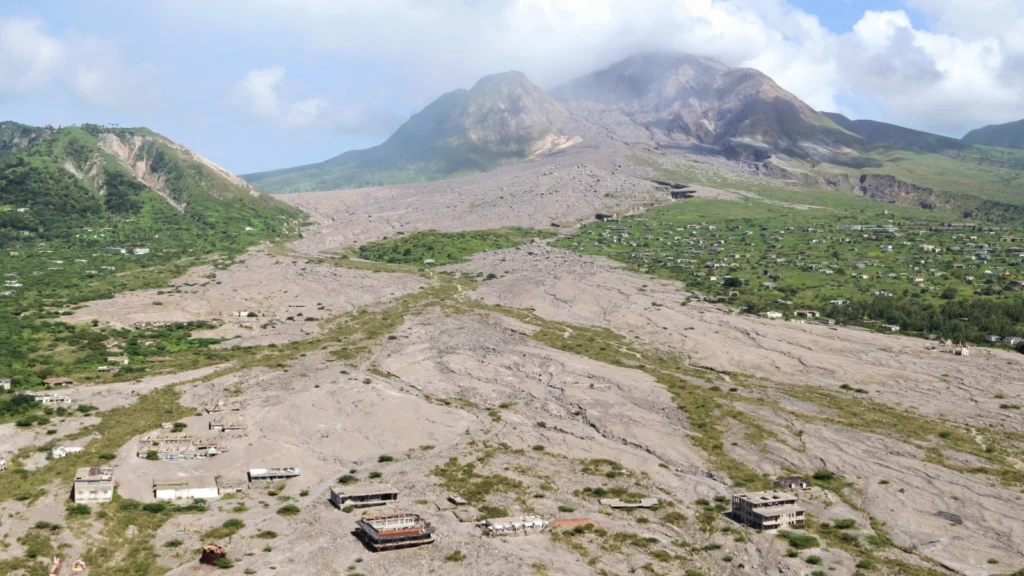
Plymouth, the capital of Montserrat, was evacuated in 1995 after the nearby Soufrière Hills Volcano (background of the image) had reactivated. Later on the town was struck by pyroclastic flows, and its centre was almost completely buried by material relocated from the upper slopes through lahars. The suburb of Town Hill can still be seen in the right centre of the photo. It remains an exclusion zo ...[Read More]
GeoLog
Introducing INTEGRATE: a complete higher-education teaching package for climate science
If you are a higher-education instructor and want to teach climate science and a suite of relevant technical skills to those with no (or minimal) prior knowledge of climatology, you may want to begin with INTEGRATE (Integrated Teaching of Atmospheric Science, Technical Skills and Empirical Methods). This teaching package is self-contained, open-access, and available online. Topics covered include ...[Read More]
Imaggeo On Monday: Both Ends of the Rainbow
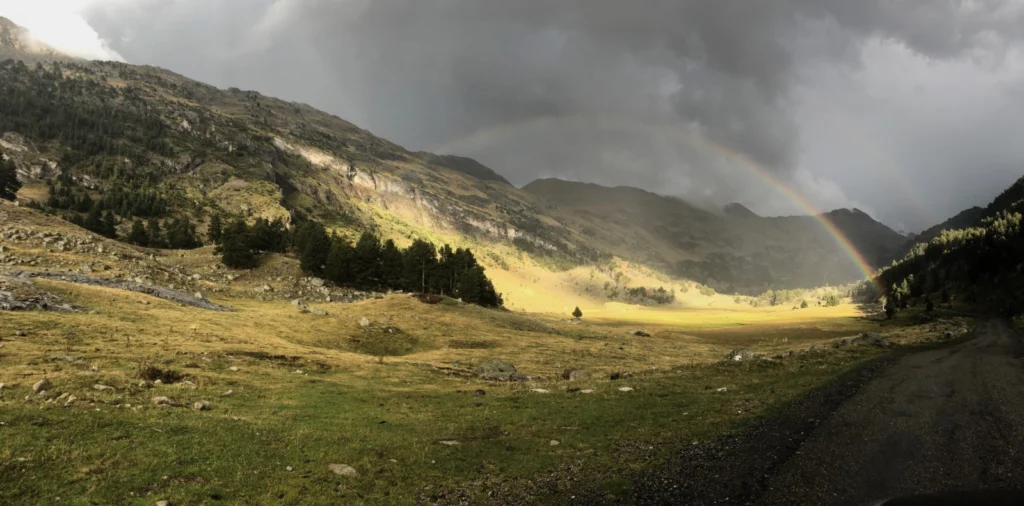
A double rainbow was captured when heading through the glaciated Benasque valley, located in the heart of the Pyrenees. The photo was taken just before the sunset, after heavy rainfall. A rainbow is caused by reflection and dispersion of light in water droplets. Second rainbow arc results from one reflection more than in the first one, thus the rainbow colours are “reverted”. The geome ...[Read More]
Crowd solutions to challenges in Earth Sciences
Research rarely follows a straight path and it is normal for challenges to arise during a scientific career. These challenges may come from scientific issues, like inaccessible field sites or data or unavailable/insufficient methods, or from social or personal problems and so on. This year we are facing an additional problem in our inability to meet in person, travel and go to the field. As we all ...[Read More]
GeoRoundup: the highlights of EGU Journals published during June!
Each month we feature specific Divisions of EGU and during the monthly GeoRoundup we will be putting the journals that publish science from those Divisions at the top of the Highlights roundup. For June, the Divisions we are featuring are: Ocean Science (OS) and Biogeosciences (BG). They are served by the journals: Geoscientific Model Development (GMD), Ocean Sciences (OS), Biogeosciences (BG) and ...[Read More]
Imaggeo On Monday: A drift of sea-snail shells
A collection of washed-up shells on a beach on the south island of New Zealand. Shore transport processes have produced a well-sorted drift of similarly sized (approx. 1-2 cm) shells and shell fragments. The main species represented are the common turret shell (Maoricolpus roseus) and wheel shell (Zethalia zelandica), both sea snails endemic to New Zealand. Description by Pontus Lurcock, af ...[Read More]
Pride on board: working on an ocean-going research vessel as an LGBTQI+ person
Working from home during the pandemic has allowed many of us to look back on past experiences and to long for the days when our work in marine science took us to amazing places all around the world. Pride month is another great opportunity for reflection and to consider how things have changed for us as LGBTQI+ individuals and the community within STEM, including, on the International Day of the S ...[Read More]
EGU Equality, Diversity and Inclusion Working Group: ‘We need to diversify our team’
In autumn 2018, the EGU Council established a working group whose aim is to promote and support equality, diversity, and inclusion in the Earth, planetary, and space sciences, with a focus on EGU activities. The group works closely with EGU’s Council and Committees to improve EGU’s equality, diversity and inclusion as an organisation. Since the Equality, Diversity and Inclusion (EDI) Working Group ...[Read More]
Imaggeo On Monday: Giant Australian Cuttlefish in the Spencer Gulf, South Australia
In the shadow of the Santos oil and gas processing plant and export terminal lies the only place in the world where cuttlefish come together by the tens of thousands to mate every winter. The unique geology of the area, with a seafloor composed of bedrock and tabular quartzite blocks, makes for an ideal egg-laying habitat, and thus is an attractive breeding ground for the Australian Giant Cuttlefi ...[Read More]
GeoPolicy: When policymakers misuse science
Most of the EGU’s GeoPolicy blog posts focus on overarching topics that I believe will be useful for the majority of scientists who read them. I see myself as a facilitator who connects scientists and policymakers, providing impartial information to promote more effective knowledge exchange and subsequently evidence-informed policies. This month’s GeoPolicy post however, takes a differ ...[Read More]