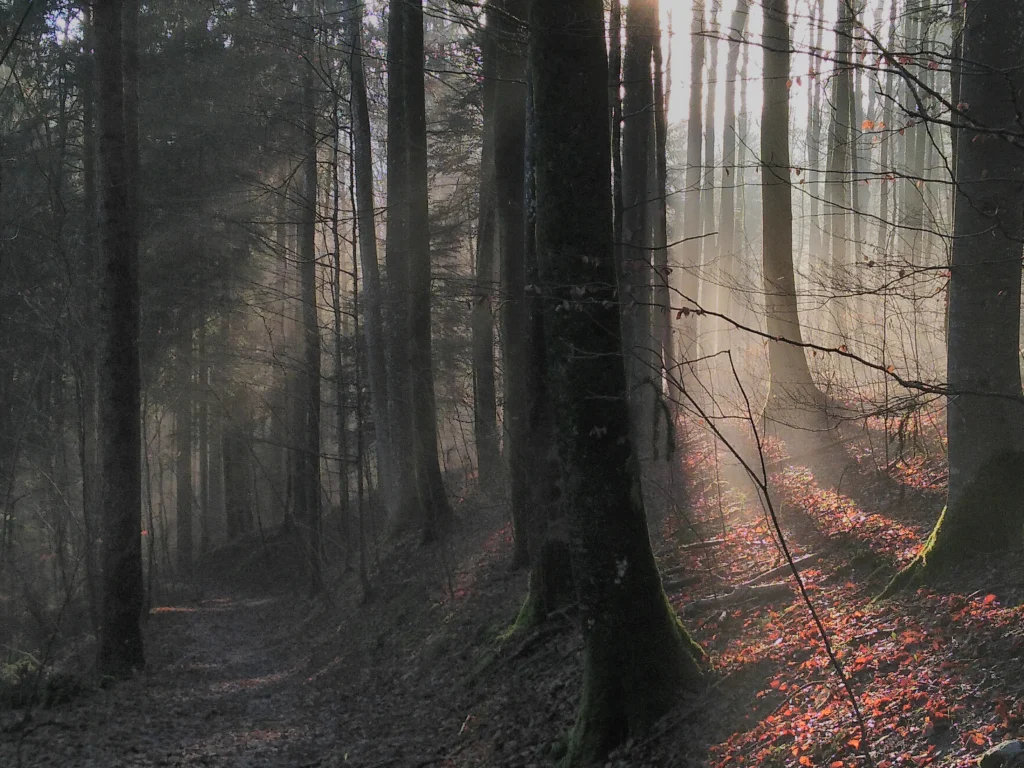
Imagine standing in the middle of an eighty-year-old Norway spruce forest in Central Europe. The canopy overhead forms a dark, emerald tomb that locks away decades of atmospheric carbon. For years, climate models and European policy frameworks treated mature forests like this as permanent carbon fortresses, heavy-duty biological vaults absorbing roughly 0.2 petagrams of carbon (that is 200 million metric tons) every single year! But pull up thirty-eight years of Earth observation data, track every canopy disturbance across Europe from 1985 through 2023, and that fortress starts to look… fragile to say the least.
According to a recent study published in EGU’s journal Biogeosciences, Europe’s natural disturbance regime has undergone quite the shift. Windstorms and bark beetle outbreaks are no longer just affecting random patches of forest, they are continuously impacting Europe’s oldest, most carbon-dense, and structurally uniform trees.
Decoding thirty-eight years of data
To track four decades of European forest changes, the authors combined long-term satellite disturbance records with detailed maps of forest age and carbon storage. The data revealed by this approach shows a clear change in which forest cohorts were being destroyed, far beyond a mere increase in total disturbed area. Between the early study period (2011 to 2016) and the recent period (2017 to 2023), the annual area of natural disturbances in forests older than 60 years nearly tripled, surging from 0.38 million hectares to 1.06 million hectares.
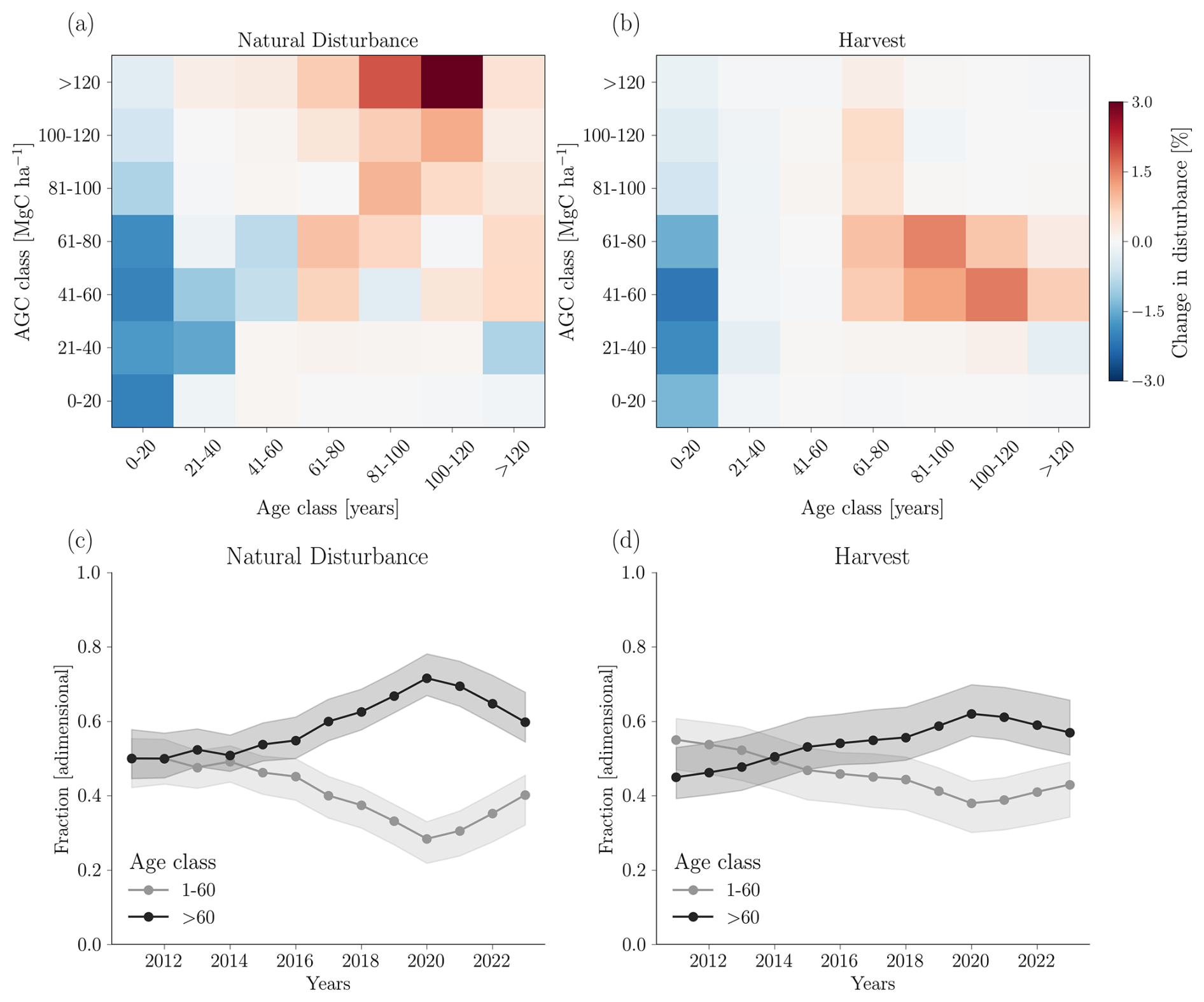
Structural characteristics of forests affected by natural disturbances and harvest across Europe.
To verify that this was not simply an artifact of forests aging six years between periods, the authors held the baseline forest age fixed to 2010 values across all analyses. Maintaining a constant landscape age ensured that any shift in the age profile of disturbed trees reflected actual, directional selectivity by disturbance agents, rather than any background stand development. Across 64% of analysed grid cells in Europe, natural disturbances noticeably changed in areas of older forest. Using the Energy Distance metric to measure distributional divergence, natural disturbances showed far greater temporal shifts, with a median Energy Distance of 1.5 years, compared to human timber harvesting, which recorded a median Energy Distance of only 0.9 years.
The spruce monoculture trap
Why is this structural change happening now? Examining the paper reveals the underlying driver: climate-amplified European spruce bark beetles (Ips typographus) interacting with historical land management legacies. Historically, winter windstorms like Cyclone Lothar in 1999 or Klaus in 2009 caused severe, episodic forest destruction. But since 2018, multi-year compound heatwaves and droughts across Central Europe have severely weakened mature spruce trees. Drought-stressed trees lose their ability to produce resin to flush out boring insects, allowing bark beetle populations to explode and infest vast swaths of forest.
Carbon losses from natural disasters in spruce stands jumped nearly five-fold, leaping from around 11.5 million to over 62 million metric tons per year. This isn’t just because more area was damaged, it’s because bark beetles are actively targeting the largest, most carbon-rich trees. In fact, while spruce made up less than half of all damaged forest land in recent years, it accounted for over half of all carbon lost to natural disasters across Europe. By contrast, broadleaf forests like oak and beech fared far better, seeing only a minor 12% increase in carbon losses over the same period.
The dangerous combination of homogeneity and salvage logging
There is a second, critical dimension to this vulnerability: structural homogeneity. Besnard’s team evaluated spatial and temporal variations in the coefficient of variation of pre-disturbance biomass across landscapes, where a low coefficient of variation indicates a uniform, single-aged forest structure. Europe’s single-species, same-aged spruce plantations offer zero natural barriers to bark beetles. Lacking structural diversity or complex canopies to slow them down, these uniform forests allow outbreaks to sweep through with almost no resistance.
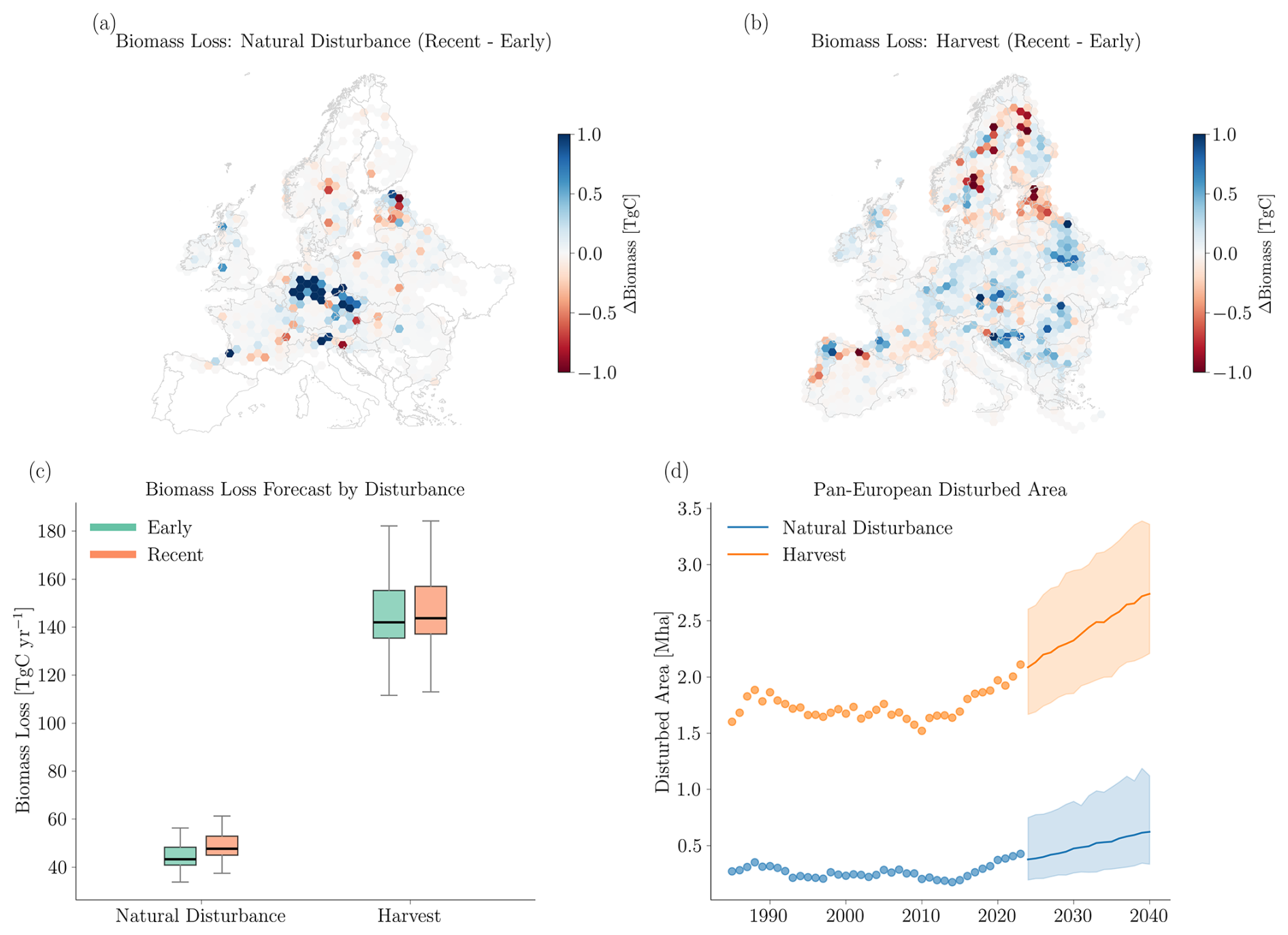
Forecasted biomass susceptibility and disturbed area across Europe through 2040 under early (2011–2016) and recent (2017–2023) disturbance scenarios.
Comparing natural disturbances to commercial timber harvests, the authors noticed that while the total harvested area expanded from 4.93 to 6.75 million hectares, harvest selectivity remained stable, and continued to target lower-biomass stands than natural disturbance events. However, the temporal trajectory of biomass coefficient of variation in harvested spruce patches closely mirrored natural disturbances that reflect widespread salvage logging operations where managers clear-cut dead timber following beetle infestations.
Looking to 2040: A flaw in climate accounting?
What does this mean for Europe’s broader climate mitigation goals? To answer this, the authors ran predictive computer models to project forest damage through 2040. The results, unsurprisingly, are concerning: if recent trends continue, the areas destroyed by storms and beetles will nearly double by 2040! That damage alone could jeopardise about 20% of the total carbon Europe’s forests absorb each year.
Even worse, because these natural disasters are now picking off older, carbon-dense trees rather than younger ones, an extra wave of stored carbon will be put at risk between now and 2040. That additional threat alone equals more than a third of what Europe’s entire forest network captures in a single year.
These findings force a careful re-evaluation of forest conservation strategies. Passive proforestation, which is the policy of withdrawing managed stands from harvest to let them age naturally, can build significant carbon stocks in structurally diverse, broadleaf ecosystems. However, in Central Europe’s even-aged spruce plantations, allowing stands to age without diversifying their structure increases their exposure to drought-amplified beetle outbreaks. As these monocultures grow older and denser, their vulnerability spikes.
To safeguard the continental carbon sink, management strategies must focus on breaking structural uniformity. This means actively pursuing species diversification by replacing monocultures with mixed broadleaf-conifer stands to break host connectivity for specialist pests. It requires structural thinning to reduce stand density, decrease drought stress, and lower canopy uniformity. Finally, it demands a move toward uneven-aged silviculture, transitioning away from uniform, single-aged blocks toward complex, multi-layered forest canopies. Besnard and his colleagues have provided a clear, data-driven assessment of Earth system dynamics. The takeaway is straightforward: Europe cannot rely on aging, uniform forests to act as passive carbon sinks unless those forests are actively managed for structural resilience in a warming climate.
A future for the forest
The real realisation here is that forest stewardship is actually going to look messier and more counterintuitive than our climate policy models often predict. It means accepting that safeguarding these sinks might actually require stepping back into the woods with chain saws and planting bags while punching holes in the dark canopy and thinning out the rows. Maybe, it’s time to give up the neat, comforting illusion of the orderly green fortress in exchange for something patchier, less predictable, and actually equipped to survive what’s coming…