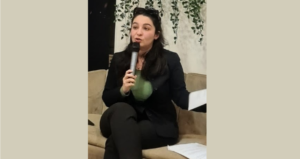
November 18 marks the LGBTQIA+ STEM day. Every year, we invite a piece from a queer scientist to share and reflect on their experience being queer in STEM. This year we have Anita Di Chiara, founder of EGU Pride and upcoming president of the EMRP division.
Hello, you, my name is Anita, and I am currently a researcher in Rome, Italy, in the field of paleomagnetism. This means I study Earth’s magnetic field recorded in geological and archaeological archives at the time of their formation, with applications in volcanic risk, paleoclimate, archaeology, and more. Looking at my CV, you can see a Ph.D. in Geophysics, four postdoctoral projects in three different countries (Brazil, the UK, and the US), numerous field trips and travels around the world (Chile, Oman, Canada, Portugal, China, the USA), roughly 70 conference presentations, and 30-some published papers.
Sounds impressive, I keep being told. But what one cannot see among these achievements, is what it took to build it as a lesbian in STEM.
While international mobility is treated as a mandatory path to success in academia (however we define success, and really, how can we?), it carries an unspoken load of worries and barriers when you are a lesbian. Before accepting a postdoc, joining a field campaign, or crossing a border, I had to run a quiet risk assessment: Is it safe, at least on paper, under local laws, for me to go there? During my Ph.D., I spent most of my time in Italy, where I completely hid my sexual orientation and private life, even denying it if asked, to protect myself and my partner from jokes, invasive questions, and assumptions.
This also meant the daily exhaustion of dodging casual small talk over coffee, deflecting questions about boyfriends or weekend plans, and carrying an invisible mental load during remote field campaigns. In geoscience, fieldwork can put you in close quarters, far from home, sometimes in countries where being queer is criminalised. While my colleagues were focused solely on collecting samples, a part of my brain was always calculating how much of myself I needed to erase just to stay safe as a scientist who’s a lesbian woman.
In 2013, I moved to California for work. It was the first time in my academic life that I could openly and naturally include my partner in everyday lab conversations and the laughs of life. It was refreshing. It was the moment I realized I didn’t have to hide everywhere, I was actually allowed to exist. At least in some places. My mentor in California was genuinely happy to hear I had a partner and sorry that she was so far away. For the first time in my career, I felt accepted.
Six years later, I returned to that same laboratory for my final postdoc, and by then, my partner and I wanted to be together this time. Getting an accompanying spousal visa for my wife, however, turned into a bureaucratic maze that my cis/heterosexual colleagues simply never have to think about. Moving from the UK to the USA, we had to sit down with the ambassador in London just to navigate the rules around marrying in Italy, except Italy does not allow same-sex marriage, only civil partnerships, and we discovered that was not enough for a U.S accompanying visa. Eventually, we got married in San Diego! In my nerves, pronouncing “lawfully wedded wife” came out as “woefully ledded-full of LED lights wife”. Eventually, we got the visa and considered ourselves lucky. My mentor invited my wife to Thanksgiving and house parties. Warmth at last. Still, so much money, time, energy, and frustration were spent simply proving our right to exist together. Then COVID hit, making much of the struggle feel almost pointless, and back to Italy we went.
At that point, the exhaustion of unstable academic contracts, compounded by everything else, hit hard. Being a lesbian woman in STEM comes with a very specific kind of double invisibility. Navigating male-dominated spaces while hiding a core part of who you are left me feeling unseen, caught in the trap of saying yes to every collaboration out of gratitude or survival while ending up in the leadership of none of them (CV cries).
Because when you shrink yourself to avoid drawing attention in male-dominated rooms, people get used to treating you as the reliable behind-the-scenes helper rather than the person meant to lead the project.
But something kept me afloat.
Starting in 2018, I began getting involved within EGU, firstly by translating a kids’ blog from English into Italian, then becoming Early Career Scientist (ECS) Representative for the Earth Magnetism & Rock Physics (EMRP) division, Union-level ECS Representative, Equality, Diversity and Inclusion (EDI) Committee member and co-Chair, and now I am the incoming EMRP Division President. Just another line on the CV? No, this was personal.
Up until then, I had not seen openly queer people in senior geoscience roles (though I hoped some were simply keeping themselves safe, just as I had been doing for years). During my postdocs in the UK, I began seeing what visibility could look like and why it mattered. I needed fresh air and a space to be fully myself, and I found kindred spirits in the international ECS community at EGU.
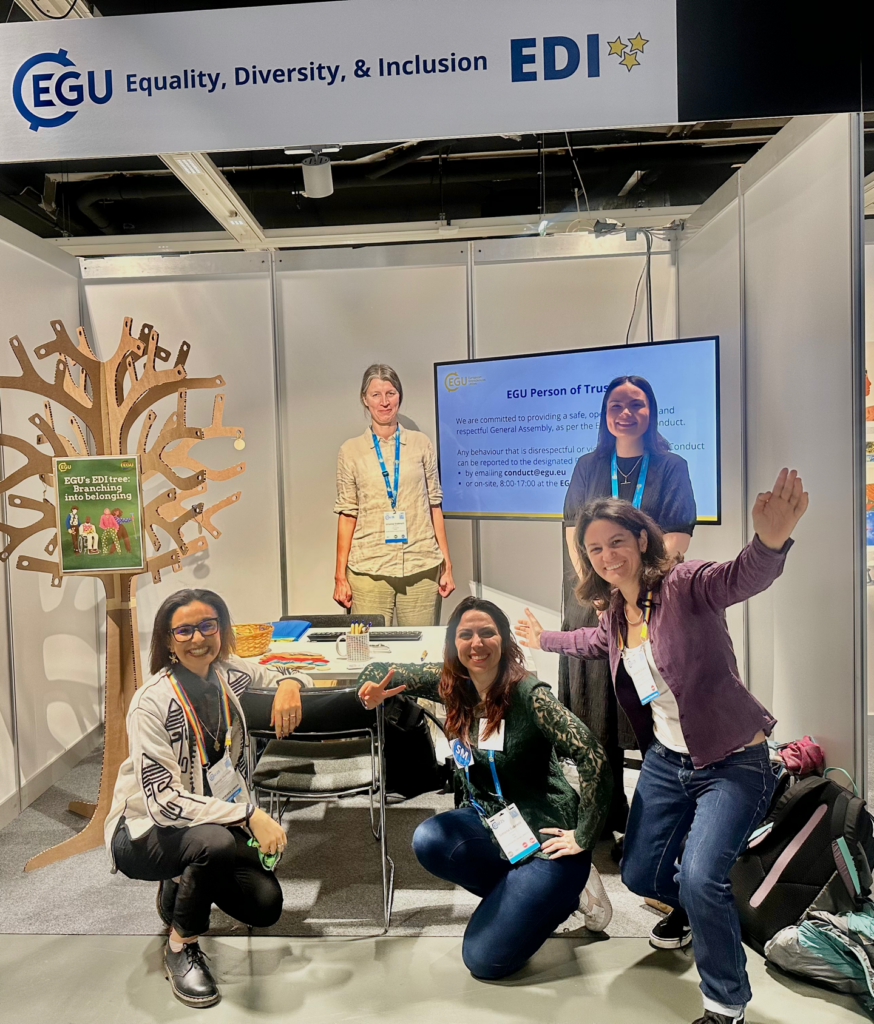
By 2019, I thought: Why don’t we have an LGBTQIA+ group at EGU? So during the General Assembly, in a small room, we held our first meeting with no clue what we were building or how many people would show up. We laid out a Progress Pride flag, held up a laptop with a few slides, and suddenly found ourselves in a small yet completely packed room! When the second group arrived to claim their booking, we marched out holding the Pride flag through an empty venue (it was after the evening sessions) straight into a huge conference room for refreshments at the ECS Forum meeting. It was our very first mini Pride parade at EGU, and from that moment, Pride EGU was born. It gave me warmth, purpose, and room to breathe between constant relocations for work. Today, we host a packed reception every year at the General Assembly in Vienna, supported by EGU and the EDI Committee, alongside webinars, short courses, and ongoing advocacy.
Pride EGU and the pride community work kept me connected, grounded, and motivated enough to make it to where I am today. Now, as a lesbian in STEM stepping into senior leadership, I want to be there for others walking that same difficult path. I need to push for safer, more inclusive labs, field sites, and institutions, I need it for all of us. Today, I can finally offer my own definition of scientific success: working together to be the change we wish to see, building community and visibility, and creating a world of geosciences where we rise together.