Hello Delphine! Thank you for agreeing to have this GeoTalk interview. Could you briefly introduce yourself and your background?
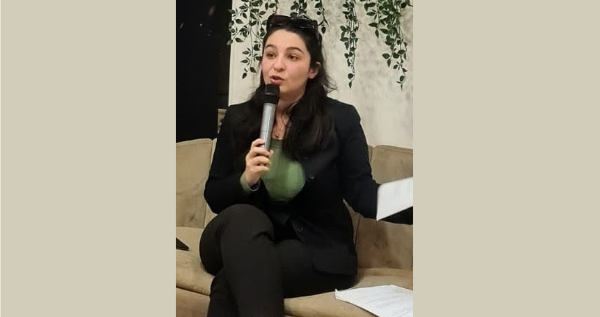
Hello, and thank you for having me! My name is Delphine Urbah, and I am a French professional working at the intersection of space, policy, ethics, and the human dimensions of space exploration. I currently work as a project manager for the Académie Spatiale Île-de-France, where I coordinate research and training initiatives in the public space research sector.
My previous experiences include the European Space Agency and the OECD. My background was in social sciences, specifically political anthropology, and my research focused on how humans live, believe, cooperate, and create meaning in space environments, as well as the legal and geopolitical frameworks around these questions.
Could introduce space anthropology to our readers?
Space anthropology is a way of looking at space exploration not first as a technical or scientific project, but as a human one. So my previous research asked questions such as: how do astronauts from different cultures live together? How do they deal with isolation, hierarchy, risk, or homesickness? What kinds of symbols, habits, rituals, or values do humans carry with them when they leave Earth?
Recently I am also increasingly interested in new questions, such as what do astronauts do after their space careers, and why do so many of them later move into public, political, diplomatic, or symbolic roles? Is this simply because they are already exceptional individuals, or does the astronaut experience itself produce a particular form of political authority?
Cultural behaviors are often adaptive technologies in disguise.
I am also fascinated by what a less Western-centred space habitat might look like, for example through the case of China’s Tiangong space station. These questions matter because space environments are never culturally neutral. Even the most advanced technological systems are imagined, designed, funded, and narrated by specific groups of people, in specific places, at specific moments in history.
Space anthropology helps us trace those assumptions: through social practices, institutional choices, epistemology, and the history of ideas.
How are values and rituals expressed in space missions?
The easy answer is to look at human spaceflight: astronauts celebrating holidays, bringing symbolic objects, taking photographs of specific places on Earth with already charged meaning, or maintaining small routines that help them feel connected to home. But I think values and rituals are present in all space missions decision making, including telecoms or robotic ones.
Space is an Earth-based, human endeavour: every funding decision, scientific priority, mission design, public communication strategy, and institutional hierarchy is shaped by humans in a specific political, cultural, and historical context. So values are not only expressed once humans arrive in orbit; they are already present in how space programmes are imagined, justified, financed, and narrated. I had a start up and am open to do consulting on that now, but that’s another story.
Why is it important that there is a legal framework for rituals and other social behaviours in space?
It is important because space missions are not ordinary private environments: they are shared, international, highly constrained workplaces where people may live, work, sleep, eat, and depend on each other for survival. In the social sciences, Erving Goffman called this kind of environment a “total institution”: a place where most aspects of life happen within the same enclosed system.
Of course, a spacecraft is not a prison or a hospital, but the comparison, maybe closer to a submarine or an Antarctic base; also total institutions, helps us understand why rights and responsibilities cannot be left vague. A legal and ethical framework does not mean controlling every personal gesture or belief. Rather, it helps clarify how freedom of conscience, cultural practices, privacy, non-discrimination, and mission constraints can coexist.
It is not enough to invite more diverse people into the room if the conditions of participation remain unequal.
It also matters for innovation: the more we make room for different ways of thinking, living, and solving problems, the more varied our responses to technical challenges can become. For example, even something as practical as hair care in space raises cultural questions: protective hairstyles developed in different communities may offer useful low-water, low-maintenance solutions that space agencies should take seriously. Cultural behaviors are often adaptive technologies in disguise.
You also work towards bettering inclusion and equity in space research. Could you share some of the work you do with us?
A lot of my work is about making the space sector more open, interdisciplinary, and structurally accessible. In my current role, I coordinate programmes that connect universities, research laboratories, public institutions, and researchers from different backgrounds. This includes supporting international mobility through scholarships, but also making practical information easier to find: financial support, disability services, social support, and resources for people facing discrimination or gender-based violence. I think inclusion has to be concrete.
It is not enough to invite more diverse people into the room if the conditions of participation remain unequal. That also means paying women and underrepresented people properly for their work, rather than treating visibility as a substitute for compensation or power.
Do you have any advice for people wishing to build inclusive communities in research?
My first advice would be to start small, but to be very intentional. Inclusion is not only about inviting “diverse people” into a room. Sometimes what we call “diversity” simply means gathering on stage all the people who were previously absent and worked their way there, while power remains somewhere else.
I am less interested in creating spaces that merely look diverse than in making spaces that already hold power more resilient to the arrival of different profiles, ideas, and ways of working. That is difficult, because institutions often want both innovation and stability: they want people to “break new ground” without shaking the house too much.
In research specifically now, I also think it is very important not to build communities only around prestige or productivity. People stay when they feel respected, useful, able to grow, and fairly compensated. For early-career researchers such as myself, it can be incredibly powerful to feel that choosing research does not mean accepting precarity as a condition of belonging.
Simon Clark is the Projects Manager at the European Geosciences Union, where they manage programmes for project, organisational and strategic development alongside overseeing the Union's webinars and online events. Simon is also chair of the Climate Hazard and Risk Task Force, and the point of contact for the early career scientists (ECS) network and Education Committee at the EGU Executive Office. A science communicator with a PhD in climate change and risk, Simon strives to make science accessible by engaging non-expert audiences, from artists and policy-makers to working with the public. Simon also has background in science-policy, having worked for academic, private and (quasi)-non-governmental organisations delivering policy analyses and briefs. They are also a co-founder and former director of an LGBTQIA+ sports charity, with over decade's worth of experience in inclusion and advocacy in academia and beyond.