Welcome to a new series on GeoLog dedicated to one of the most critical yet frequently misunderstood aspects of research: Communicating uncertainty in science. Over the coming months, we will feature six guest posts written by students from a summer course at the University of Tübingen. Bringing together 13 students across diverse disciplines, the course challenged them to reframe uncertainty as a driver of scientific progress rather than a weakness. Before launching the blogs that cover topics ranging from pandemic risk communication and gender data gaps to football statistics, I sat down with course lecturer Solmaz Mohadjer to discuss the inspiration behind the initiative, the power of interdisciplinary learning, and why blogging is a game-changer for science communication.
Hello Solmaz and thank you so much for chatting with me today! I’m so happy you are launching this blog series and I’d love to learn more about this initiative. What inspired you to design and teach a dedicated course on “Communicating Uncertainty in Science” at the University of Tübingen this summer?
Hi Asmae, thanks for having me. Two years ago, I ran into two strangers (now collaborators and friends) who, like me, were kind of obsessed with scientific uncertainty, its communication and impact on trust and decisionmaking. We financed our obsession with a research prize that planted the seeds for DICE, an interdisciplinary initiative that looks into the communication of scientific uncertainty through research, teaching and public engagement. We then created an online course on this topic and opened it to all students including those from the CIVIS network through the Transdisciplinary Course Program at the University of Tübingen.
The core idea was to offer a productive, interdisciplinary space for students to tackle uncertainty with curiosity and openness. There are many unknowns, yet we’re expected to make sense of them as we get bombarded with data, algorithms and news. What we do in this course is try to make sense of uncertainty in science, learn how to talk about it, and use it to learn new things.
Uncertainty is sometimes misinterpreted by the public as a lack of knowledge, whereas in science, it’s a standard measure of precision. How did this course help students reframe scientific uncertainty as a strength rather than a weakness?
We looked at different examples and did some exercises in the course to understand what uncertainty is and how/why it arises before diving into uncertainty communication, management and decision making. This enabled students to warm up with the nature and sources of uncertainty in science, which ultimately helped with framing uncertainty as a valuable outcome inherent to science. Many of the examples I use come from geosciences, but I also ask students to consider how uncertainty shows up in their own field of study.
I’m happy to see that two out of six student blog posts are written in defense of uncertainty and build on some of the case studies and analogies covered in class, including the excellent tree analogy by Sebastian Mutz. I think his analogy, together with the animated documentary “Degrees of Uncertainty” which students watched and discussed in class, made a compelling case that uncertainty is not a sign of failure, but rather a normal (and measurable) part of how science is done.
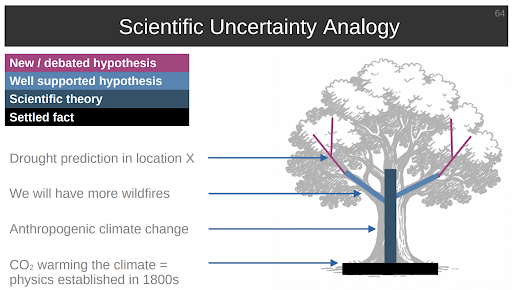
Tree for scientific uncertainty: The base of the tree is the settled fact upon which the trunk (scientific theory) stands. The branches of the tree closest to the trunk are well-supported hypotheses while those further away are new/debated hypotheses. The text in gray (left) shows how this analogy can be used in the context of climate change science. The analogy begs the question “Do you view the tree as unstable if a storm breaks off a small branch?”
Your course was offered through a transdisciplinary program (and open to CIVIS students), bringing together 13 BA and MA students from diverse fields, including social sciences. How did having such an interdisciplinary classroom shape the discussions on science communication?
Let me first say what a joy (though sometimes difficult experience) it is for me to be in an interdisciplinary classroom discussing topics that bring out different reactions from different disciplines. There are a lot of unknowns, and we (the students and I) have to not only be okay with this, but turn it into meaningful discussions and creative solutions.
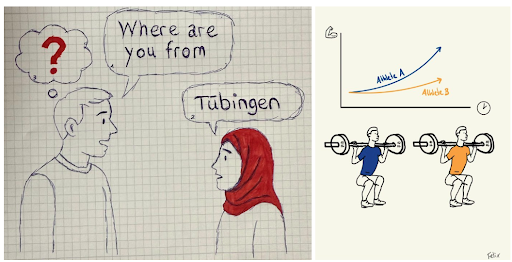
Just to show you what I mean, take a look at the images below. These are drawings of ‘uncertainty’ made by two students, one from Sport Sciences and one from English and American Studies. The former sees uncertainty in predicting training outcomes for different athletes following the same plan. The latter sees uncertainty when people don’t fit cleanly into standard labels. In an interdisciplinary classroom, we need to be able to hold conversations across different fields like the ones above, and stay connected. Only then we can create a meaningful space for open exploration of the topic where different perspectives are included.
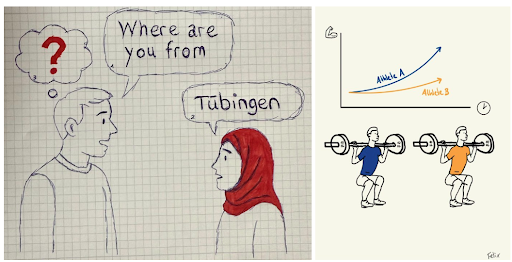
Students’ drawings of uncertainty in their field of studies. (L) Uncertainty in Sociology: the complexity of social identity categorization (image credit: Zisan Tosun), (R) Uncertainty in Sport Sciences; training results for different athletes following the exact same plan. Drawing by Felix Seibold.
Rather than traditional academic assessments, you had students work in small groups to author blog posts. Why is blogging such a powerful tool for teaching ECSs how to communicate complex concepts?
I think blogging is a great communication format, especially for societally relevant and complex topics like disaster risk, climate change, and scientific uncertainty. What I like about blogging is that it can break complex topics into smaller, and more digestible pieces and combine them with interesting content like images, videos, and stories that are informative, fun, and sometimes even personal. But blogging is rarely taught or integrated into university curricula except perhaps in specific fields like marketing and journalism. I think we miss an opportunity here to sharpen students’ writing and critical thinking skills and create lasting impact outside the classroom.
Can you tell us a bit about the topics covered in your students’ blogs and their relevance to the geoscience community?
My students looked into different aspects of uncertainty in science (what uncertainty is and where it comes from) as well as how to manage and communicate it. They do this in an accessible way by using examples from everyday experiences like grocery shopping or finding locations on Google Maps, as well as familiar case studies like the Covid-19 pandemic or FIFA World Cup 2026.
I think each blog has something to offer to the geoscience community. For example, in a blog titled Pandemic of Uncertainty, master’s students Berenice Schramm (Japanese Studies) and Benni Suchalla (Biomedical Technology) explain how poor risk communication (hiding uncertainties) eroded public trust during the Covid-19 vaccine rollout, causing confusion, fear, and bad choices. This, unfortunately, also happens in geosciences where scientists give guidance in a crisis but don’t fully acknowledge the ‘knowns and unknowns’. For example, ahead of the deadly 2009 L’Aquila earthquake residents were told that their absolute risk of an earthquake was low, but not warned that their relative risk was at least a hundred times normal. Or how some people misinterpret visualizations like the ‘cone of uncertainty’ that are used for planning and making decisions ahead of and during storms. There are many lessons geoscientists can learn from the pandemic, particularly in the context of climate change and natural hazards where clear communication matters. I think the blog does a good job highlighting these lessons.
You previously ran a successful student blog project with EGU’s Natural Hazards (NH) division blog. How has that past experience shaped how you approached this collection for GeoLog?
Back in 2025, I collaborated with the EGU’s NH division blog to publish my students’ blog interviews with non-profit organizations involved in disaster risk reduction work. Thanks to the blog editorial team, the process was smooth, enjoyable and rewarding. One student described it as “one of the most impactful courses of my undergraduate studies”. This positive experience encouraged me to do it again, but this time on the topic of communicating uncertainty in science which is of relevance to all the EGU’s scientific divisions (and beyond). GeoLog was excellent for this reason.
One main difference about this collection is that it was entirely student-driven, from choosing to write a blog post for their final project to generating ideas, forming teams and creating the final blog posts. I used the cooperative learning format “Think-Pair-Share” to facilitate this process. First, students started alone, thinking about an idea for a blog post. Then they paired up to discuss and refine their ideas, and add them to a central board. Students used the board to form teams by rallying around an idea that intrigued them the most. This process, though time-consuming, allowed students to have more authority over their final project.
What was the most surprising or gratifying insight you gained from reading and your students’ blog drafts?
It was wonderful to see how students turned their rough draft into a polished final blog following my feedback. Many of the blogs started as lengthy articles, lacked focus, written in an academic tone, with pictures that didn’t support the content. It was impressive to see how in less than 10 days, students were able to shorten their blog posts, ditch the boring voice, and bring in stories that are relevant and fun to read. It was a pleasure to be accompanying students in this process and watch their learning first-hand.
I also found it fascinating how differently students handled uncertainty in their blog posts. For example, in the blog “The data gap no man talks about”, Anna-Sophia Bauer (Rhetoric) and Lena Heilig (Molecular Medicine) point out that by focusing on male bodies, the media research has created a massive gender gap in health data. They call for closing this gap to improve well-being for all, not just women. In contrast, in the blog “How statistics can tackle uncertainty in football”(written during the 2026 FIFA World Cup), Pierce Allen (Environmental Science) and Stefan Gopp (Medical Technology) use football to explain concepts in math and statistics like probability, randomness, Poisson Distribution, and Monte Carlo. They do this in a fun and engaging way, showing how statistics work better than making guesses, and why football fans are obsessed with them.
For other university educators or researchers looking to integrate science communication and blogging into their curricula, what advice would you give them?
Here’s my two cents when asking students to write a blog post:
- First, decide on what you want to use the blog posts for (e.g., reinforcing course content, evaluating students’ learning, broader impact, etc.)
- Give a clear guideline for drafting a blog post. Here’s a good one to adapt.
- Give supportive assignments (e.g., browsing, reading and evaluating blogs) both as homework and in-class group activities.
- Ask students to submit a draft to get your feedback before final submission.
- Make blog publication optional but support those who decide to do it.
For researchers or educators with limited science communication or blogging experience who worry about integrating blogging into their curricula, I suggest asking more experienced colleagues to give you a hand and/or get some training like those offered by the EGU.