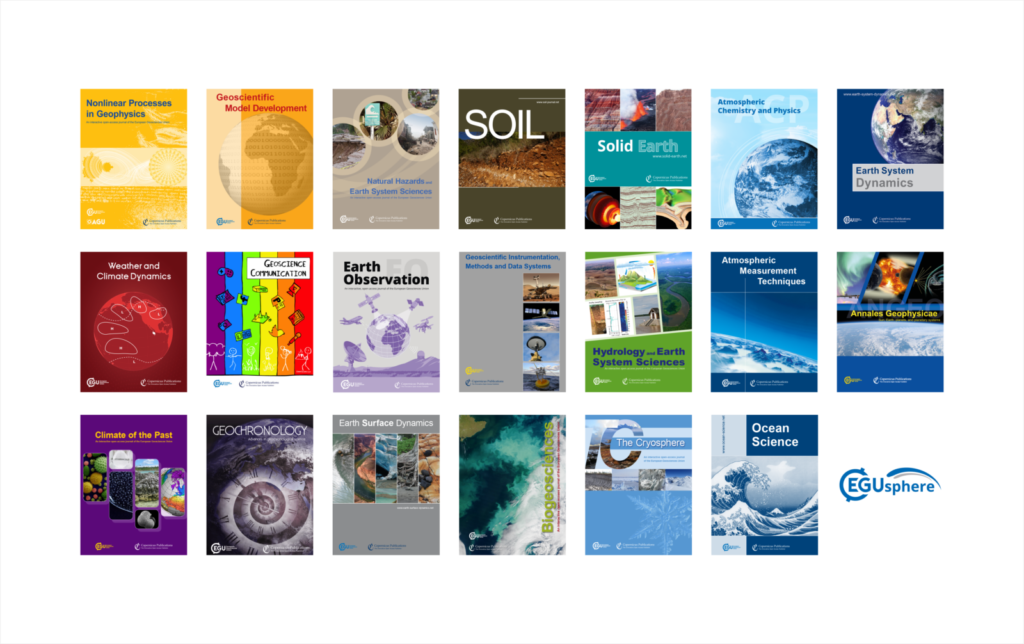
Each month we feature specific Divisions of EGU and during the monthly GeoRoundup we put the journals that publish science from those Divisions at the top of the Highlights section. For September, we are featuring Earth Magnetism & Rock Physics (EMRP),Geosciences Instrumentation and Data Systems (GI), and Geosciences Instrumentation and Data Systems (ESSI). They are represented by the journals Solid Earth (SE), Geoscientific Model Development (GMD),Geoscientific Instrumentation, Methods and Data Systems (GI), and Natural Hazards and Earth System Sciences (NHESS).
 Geoscientific Model Development
The Geoengineering Model Intercomparison Project (GeoMIP) contribution to CMIP7 – description of new experimental protocols and preliminary results – 11 September 2026
The Geoengineering Model Intercomparison Project is a coordinated international model intercomparison effort aiming to provide robust experimental protocols for simulations of various Solar Radiation Modification (SRM) methods. In this manuscript, we describe a list of novel experiments decided by the community, to be run by climate models to better understand sources of uncertainty in SRM. We also show and discuss some preliminary results from a few climate models.
The Cloud Feedback Model Intercomparison Project (CFMIP) contribution to CMIP7 – 18 September 2026
Clouds constitute a key uncertainty for climate change projections. The Cloud Feedback Model Intercomparison Project (CFMIP) aims to address this challenge by evaluating and understanding clouds and their impacts on atmospheric circulation, precipitation, and climate sensitivity. The present paper describes the CFMIP experiment protocol for the Coupled Model Intercomparison Project phase 7 (CMIP7), and discusses the accompanying science questions and opportunities for progress.
The North American CORDEX-CMIP6 WRF evaluation run: comparing historical simulations from 25 km to convection-permitting scales – 23 September 2026
This study presents a new 12 km CORDEX (Coordinated Regional Downscaling Experiment )-CMIP6 (Coupled Model Intercomparison Project) WRF (Weather Research and Forecasting) simulation for North America, compared against an earlier 25 km CMIP5 version and a 4 km convection-permitting simulation. The updated run reduces temperature and precipitation biases, improves precipitation timing, and better captures tropical cyclone intensity. Extreme precipitation at 12 km closely matches convection-permitting results, offering a practical resolution for regional climate assessment.
Natural Hazards and Earth System Sciences
Invited perspectives: Towards usable compound event research – 07 September 2026
Impacts from extreme weather events may become more severe due to increased likelihood of compounding events under global warming, which challenge present day climate modelling and forecasting capacities. In this perspective we reflect on the usability of compound event research to bridge the gap between academic research and real-world applications.
Ballistic projectile hazard of major explosions and paroxysms at Stromboli (Italy) with uncertainty quantification – Part 2: Conditional and temporal probability maps – 17 September 2026
Using historical records and mathematical models, researchers created maps that show the probability of different areas being affected by ballistic fallout from volcanic eruptions in Stromboli, Italy. Hazard maps were developed for both major explosions and paroxysms as well as for the two categories combined together by assuming a relative proportion. By using a temporal model of the explosive events, first probability maps of ballistic fallout in the next 10 and 50 years are finally presented.
Invited Perspectives: Science for Comprehensive Disaster and Climate Risk Management – 24 September 2026
We explore five core challenges that need to be addressed in order to move towards the Comprehensive Disaster and Climate Risk Management approach. This approach has been proposed within the newly emerging paradigm of a more holistic approach to managing the risks associated with climatic and/or non-climatic hazards and non-climatic risk drivers. We elaborate on each challenge, discuss why they matter for comprehensive disaster risk management, and provide ideas of how to overcome them.
Atmospheric Chemistry and Physics
Cloud liquid water path at the North Slope of Alaska has minimal sensitivity to local meteorology in Arctic winter – 08 September 2026
Origin of low ozone above western North America: an investigation of sources and trends – 29 September 2026
Imaging deep carbon stocks with complex electrical conductivity – 11 September 2026
Limited atmospheric iron availability increase during the Younger Dryas in the Northern Hemisphere – 15 September 2026
Global hyper-resolution modeling of historical and future groundwater dynamics – 07 September 2026
Ocean dynamics amplify remote warming effects of reforestation – 24 September 2026
Assessing Earth system responses in mitigation scenarios with activity-driven simulation of carbon dioxide removal – 25 September 2026
The state of diversity, equity, and inclusion in the cloud physics community – 17 September 2026
Evaluating surface mass balance variability from climate models using GPS Bedrock Vertical Time Series data – 10 September 2026
EGU in the news: