Welcome to the second post in our GeoLog series on communicating uncertainty! Written by students from an interdisciplinary course at the University of Tübingen led by Dr. Solmaz Mohadjer, this series highlights how reframing the unknown as a strength can transform science communication. In this piece, Ana Isidora Ciobanu, Sarah Lind, and Kevin Erik show why uncertainty is far from a scientific flaw, but is, in fact, the very engine of scientific progress. By drawing parallels to how we manage everyday unknowns, like checking weather forecasts or route traffic, they unpack concepts like epistemic versus aleatory uncertainty, falsifiability, and the Information-Gap Theory. Using a vivid metaphor of science as a growing tree, they demonstrate why embracing what we don’t know fuels curiosity and prevents knowledge from hardening into dogma, concluding with a practical three-step guide to help readers navigate uncertainty-related stress.
When thinking about the concept of uncertainty, people often describe it as something that needs to be eliminated with knowledge and scientific proof. Yet uncertainty also represents a fundamental part of how we explore and understand the world.
But looking at the relationship between uncertainty and science, we may see that it’s not actually all bad. In fact, people manage uncertainty all the time, and without it, life would be quite boring. Let us explain!
Trusting uncertainty
When was the last time you planned a trip? While planning, you probably looked at maps to decide on a route. But I bet you didn’t just accept what your GPS told you about how long it would take. You probably planned a little time extra. What if the train runs late or there’s a traffic jam?
Day-to-day life is full of little uncertainties. And yet we still trust mobile apps for an approximation. We still look at weather forecasts, trust stores to deliver us our groceries, and some of us even invest in stocks!
So, if our lives are full of uncertainties, how can we expect science not to have any? Scientists likely deal with small uncertainties in their work as much as any of us do. They also deal with much bigger uncertainties, because their job is fundamentally about dealing with unknowns and making them known.
Important isn’t that scientists are certain or uncertain, but how certain they are. Scientist saying they are uncertain means a different thing to them than it does to the public. Because in science, complete certainty is an ideal that cannot actually be met. So, scientists are always unsure.
But generally they are sure enough to act on their results. For example, scientists don’t know how hot the summer will be in 10 years exactly, but they can tell us that summers globally are getting hotter.
Usually, results are reviewed multiple times before they’re published. Several other scientists in that field check research for errors and missing elements in a process called peer-review before a journal accepts the revised article. This collaborative process ensures the quality of published science and makes scientists aware of the limitations of their research.
But when speaking to the public, some scientists don’t want to omit their uncertainties. That would be unethical. This admission of uncertainty can create unease, because the public doesn’t want to act on advice the advice-giver seems uncertain about, especially in high-risk situations. Other scientists hesitate to mention their uncertainties to the public because they fear this misinterpretation. These problems are created by a misunderstanding of what uncertainty means. But what even is uncertainty?
Understanding uncertainty
The concept can be divided into two categories, epistemic and aleatory uncertainty. Epistemic uncertainty arises from incomplete information or limited understanding. It can be solved or reduced through further research or new discoveries. This can also be applicable in our day-to-day activities, just like not knowing how long you must drive for that trip because you haven’t checked the route.
One major cause of uncertainty is the many factors of natural phenomena. Taking climate change as an example, making accurate predictions is very difficult because environmental conditions are constantly changing.
Sometimes, the easiest way to understand a complex concept is through a visual metaphor.
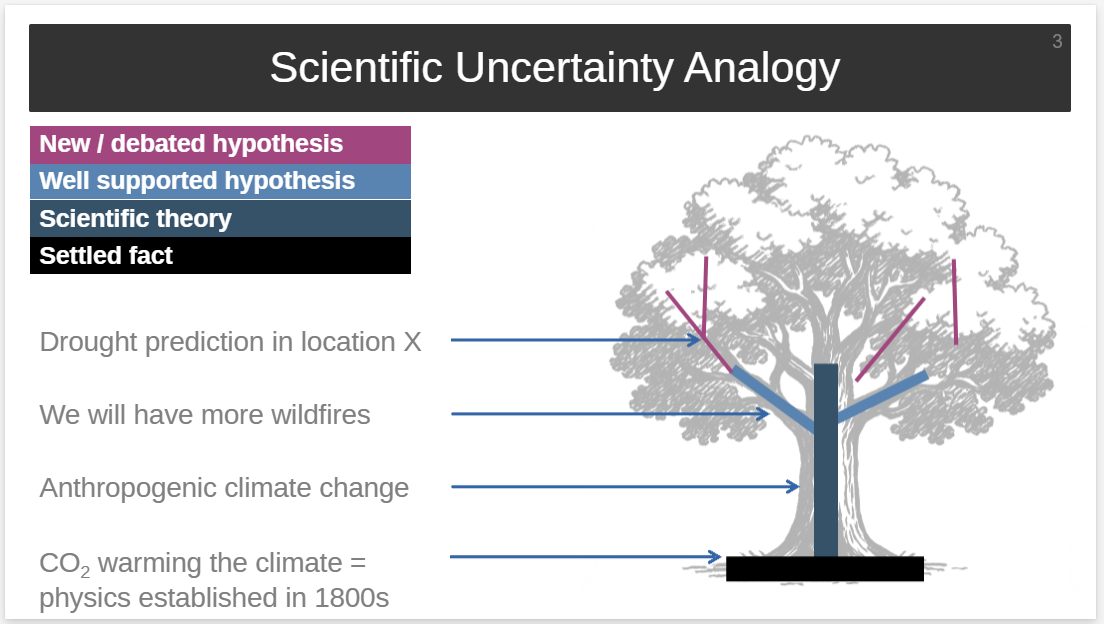
Climatologist Sebastian Mutz organises knowledge in science like a tree. (Source: Sebastian Mutz)
Here, the roots represent the well-proven knowledge that science continues to build on. Such as the fact that increase in CO2 cause global warming.
The necessity of uncertainty
Uncertainty isn’t something that must be eliminated completely, it’s a crucial part of science.
One of the core principles underlying all science is falsifiability. When a scientist puts forward a hypothesis, they need to make sure that this statement is in principle falsifiable, it must be possible to prove this statement wrong with new evidence.
This means that some uncertainty is always present, that we can never be fully sure that any given scientific theory is the absolute truth. Because of the principle of falsifiability, even extremely well-established theories always have a small chance to turn out to be wrong. The question shifts from whether there is uncertainty to what degree of uncertainty there is.
The very uncertainty that science operates on also helps it move forward. If we held scientific claims to be absolutely certain, science would become dogma. Ideas and even well-established theories would not be allowed to be questioned or revised. The tree would stop growing.
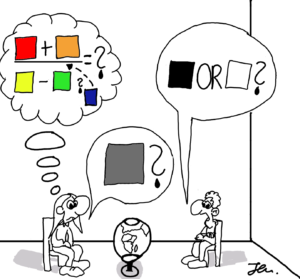
Researchers should always try to falsify each other’s claims and even their own, gather new evidence and move the field forward. The uncomfortable feeling that stems from the gap between the known and the unknown sparks curiosity that motivates us to search for answers. This is known as the Information-Gap Theory, a concept that has received a lot of attention in psychological literature.
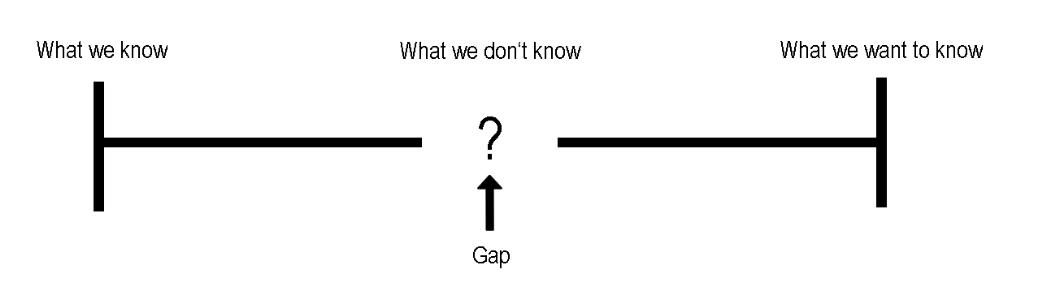
The Information-Gap Theory asserts we feel motivated to close the gap between what we already know and what we want to know. (Shared with permission; identity withheld by request).
For these reasons, uncertainty is not only impossible to separate from science, but it also shouldn’t be.
How to deal with uncertainty?
Unfortunately, understanding the importance and necessity of uncertainty doesn’t make it not stressful. But it can help to re-frame an uncertain situation inside the mind. Maybe we can even spark that curiosity the information-gap theory talks about.
Step 1 is being aware of uncertainty-related stress. We know that we’re stressed, but why? Finding the source helps us work out the questions we need to ask.
Step 2 is to assess the situation: What are the uncertainties? What kind? And then: What possible actions are there to reduce uncertainty? This can be searching for more information, but also re-assessing how stressed we even have to be.
Step 3 is to ask what we can do to avoid future uncertainty. This means finding sources you trust to bring you news about this topic in the future, not just right now. A lot of scientific topics have podcasts or blogs that explain them in understandable terms. Some scientists also write for the public themselves, for example about the climate. Once you’ve found one or several sources you trust, they can help you to reduce the fear associated with uncertainty about the topic and make it easier to look up information in the future.
Uncertainty is a fact of life, and an uncomfortable one. But trying to get rid of it as fast as possible isn’t the solution.