Using stable isotopes to uncover a hidden step in Earth’s water cycle
The Indian summer monsoon transforms South Asia’s landscape. Rivers swell, reservoirs replenish, crops receive life-sustaining water, and millions await relief after months of intense heat.
But what happens to a raindrop between the cloud and the ground?
Not every raindrop reaches the surface intact. As raindrops fall, they often pass through air that is warmer and drier than the environment where they formed. Some of the falling water evaporates before reaching the ground. This process, known as below-cloud evaporation, is invisible to the naked eye, but it can significantly reduce rainfall reaching the surface and alter the chemical composition of rainwater.
Our recent study, published in Atmospheric Chemistry and Physics, used stable water isotopes to investigate this hidden leg of a raindrop’s journey during the Indian summer monsoon.
A raindrop’s journey
A raindrop begins inside a cloud, where micro-droplets collide and merge until they grow heavy enough to fall. Once it leaves the cloud, however, its journey is far from over.
As it falls through drier air, water evaporates from its surface. Smaller drops may vanish entirely, while larger drops survive at reduced mass.
Evaporation also alters the isotopic signature of the remaining rainwater. Lighter isotopes of hydrogen and oxygen evaporate more readily than heavier ones. As a result, the surviving raindrop becomes enriched in heavier isotopes, while its d-excess (a parameter derived from hydrogen and oxygen isotope ratios) decreases. These isotopic shifts leave a distinct fingerprint of evaporation.
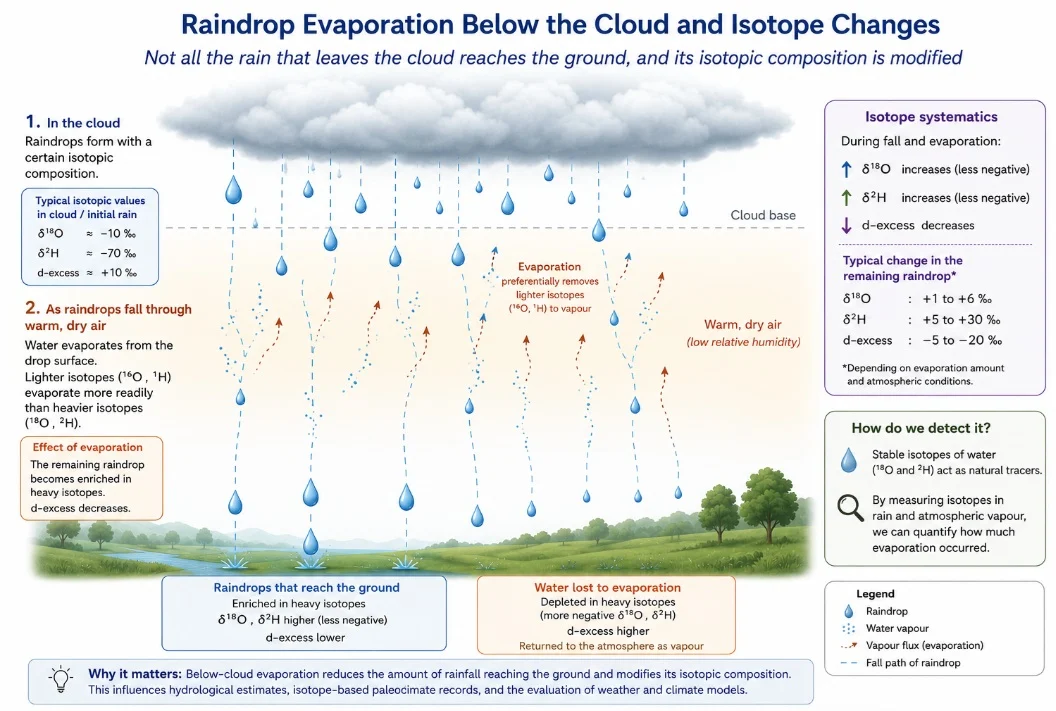
Figure 1. Conceptual illustration of below-cloud evaporation. As raindrops fall through warm, relatively dry air, part of their mass evaporates before reaching the ground. Preferential removal of lighter water isotopes leaves remaining drops enriched in heavier isotopes and lowers d-excess.
Using isotopes to see the invisible
Water consists of different isotopic forms of hydrogen and oxygen. Because evaporation and condensation affect these isotopes in predictable ways, their ratios preserve a recorded history of the physical processes the water has undergone.
Recent advances in laser spectroscopy allow scientists to measure the isotopic composition of rainfall and atmospheric water vapor with high precision. In our study, we combined field observations of rainfall and water vapor with an isotope-enabled atmospheric model to quantify below-cloud evaporation under natural monsoon conditions.
Following monsoon rain over the Western Ghats
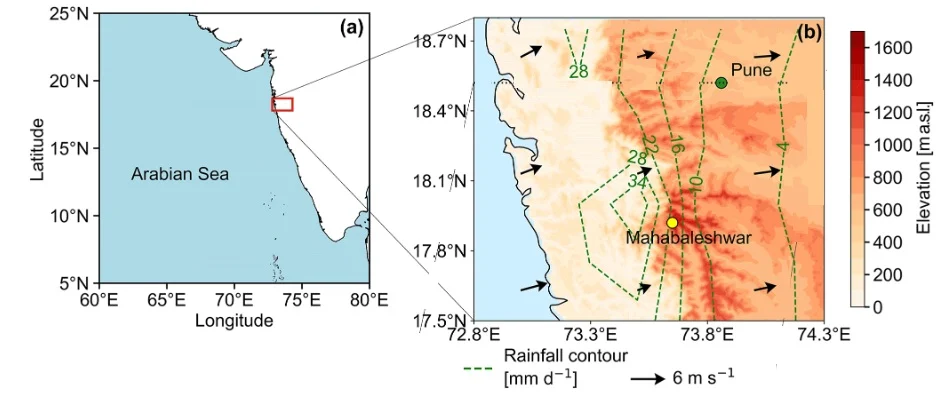
We conducted our research in Pune, located on the eastern (leeward) side of the Western Ghats in western India.
The Western Ghats act as a major topographic barrier to the Indian summer monsoon. Moist air arriving from the Arabian Sea rises over the mountain range, releasing heavy rainfall on the windward side. As the air descends toward Pune on the leeward side, it grows warmer and drier, creating ideal conditions for falling raindrops to evaporate.
This unique topography makes the region an ideal natural laboratory for studying raindrop evaporation.
Figure 2. (a) Location of the study area in India. (b) Topographic map of the northern Western Ghats. Rainfall contours show long-term mean June–September rainfall, and the arrow indicates 850-hPa wind direction. (Adapted from Fig. 1 of Nimya et al., 2026).
How we measured It
During the 2019 monsoon season, our team collected rainwater samples during individual rain events while simultaneously sampling atmospheric water vapor using cryogenic condensation.
In the laboratory, we analyzed the hydrogen and oxygen isotope compositions with high-precision laser spectrometry. Integrating these field data with numerical modeling allowed us to reconstruct a process that cannot be observed directly beneath a cloud.
Behind every data point were hours of field sampling, laboratory preparation, instrument calibration, and rigorous quality control.
Figure 3. Research team members collecting atmospheric water vapor and rainfall samples, and analyzing water isotopes in the laboratory.

What we found
Our observations revealed clear evidence of below-cloud evaporation across monsoon rain events over Pune:
-
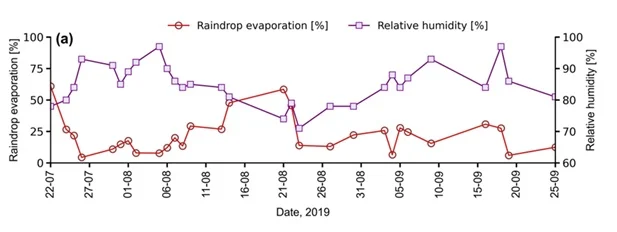
Average Rainwater Loss: An estimated 23% of rainwater mass evaporated between cloud base and the ground.
-
Event Variability: Evaporation rates varied substantially between individual storms, ranging from 4% to 61%.
-
Key Drivers: This variability was primarily driven by differences in atmospheric temperature, relative humidity, and rainfall intensity.
The isotope measurements provided a clear, quantitative signature of this otherwise hidden atmospheric process.
Figure 4. Estimated below-cloud evaporation for individual rainfall events during the study period. (Adapted from Fig. 9a of Nimya et al., 2026).
Why this study matters
Below-cloud evaporation is crucial because water isotopes are widely used across Earth science disciplines to trace the hydrologic cycle:
-
Hydrology: Scientists use rain isotopes to estimate groundwater recharge and catchment dynamics.
-
Atmospheric Science: Researchers rely on isotope signatures to evaluate moisture transport and refine climate model physics.
-
Paleoclimatology: Isotope signals preserved in natural archives, such as cave deposits (speleothems), lake sediments, and ice cores, are used to reconstruct past climates.
All of these applications rely on accurately accounting for how rainfall changes between the cloud base and the ground.
Looking ahead
Many steps in Earth’s water cycle remain difficult to observe directly. Stable isotopes offer a powerful lens for uncovering these hidden mechanisms.
Expanding rain and vapor isotope measurements across diverse climatic and topographic settings will help scientists better understand how below-cloud evaporation varies globally. Ultimately, these insights will improve climate projections, weather forecasting, and water resource management.
The next time you watch a monsoon shower, remember that a raindrop’s journey is more complex than it appears. While some drops reach the ground unchanged, many lose a significant portion of their mass along the way—leaving behind an isotopic story for us to read.