When you picture the western Mediterranean, you likely imagine sun-drenched beaches, terracotta roofs, and bright blue skies. But has it always been this sunny?
A groundbreaking study published in the journal Research provides a definitive answer: it has not. By pulling back the curtain – or rather, the cloud cover – on a thousand years of climate history, scientists have developed the very first millennial-length reconstruction of annual total cloud cover in the region, spanning from 969 to 2022 CE. This detective story takes us deep into the past to solve a modern puzzle, revealing not just what the sky was doing, but why it matters so profoundly for our warming world.
For centuries, landscape painting served as an inadvertent archive of the Earth’s atmosphere. This became especially pronounced in the nineteenth century, when artists found themselves painting under skies drastically altered by massive volcanic eruptions. Artists like Claude Monet and Vincent van Gogh, alongside precursors like J.M.W. Turner, meticulously depicted sunsets and cloud formations glowing with unusual, intensely saturated hues (Figure 1, left). These dramatic colorations were the direct optical result of volcanic aerosols reflecting and refracting sunlight in a disrupted atmosphere. This artistic record provides a striking testament to a centuries-long climatic anomaly characterized by volcanic winters and persistent overcast skies.
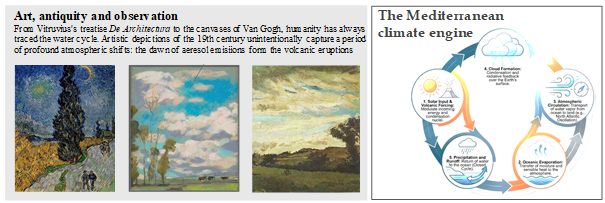
Figure 1. Left: Art, antiquity and observation: Artistic depictions of atmospheric and sky conditions across history. Left: Vincent van Gogh’s Starry Night (1890), illustrating a dramatic starry sky. Right: A 19th-century painting showing the atmospheric effects of the 1883 Krakatoa volcanic eruption, highlighting the imprint of volcanic aerosols. Such artworks provide qualitative historical context for long-term changes in cloud cover and atmospheric transparency; Right: The Mediterranean climate engine. This conceptual diagram illustrates the key interconnected processes driving cloud formation and climate variability in the region, including solar input and volcanic forcing, oceanic evaporation, atmospheric circulation (e.g., North Atlantic Oscillation), cloud formation with radiative feedbacks, and precipitation/runoff in a closed water cycle.
Why clouds matter in a warming world
Clouds are crucial regulators of Earth’s energy balance. They reflect sunlight, influence rainfall patterns, and affect temperature and drought. In recent decades, many areas of Spain, Italy, Portugal, and the broader Mediterranean have experienced a steady decline in cloud cover at the same time as temperatures have risen. This is the mystery at the heart of the investigation: is this trend part of a natural cycle, or is it something more unusual? Understanding this is key to projecting future risks in this sensitive region, a major climate hotspot.
Modern satellite records, our high-tech “eyes in the sky”, only extend back about 30 to 40 years, far too short to capture the full scope of natural climate cycles that play out over centuries. To see the big picture, scientists had to become climate detectives, turning to the Earth’s own archives (Figure 1, right).
Reconstructing the past with proxy data
To see into the past, scientists look away from satellites and toward the natural world. They collect indirect evidence, known as proxy data, from sources such as tree rings and lake sediments that reflect past cloudiness. Placed side‑by‑side, the three eras make the Little Ice Age leap out visually: a singular pocket of cool, wet, and persistently cloudy conditions wedged between two markedly warmer, drier, and sunnier periods. It reads almost like an interruption in the millennium’s rhythm, a darkened interval framed by bright bookends.
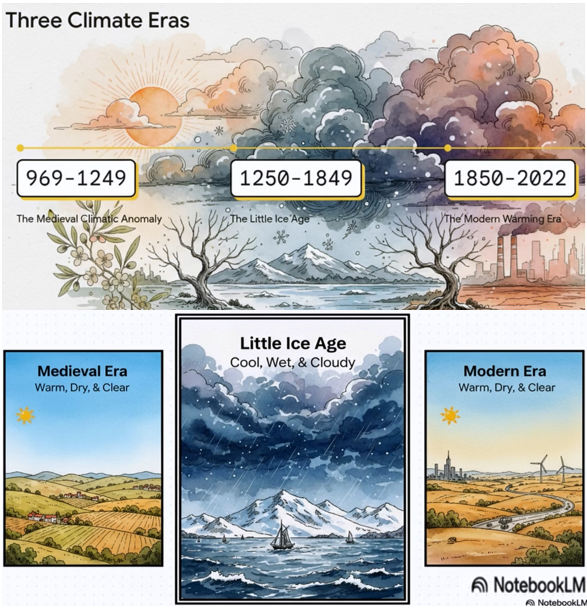
Figure 2. Three climate eras in the western Mediterranean (969–2022 CE). This illustration summarises the millennial cloud cover reconstruction, showing the generally warm, dry and clear Medieval Climatic Anomaly (969-1249), the cool, wet and cloudy Little Ice Age (1250-1849), and the modern warming era (1850-2022) characterised by declining cloud cover and clearer skies. The signle images derive from Gemini Notebook and assembled by the Authors on data results.
Following a clear three-step process, they gather this natural evidence, feed it into a computer to build a statistical model of past cloud cover, and then rigorously validate the results against independent historical observations to ensure accuracy. This process reveals that the last millennium does not unfold as a single, continuous climatic story, but as three sharply contrasting chapters (Figure 2).
First comes a broadly sunnier Medieval period, followed by the cooler, wetter, and markedly cloudier centuries of the Little Ice Age (14th-19th centuries), when sky conditions reached their cloudiest around 1600 CE. In our reconstruction, this interval emerges as a dense, self‑contained cloudy “bubble” nestled between two brighter eras, making the long‑term swings in atmospheric clarity unmistakable. The final chapter is our modern period, defined by a steady, persistent decline in cloud cover, that is a return to brighter skies, but driven by entirely different forces than those that shaped the Medieval world.
Placed side‑by‑side, the three eras make the Little Ice Age leap out visually: a singular pocket of cool, wet, and persistently cloudy conditions wedged between two markedly warmer, drier, and sunnier periods. It reads almost like an interruption in the millennium’s rhythm, a darkened interval framed by bright bookends.
The drivers behind the changes
This begs the question: what forces were strong enough to create these huge, centuries-long shifts? The research points to three key natural factors, alongside broader atmospheric teleconnections.
First on the list is the Atlantic Multidecadal Oscillation (AMO). You can think of it like a slow, powerful heartbeat for the Atlantic Ocean, cycling between warm and cool phases over decades. The study finds that cooler phases of the AMO tend to bring more clouds to the Mediterranean, while warmer phases are associated with clearer skies.
Next up is the Sun itself. Its energy output fluctuates in long cycles, and during periods of lower solar activity, it can lead to cooler and cloudier conditions here on Earth. This alignment with solar variability has been noted by researchers like ecologist John Roger Bray (1929-2018) for decades, who recognized these deep connections as powerful drivers of change.
Our final suspect is volcanic eruptions. A big eruption can blast tons of tiny aerosols high into the atmosphere, which act as seeds around which clouds can form. Clusters of major eruptions, particularly at the onset of the Little Ice Age, likely contributed to kicking that whole cloudy period into gear.
These natural drivers intertwine with other teleconnections like the North Atlantic Oscillation (NAO), Pacific Decadal Oscillation (PDO), and El Niño-Southern Oscillation (ENSO). For example, the current strong El Niño event, while not triggered by climate change, is a prominent part of this natural variability. Scientists are analyzing whether rising global temperatures might alter the frequency and severity of these events, and importantly, it is the distribution and extent of cloud cover that plays a major role in how these patterns translate into regional warming.
Current conditions in historical context
This brings our detective story full circle. The crucial point of all this is that when you look at the full 1,000+ year record, the amount of cloud cover we are seeing in the Mediterranean right now is not just low, it is the lowest observed across the entire period. It is truly unprecedented. This does not downplay the role of greenhouse gases. Rather, it illustrates how natural variability and anthropogenic warming interact, particularly in vulnerable regions like the Mediterranean.
Looking ahead
As natural cycles like ENSO (El Nino Southern Oscillation), and AMO (Atlantic Multidecadal Oscillation), and solar variability continue alongside human-driven warming, long-term reconstructions like this one provide essential context for improved climate projections and adaptation planning. This singular research does more than just solve a historical mystery; it leaves us with a critical and urgent question about what happens next, as these powerful forces combine in our planet’s most sensitive regions.
By examining the deep past, we gain better insight into whether today’s trends are exceptional and what they may mean for the future. This is the true value of historical studies in climatology: looking back centuries helps us understand, and prepare for, the challenges ahead under the Mediterranean sun.