
Have you ever heard of “analogue modelling”? In solid Earth science, directly observing the Earth’s interior is challenging, and the analogue modelling approach often overcomes this limitation by using alternative systems analogous to natural phenomena. By identifying fundamental mechanisms in these tractable systems, we can apply physical scaling laws to understand processes deep within the Earth. This broad concept encompasses not only laboratory experiments but also numerical models and even geological studies. In this post, we explore how analogue modelling helps us understand a fundamental puzzle: the mysterious statistics of regular and slow earthquakes.
What is analogue modelling?
Directly observing the interior of Earth and planets is quite difficult due to the opacity, high temperature, and high pressure. While many experimental attempts to recreate the Earth’s interior conditions have yielded numerous important insights, they are also difficult due to technical limitations. Analog modelling offers a practical alternative to overcome these difficulties and to elucidate underlying physics.
In solid Earth science, analogue modelling studies natural phenomena (such as earthquake dynamics) using systems in which some complex elements of reality have been modified or removed, while the essential principles and elementary processes are considered to be shared with nature. The approach aims to identify underlying physical mechanisms and governing laws, then apply these common principles and processes to the Earth’s interior through physical scaling. In other words, it investigates the underlying physics using systems where analogy or similarity laws hold for certain aspects of the target phenomenon.
In this sense, high-pressure/high-temperature experiments are also a kind of analogue in terms of system size, strain rate, impurity, etc. Moreover, analogue modelling is not limited to laboratory experiments: highly simplified physical systems like cellular automata can serve as numerical analogues, and geological studies examining high-pressure/high-temperature rock bodies exhumed from the Earth’s interior could also be considered a type of deep Earth analogue.
Depending on the degree of simplification, the model may appear unrelated to geophysical phenomena at first glance; however, it can share universal physical principles in certain aspects, which can serve as a basis for understanding the underlying mechanisms (Fig. 1). Although there are numerous analogue model systems and we cannot review all of them here, you may, for example, refer to Reber et al. (2020), as well as the Wikipedia article on “Rock analogs for structural geology”.
In this blog post, we introduce some analogue systems that have been used to explore the statistical properties of earthquakes, which should reflect the underlying mechanism and influence the probabilistic evaluation of seismicity.
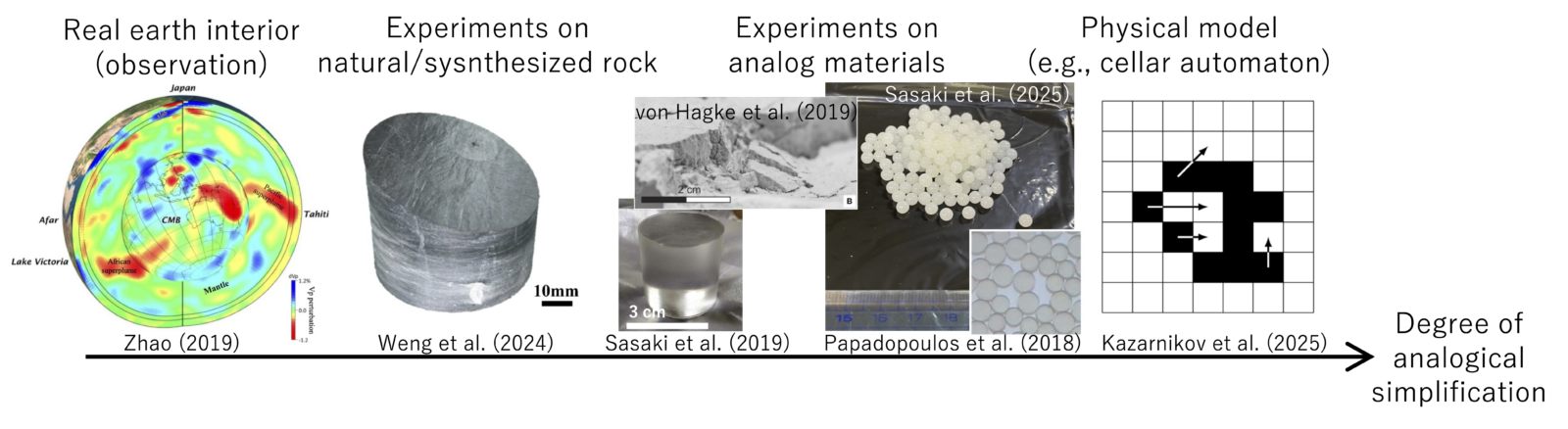
Figure 1. Various analogue systems, ranging from real nature to simplified numerical models. The level of analogy changes continuously with the degree of simplification. This figure is created by Yuto Sasak and includes elements adapted from Zhao (2019), Weng et al. (2024), Von-Hagke et al. (2019), Sasaki et al. (2025), Papadopoulos et al. (2018), and Kazarnikov et al. (2025).
Mysterious differences between two kinds of earthquakes
Earthquakes are currently proposed to be classified into two types—regular earthquakes and slow earthquakes—based on the scaling relationship between their seismic moment M0 (event size) and duration T, as shown in Fig. 2 Left (Ide & Beroza, 2023). Slow earthquakes have longer durations than regular earthquakes of equivalent size, and this is why slow earthquakes are referred to as “slow”.
In addition, some slow earthquakes seem to follow a size-frequency distribution qualitatively different from that of regular earthquakes, a power-law size distribution known as the Gutenberg–Richter (GR) relation, as shown in Fig. 2 Right (Chestler & Creager, 2017). Note that, in some cases, they may follow the power-law distribution with a similar power exponent to regular ones (Chiba, 2020).
No one knows what causes these differences between regular and slow earthquakes. Nevertheless, analogue modeling has contributed to elucidating the processes underlying these statistics.
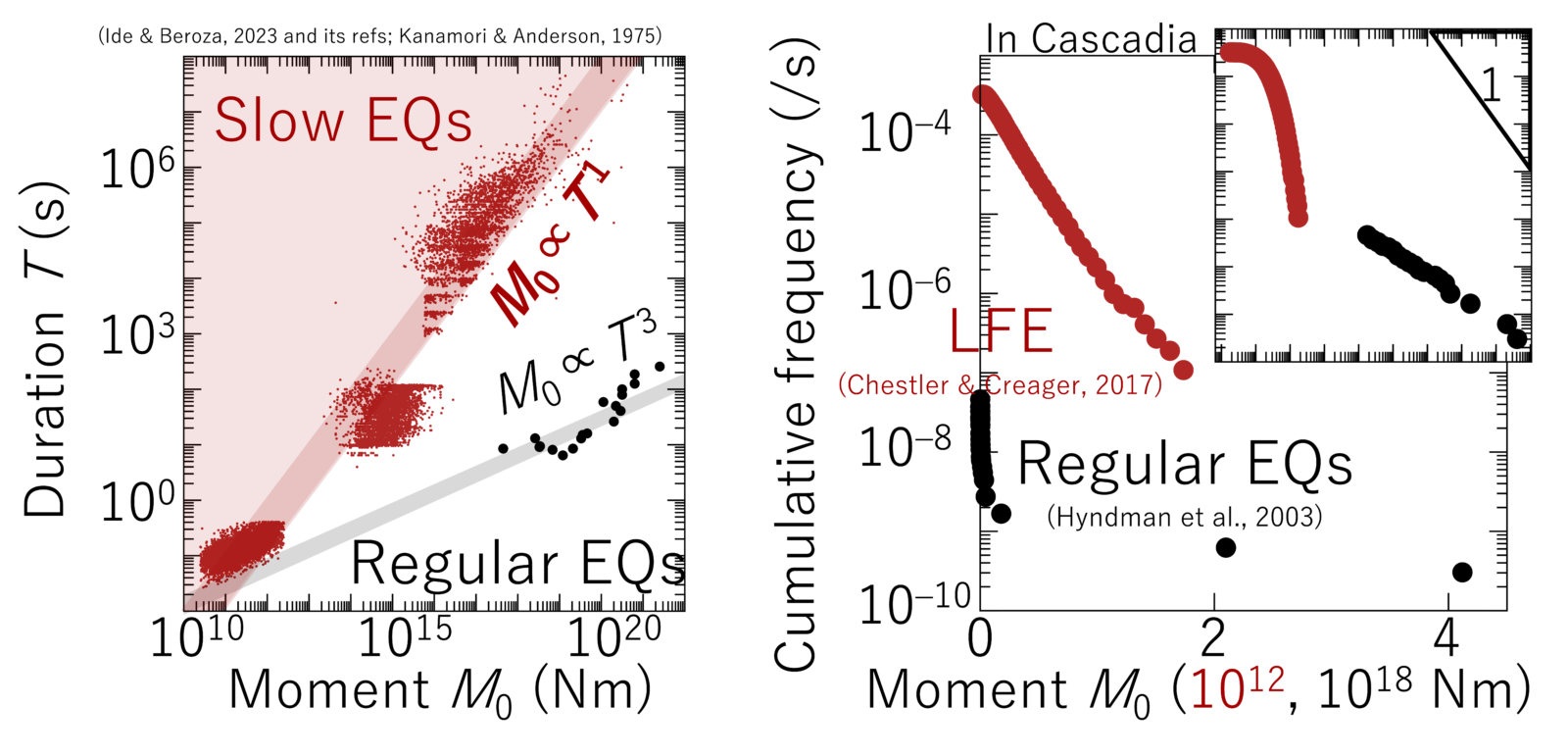
Figure 2. Statistical differences between regular (black data) and slow (red data) earthquakes. (Left) Relationship between seismic moment and duration. (Right) Cumulative frequency distribution of seismic moment in Cascadia on a semi-log scale. LFE stands for low-frequency earthquakes, a type of slow earthquake. Note that the x-axis range differs depending on the data type. The inset shows the same data on a log-log scale, with identical axis ranges for all data types. Data are taken from Ide & Beroza (2023) and its references, Kanamori & Anderson (1975), Chestler & Creager (2017), Hyndman et al. (2003).
Analogue system exploring size-frequency distributions of earthquakes
The mysterious power-law size distribution of regular earthquakes has long been investigated. In 1967, an analogue model provided a clue to understanding the problem. This model is called a spring-block model or Burridge-Knopoff model (Burridge & Knopoff, 1967).
The model consists of multiple blocks placed on a lower surface, which are connected to each other and to an upper driving plate via springs, as shown in Fig. 3 (Mascia & Moschetta, 2020).
You can see how this model behaves and how it is analogous to seismogenic slip bursts on YouTube, for both single-block and multiple-block cases.
This model, along with cellular automaton models inspired by it (Olami et al., 1992), has increasingly succeeded in explaining the observed power-law distributions. Moreover, shear experiments using beads analogous to fault gouges (Geller et al., 2015; Korkolis et al., 2021) also reproduce and explain the observed power-law distribution for regular earthquakes.
In this way, analogue modeling has contributed to understanding the statistical properties of regular earthquakes. The question then arises: what about slow earthquakes?
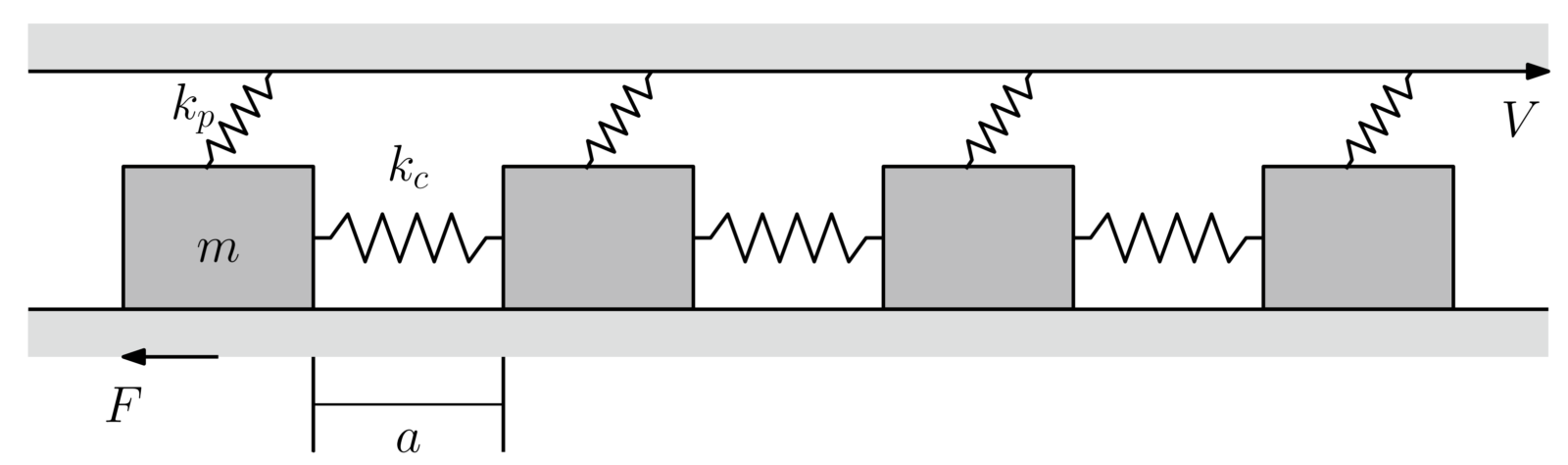
Figure 3. Schematic of the Burridge–Knopoff model. From Mascia & Moschetta (2020).
How could analogue modelling elucidate the mysterious origin of slow earthquakes?
Compared to regular earthquakes, deeper source regions of slow earthquakes are thought to contain abundant viscous phases, e.g., ductile minerals and fluids.
Some metamorphic rocks that have experienced the corresponding conditions of pressure, temperature, and tectonic setting exhibit block-in-matrix fabric (Fig. 4), where rigid blocks and soft matrix exhibit brittle failure and viscous flow structures, respectively.
To construct an analogue system corresponding to such a geological structure, Reber et al. (2014) and Birren & Reber (2019) performed analogue experiments using acrylic discs embedded in a viscous fluid and a mixture of microgel particles with interstitial fluid, respectively. They captured the transition between seismogenic-like stick-slip and creep behaviors.
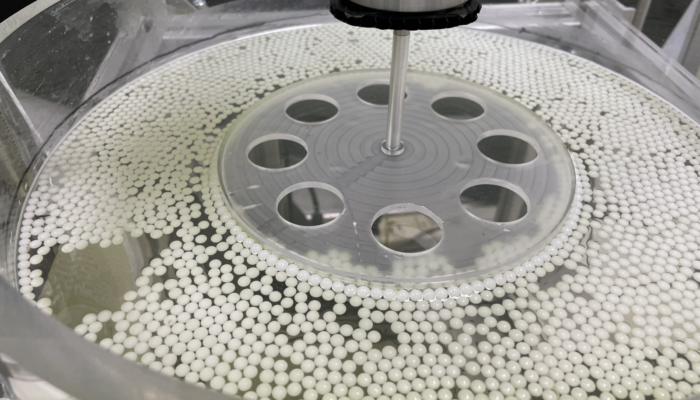
Inspired by their works, the mixture of hydrogel spheres and viscous fluid (the feature image above) has been found to exhibit statistical properties similar to those of slow earthquakes, as shown in Fig.5 (Sasaki et al., 2025).
Although the underlying physics remains controversial even today, combining analogue modeling based on geological insights with high-temperature, high-pressure rock experiments could help explain the geophysical observations and potentially elucidate the enigmatic mechanisms of both regular and slow earthquakes. This would strengthen the probabilistic evaluation of the interaction between their seismicity and help with disaster preparedness, as well as the physical mechanism of multiphase flow and the origin of shear zones in plate tectonics.
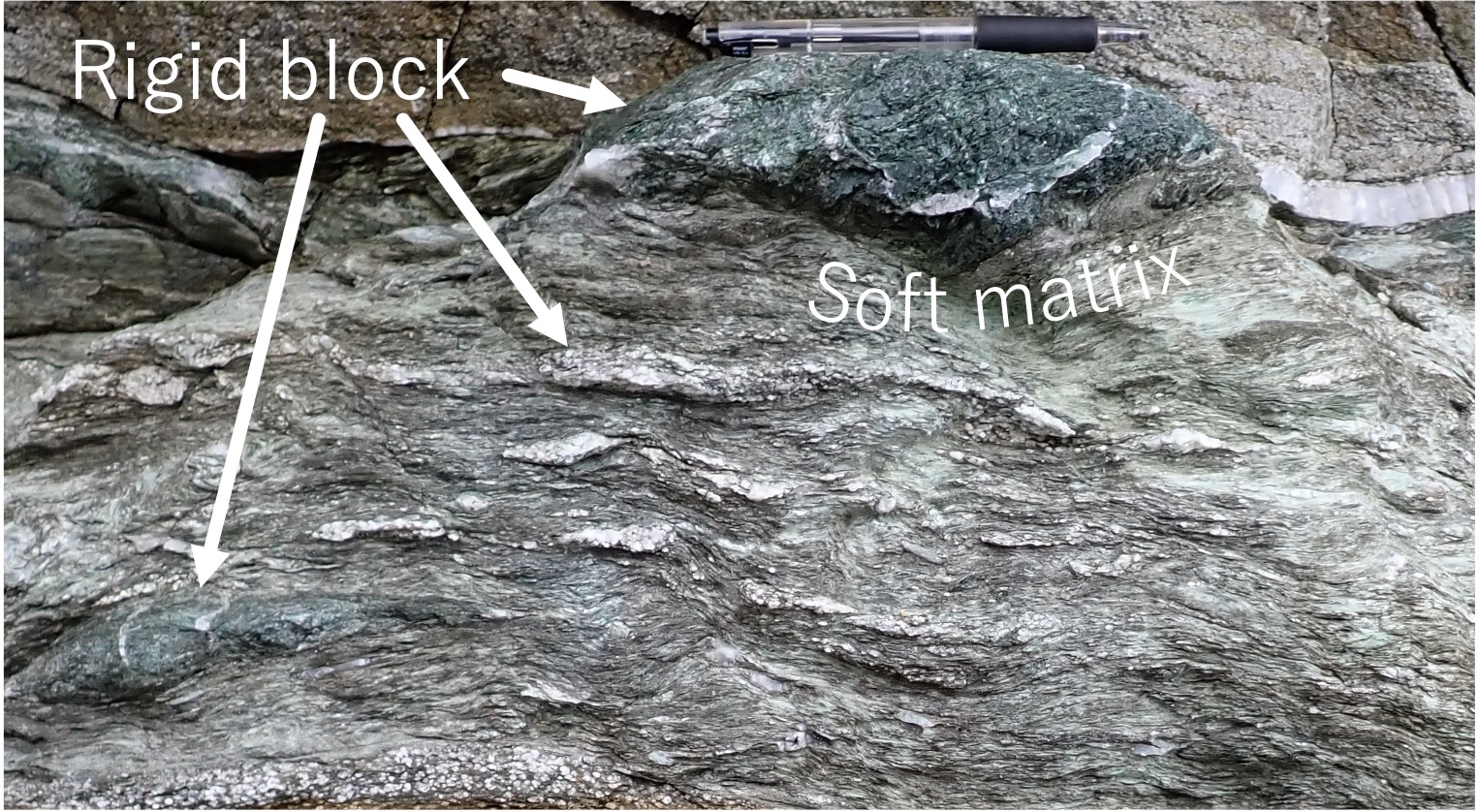
Figure 4. Block-in-matrix fabric within a shear zone that has experienced conditions characteristic of slow earthquake source regions (blueschist facies). Credits: Yuto Sasaki, 2026.
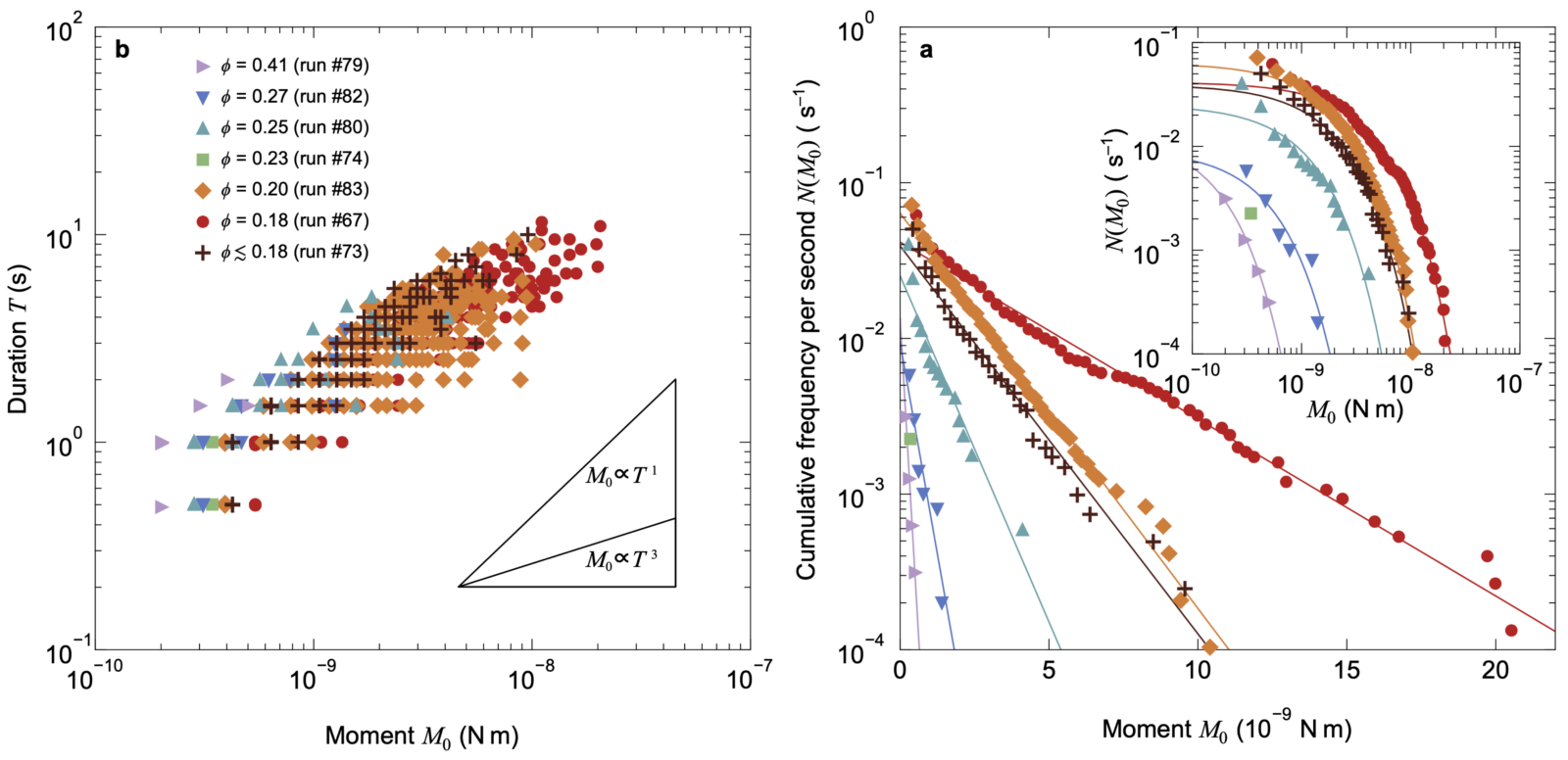
Figure 5. Hydrogel-fluid mixture qualitatively exhibiting the slow-earthquake statistics: (Left) Moment-frequency distribution, (Right) moment-duration relationship (Sasaki & Katsuragi, 2025).
References
Birren, T., & Reber, J. E. (2019). The impact of rheology on the transition from stick‐slip to creep in a semibrittle analog. Journal of Geophysical Research: Solid Earth, 124(3), 3144-3154. https://agupubs.onlinelibrary.wiley.com/doi/10.1029/2018JB016914
Burridge, R., & Knopoff, L. (1967). Model and theoretical seismicity. Bulletin of the seismological society of america, 57(3), 341-371. https://pubs.geoscienceworld.org/ssa/bssa/article-abstract/57/3/341/116471/Model-and-theoretical-seismicity
Chestler, S. R., & Creager, K. C. (2017). Evidence for a scale‐limited low‐frequency earthquake source process. Journal of Geophysical Research: Solid Earth, 122(4), 3099-3114. https://agupubs.onlinelibrary.wiley.com/doi/full/10.1002/2016JB013717
Chiba, K. (2020). Stress state along the western Nankai Trough subduction zone inferred from b-values, long-term slow-slip events, and low-frequency earthquakes. Earth, Planets and Space, 72(1), 3. https://link.springer.com/article/10.1186/s40623-020-1130-7
Geller, D. A., Ecke, R. E., Dahmen, K. A., & Backhaus, S. (2015). Stick-slip behavior in a continuum-granular experiment. Physical Review E, 92(6), 060201. https://journals.aps.org/pre/abstract/10.1103/PhysRevE.92.060201
Gutenberg, B. & Richter, C. F. (1944). Frequency of earthquakes in California. Bulletin of the Seismological Society of America, 34, 185–188. https://pubs.geoscienceworld.org/ssa/bssa/article-abstract/34/4/185/101140/Frequency-of-earthquakes-in-California
Hyndman, R. D., S.Mazzotti, D.Weichert, and G. C.Rogers (2003). Frequency of large crustal earthquakes in Puget Sound–Southern Georgia Strait predicted from geodetic and geological deformation rates. Journal of Geophysical Research: Solid Earth, 108, 2033. https://agupubs.onlinelibrary.wiley.com/doi/full/10.1029/2001JB001710
Ide, S., & Beroza, G. C. (2023). Slow earthquake scaling reconsidered as a boundary between distinct modes of rupture propagation. Proceedings of the National Academy of Sciences, 120(32), e2222102120. https://www.pnas.org/doi/10.1073/pnas.2222102120
Kanamori, H., & Anderson, D. L. (1975). Theoretical basis of some empirical relations in seismology. Bulletin of the Seismological Society of America (1975) 65 (5): 1073–1095. https://pubs.geoscienceworld.org/ssa/bssa/article-abstract/65/5/1073/117458/Theoretical-basis-of-some-empirical-relations-in
Kazarnikov, A., Ray, N., Haario, H., Lappalainen, J., & Rupp, A. (2025). Parameter estimation for cellular automata. Japanese Journal of Statistics and Data Science, 1-26. https://link.springer.com/article/10.1007/s42081-024-00283-w
Korkolis, E., Niemeijer, A. R., Paulssen, H., & Trampert, J. (2021). A laboratory perspective on the Gutenberg‐Richter and characteristic earthquake models. Journal of Geophysical Research: Solid Earth, 126(8), e2021JB021730. https://agupubs.onlinelibrary.wiley.com/doi/10.1029/2021JB021730
Mascia, C., & Moschetta, P. (2020). Numerical evidences of almost convergence of wave speeds for the Burridge–Knopoff model. SN Applied Sciences, 2(12), 2053. https://link.springer.com/article/10.1007/s42452-020-03856-y
Olami, Z., Feder, H. J. S., & Christensen, K. (1992). Self-organized criticality in a continuous, nonconservative cellular automaton modeling earthquakes. Physical Review Letters, 68(8), 1244. https://journals.aps.org/prl/abstract/10.1103/PhysRevLett.68.1244
Papadopoulos, L., Porter, M. A., Daniels, K. E., & Bassett, D. S. (2018). Network analysis of particles and grains. Journal of Complex Networks, 6(4), 485-565. https://academic.oup.com/comnet/article/6/4/485/4959635
Reber, J. E., Cooke, M. L., & Dooley, T. P. (2020). What model material to use? A Review on rock analogs for structural geology and tectonics. Earth-Science Reviews, 202, 103107. https://www.sciencedirect.com/science/article/abs/pii/S0012825219306026
Reber, J. E., Hayman, N. W., & Lavier, L. L. (2014). Stick‐slip and creep behavior in lubricated granular material: Insights into the brittle‐ductile transition. Geophysical Research Letters, 41(10), 3471-3477. https://agupubs.onlinelibrary.wiley.com/doi/10.1002/2014GL059832
Sasaki, Y., & Katsuragi, H. (2025). Origin of slow earthquake statistics in low-friction soft granular shear. Nature Communications, 16(1), 10236. https://www.nature.com/articles/s41467-025-65230-z
Sasaki, Y., Takei, Y., McCarthy, C., & Rudge, J. F. (2019). Experimental study of dislocation damping using a rock analogue. Journal of Geophysical Research: Solid Earth, 124(7), 6523-6541. https://agupubs.onlinelibrary.wiley.com/doi/10.1029/2018JB016906
Von Hagke, C., Kettermann, M., Bitsch, N., Bücken, D., Weismüller, C., & Urai, J. L. (2019). The effect of obliquity of slip in normal faults on distribution of open fractures. Frontiers in Earth Science, 7, 18. https://www.frontiersin.org/journals/earth-science/articles/10.3389/feart.2019.00018/full
Weng, M. C., Lin, S. S., Lee, C. S., Wu, W. H., Li, J. H., & Liu, C. H. (2024). An anisotropic thermal–mechanical coupling failure criterion for slate. Rock Mechanics and Rock Engineering, 57(10), 8157-8177. https://link.springer.com/article/10.1007/s00603-024-03992-6
Zhao, D. (2019). Importance of later phases in seismic tomography. Physics of the Earth and Planetary Interiors, 296, 106314. https://www.sciencedirect.com/science/article/pii/S0031920119302195
Attila Gergely (2022). “1D Burridge-Knopoff experiment 91” (accessed 1 April, 2026). https://www.youtube.com/watch?v=3auyKm_uZ1E
Institut für Geowissenschaften & RUHR-UNIVERSITÄT BOCHUM (2025). “Stick-slip: earthquakes in the laboratory using a spring-block slider” (accessed 1 April, 2026). https://www.youtube.com/watch?v=AylMEWgVAGA
Wikipedia contributors (2026). “Rock analogs for structural geology” Wikipedia (accessed 1 April, 2026). https://en.wikipedia.org/wiki/Rock_analogs_for_structural_geology