Introduction
Geomagnetic storms present a constant challenge to global navigation satellite systems (GNSS), driving space weather researchers to better understand how the ionosphere responds when solar drivers strike. A primary key to this puzzle is ionospheric delay time, the exact duration between the onset of a geomagnetic storm and its peak impact on the Total Electron Content relative to quiet-time baselines (DTEC).
While much of space weather literature focuses on high-latitude storm dynamics, low-latitude regions harbor unique plasma physics, driven by the Equatorial Ionization Anomaly (EIA) and complex electrodynamics.
In a long-term study analyzing 124 geomagnetic storms between 2002 and 2021 (Solar Cycles 23–25), researchers H. S. Mohamed and collaborators investigated how background solar radiative flux and energetic proton precipitation influence storm-time ionospheric delays at two low-latitude IGS stations: CUSV (Thailand, near the magnetic dip equator) and COCO (Keeling Island, near the EIA crest).
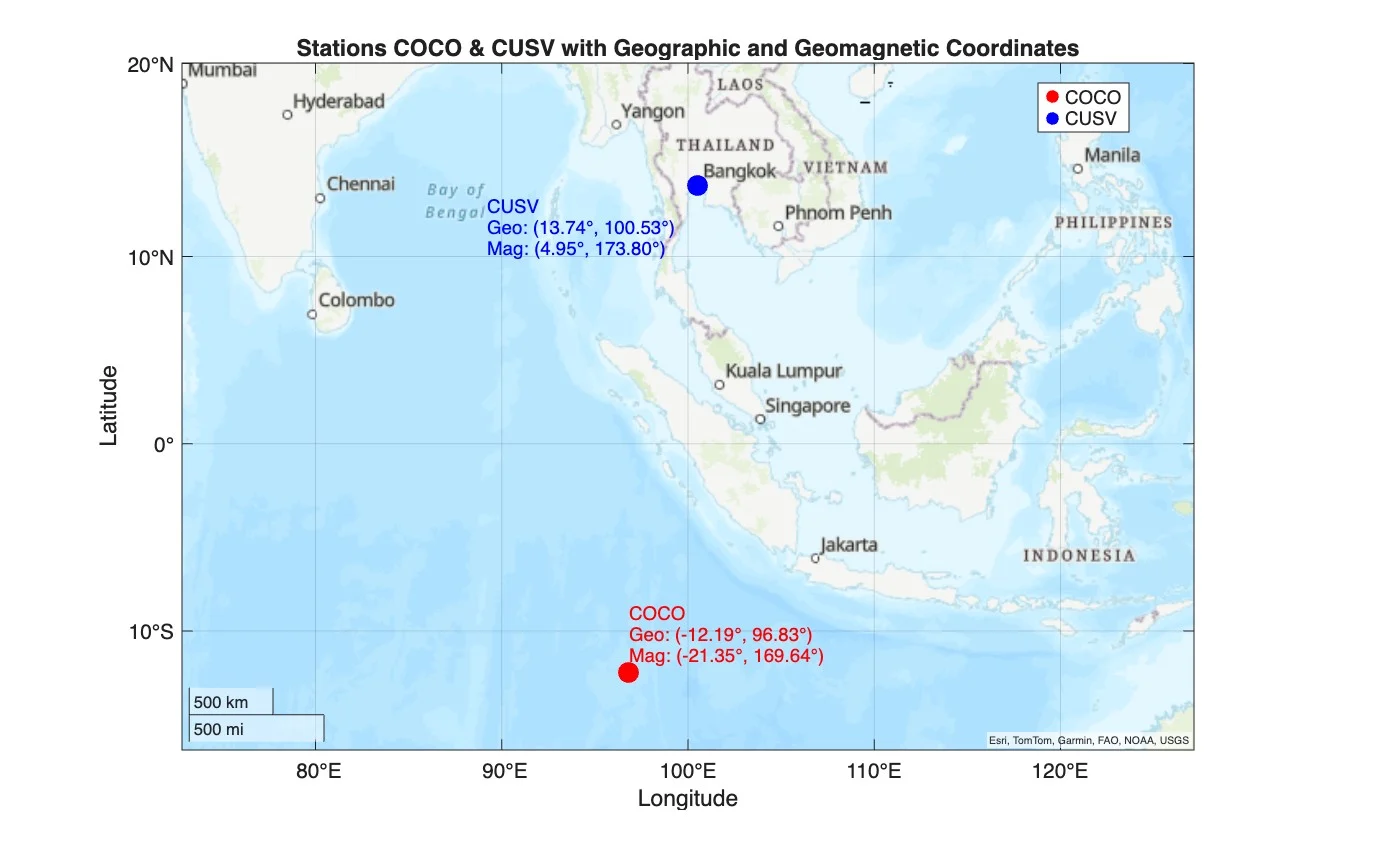
Figure 1.- Map with the locations of the two GPS stations CUSV and COCO.
Methodology
Our work was inspired by Liu et al. (2011) and Mohamed et al. (2023), who demonstrated a correlation coefficient for the time delay in the maximum ionospheric delay during an intense magnetic storm. We used varied datasets for solar parameters, magnetic indices, GNSS stations, solar origin of the event source as well as various coding technique regarding a selection criteria for the events contributed in the study.
Core Scientific Findings and Key Themes
-
Robust correlation between Dst index and ionospheric delay time across decades: Across most phases of Solar Cycles 23, 24 and 25, the correlation between geomagnetic storm intensity (Dst index) and ionospheric delay time was statistically significant at the 95% confidence level. Correlation coefficients ranged from a minimum of 0.27 at COCO (during the declining phase of SC 23, with the correlation likely weakened by gaps in station hardware operation) to a maximum of 0.89 at CUSV during the ascending phase of SC 25.
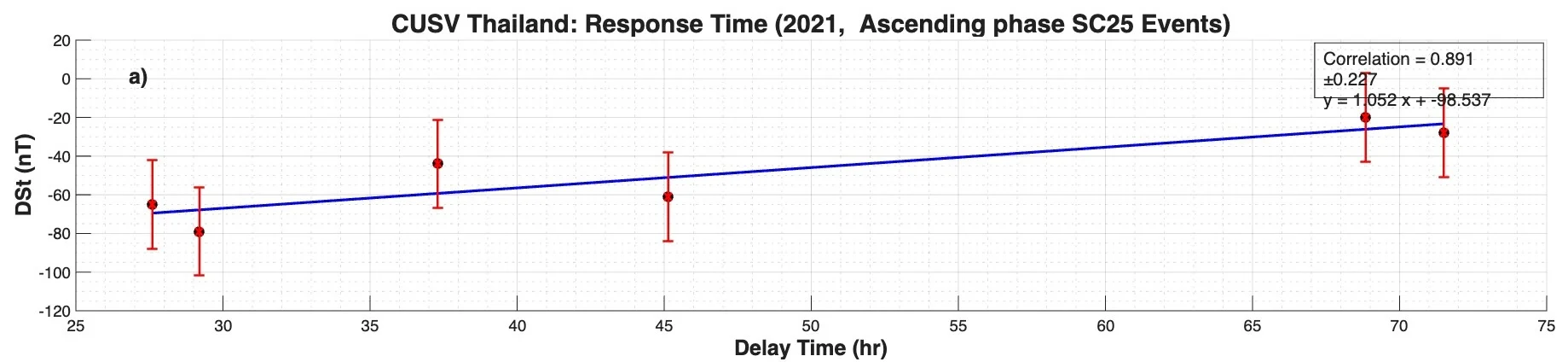
Figure 2.- Correlation between Dst-index and DTEC delay time at CUSV.
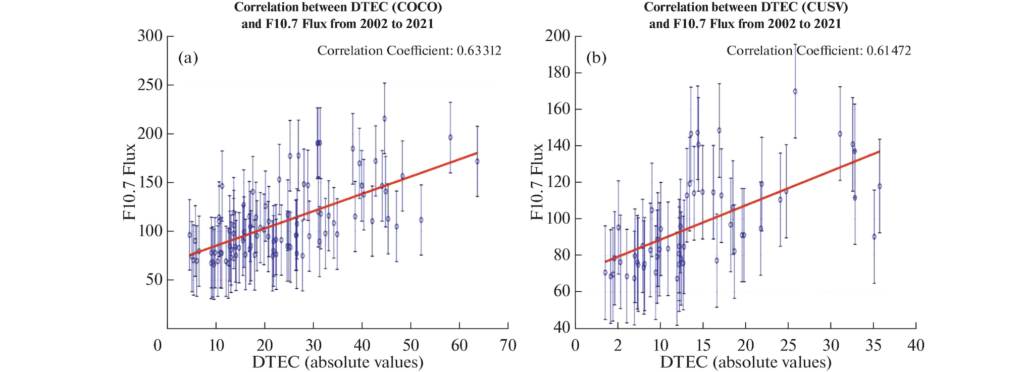
- Solar Background Radiative Control: While solar radio flux (F10.7) and Lyman-alpha (Ly-a) irradiance vary on broader timescales than rapid storm events, they directly govern the baseline electron density of the low-latitude ionosphere (r > 0.60) . Ly-a photoionization sets the pre-storm background state in the D/E-layers upon which storm-time perturbations superimpose.
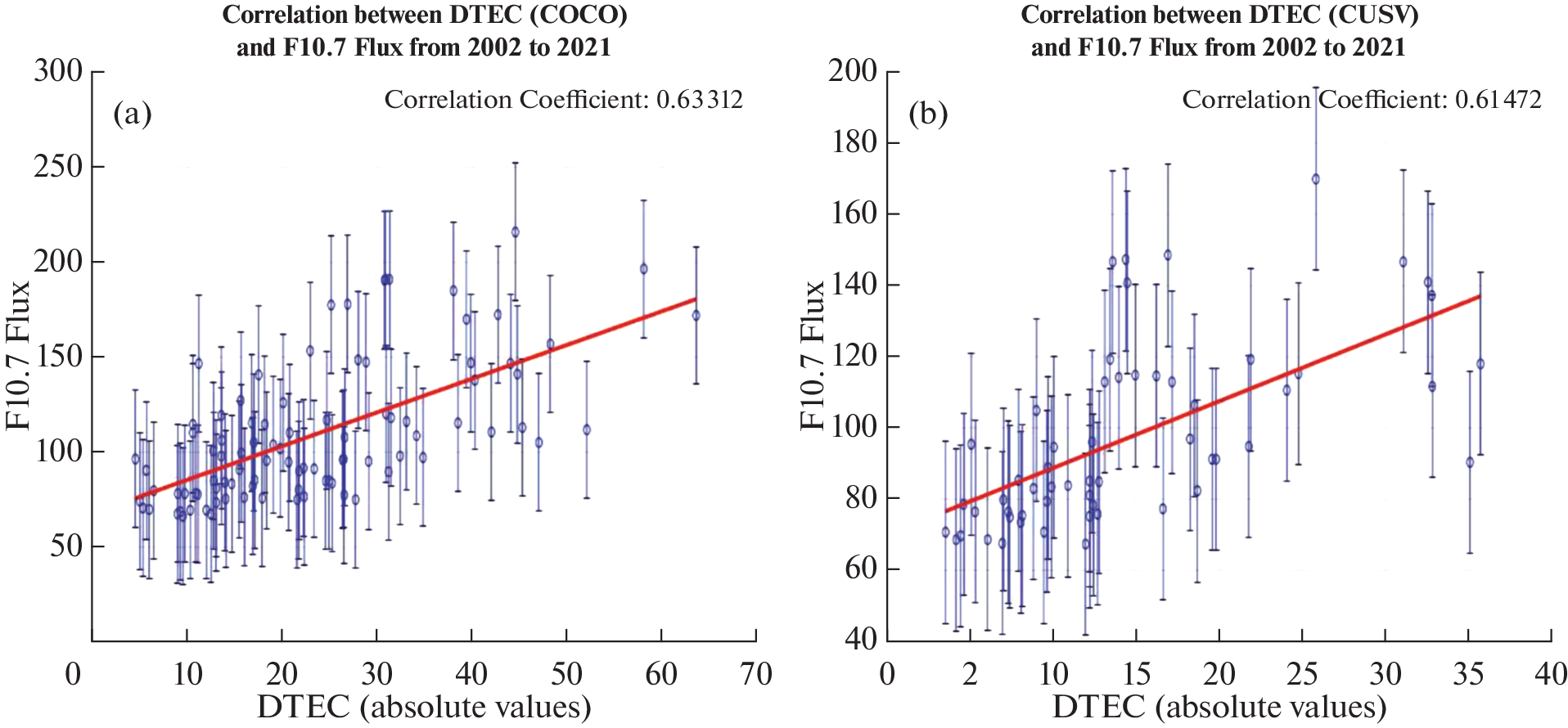
Figure 3.- a) Correlation between F10.7 solar radio flux and the absolute value of DTEC at COCO station. The Pearson correlation coefficient for this relationship is r=0.633 for 93 events. Panel b) Correlation between F10.7 solar radio flux and the absolute value of DTEC delay time at CUSV station. The Pearson correlation coefficient for this relationship is r=0.61472 for 57 events.
- Energy-Dependent Proton Coupling Mechanisms: Energetic Storm Particles (ESPs) and solar proton flux play a direct role in driving low-latitude ionization:
⚬ Low-Energy Protons (6-16) MEV Consistently show strong correlations with DTEC at both stations, serving as a direct proxy for storm shock intensity.
⚬ High-Energy Protons (32-46) MEV Reveal a clear latitudinal divergence. Correlations remain strong right at the dip equator (CUSV), but weaken significantly at the EIA crest (COCO).
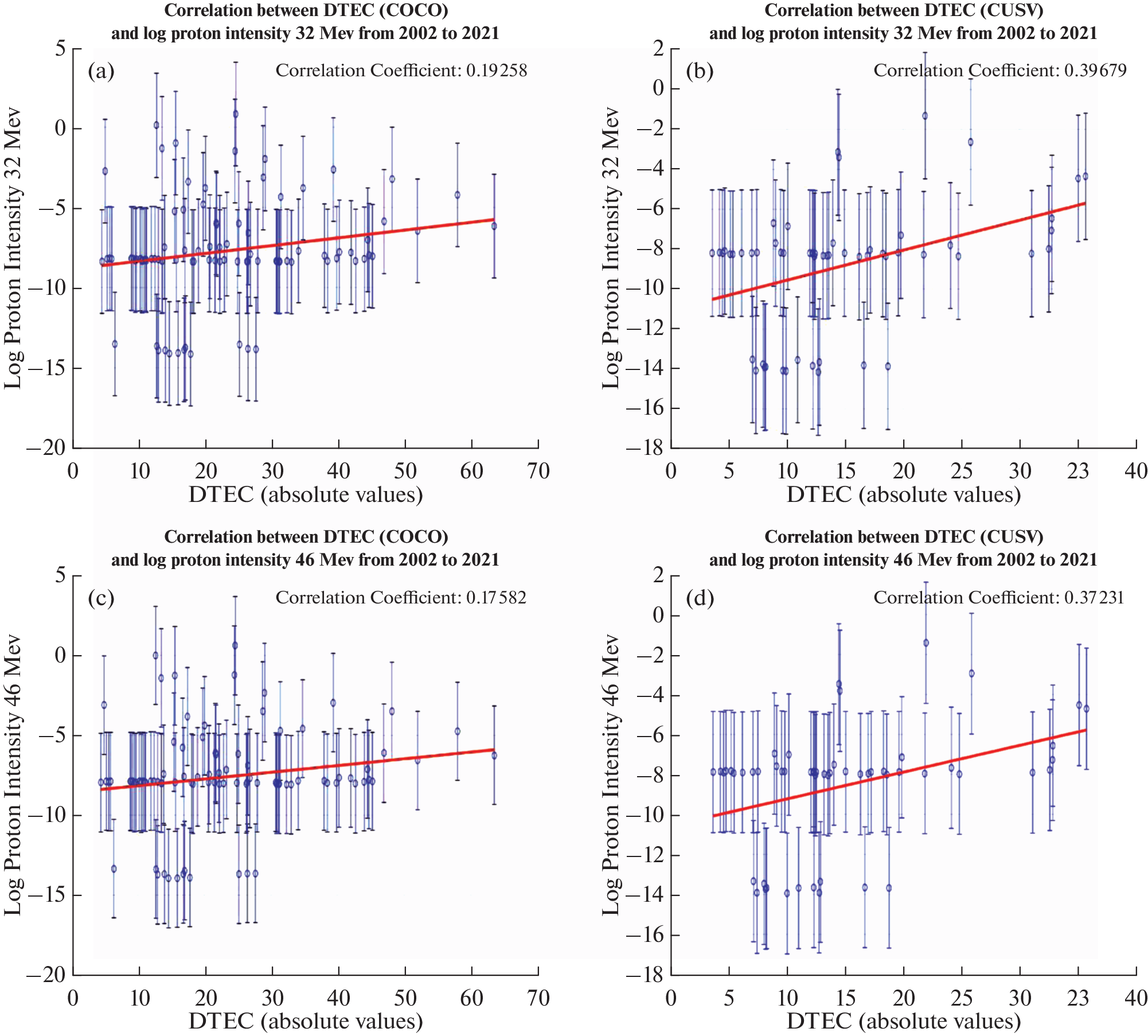
Figure 4.- Panel a) Relationship between the absolute value of DTEC at COCO station and the logarithmic proton intensity for the 6 MeV energy range. The Pearson correlation coefficient for this relationship is r= 0.26875 for 93 events. Panel b) Relationship between the absolute value of DTEC at CUSV station and the logarithmic proton intensity for the 6 MeV energy range. The Pearson correlation coefficient for this relationship is r=0.4255 for 57 events. Panel c) Relationship between the absolute value of DTEC at COCO station and the logarithmic proton intensity for 16 MeV protons. The Pearson correlation coefficient for this relationship is r=0.26772 for 93 events. Panel d) Relationship between the absolute value of DTEC delay time at CUSV station and the logarithmic proton intensity for 16 MeV protons. The Pearson correlation coefficient for this relationship is r= 0.490 for 57 events.
- A distinct solar-cycle dependence in ionospheric time delay, governed by the complexity of the solar wind driver:During the early declining phase of SC 23, the longest delay times (~48 hr) occurred during periods of strong solar activity. In contrast, during the declining phase of SC 24 (characterized by weak cycle dynamics), the shortest delay times (~27 hr) were observed.
The Physical Picture
This energy-dependent divergence highlights the fundamental difference between the “source” (the magnetic equator) and the “sink” (the crests) of the equatorial plasma fountain. At the dip equator, prompt signatures of high-energy proton forcing are preserved. However, as plasma is transported toward the EIA crests via field-aligned diffusion and E X B dynamics, localized turbulent transport obscures these prompt energetic forcing signatures at places like COCO.
Scientific Significance
By combining multi-cycle statistical monitoring with energy-channel breakdown, this work demonstrates that low-latitude storm delays cannot be modeled by geomagnetic indices alone. Accurate regional space weather forecasting requires accounting for background solar irradiance controls (F10.7/Ly-a) local electrodynamic transport, and the distinct shock impacts of energetic solar proton populations.
 Heba S. Mohamed is a PhD researcher in the Department of Astronomy, Space Science and Meteorology at Cairo University, Egypt. Her research focuses on ionospheric dynamics and space weather phenomena, with a particular emphasis on low-latitude ionospheric responses, geomagnetic storm dynamics, and storm-time delay variations. Heba has extensive experience analyzing diverse observational datasets across space weather domain layers, including ground- and space-based instruments such as GNSS Total Electron Content (TEC) receivers, the e-CALLISTO radio spectrometer network, SOHO solar observations, and MAGDAS magnetometer networks. Her technical expertise spans the study of geomagnetic pulsations, solar radio bursts, solar wind-magnetosphere coupling, and interplanetary drivers. She aims to quantitatively disentangle the energy-dependent solar and geomagnetic parameters that govern ionospheric variability, advancing predictive modeling for TEC variations and clarifying the fundamental physical mechanisms active throughout distinct phases of geomagnetic storms.