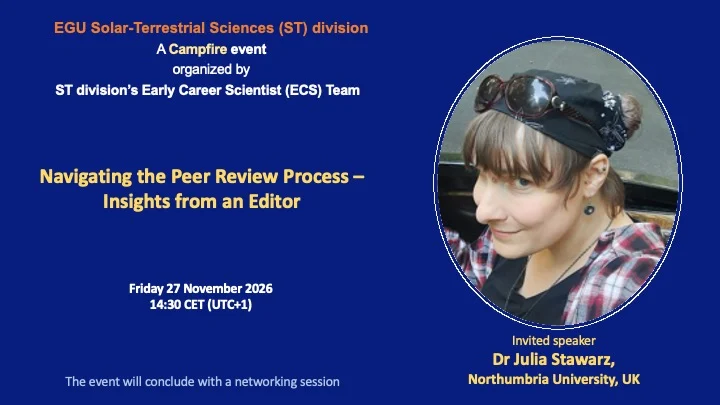
Have you ever wondered what makes a good peer review? Are you an early career scientist preparing to review your first manuscript, or curious about what happens behind the scenes in academic publishing?
The Early Career Scientists (ECS) team of the EGU Solar-Terrestrial Sciences (ST) Division is delighted to invite you to our upcoming ST-ECS Networking Campfire on 27 November 2026 , featuring Dr Julia Stawarz , Associate Professor at Northumbria University, UK.
Abstract
Peer review is a key element of the academic publication process and an important form of academic service to the wider scientific community. Peer review provides a means of quality control for the body of scientific literature and can also be a useful way for authors to obtain feedback on how to better present their ideas to the broader scientific community. Peer review is often one of the initial ways that early career researchers get involved in with supporting the wider scientific community beyond their own institutions and research groups, but it can also sometimes be a daunting new experience. In this session, we will discuss the landscape of academic publishing across the different subfields of heliophysics, the purpose of peer review and what makes for a good peer review, as well as what the process looks like from the other side as a scientific editor.
Venue: Online
Register Here: https://us02web.zoom.us/meeting/register/NgbxgEk7SHWntjqPi19fFA
Date: Friday, 27 November 2026
Time: 1430 CET (UTC+1)
Speaker: Dr Julia Stawarz, Northumbria University, UK
Meet our speaker: Dr Julia Stawarz
Dr Julia Stawarz is an Associate Professor and Royal Society University Research Fellow at Northumbria University in the UK. She has extensive experience across her career in the field of heliophysics using spacecraft observations and, at times, numerical simulations to study fundamental plasma physics processes, such as turbulence and magnetic reconnection, that occur across the solar wind, magnetospheres, and other space plasma environments. She is a Co-I for NASA’s Magnetospheric Multiscale mission and has been helping to lead the proposal for ESA’s recommended M7 Plasma Observatory as a member of the mission’s Science Study Team. She currently serves as an Associate Editor for the academic journal Physics of Plasmas .
We warmly welcome researchers at all career stages, particularly students and early career scientists interested in learning more about the peer review process.
Bring your questions, share your experiences, and join us for an engaging discussion about scientific publishing!
We look forward to seeing you there!