Congratulations on receiving the OSPP Award 2025! What was your reaction when you found out you had been selected for the award?
I was very surprised when I received the email, and I read it several times to make sure it was real. After that, I felt extremely proud of my work because I could see the evaluation scores, comments, and recommendations from the judges. Their feedback confirmed that my research, the design of my poster, and the overall quality of my work met the high standards of the EGU and were valued by the scientific community
Could you briefly describe your EGU presentation, what is your core research about, and what inspired you to focus on this topic?
My presentation focused on the interhemispheric differences in Total Electron Content (TEC) during 25 geomagnetic storms. Specifically, I investigated how TEC enhancements propagate from the polar regions toward lower latitudes by analyzing data from GNSS receivers located at magnetic high-latitudes in Antarctica and North America. My interest in this topic comes from studying ionospheric processes over Antarctica and noticing that the Southern Hemisphere does not always exhibit the same behavior observed in the Northern Hemisphere. While many of our current models and understanding are based on observations from the Northern Hemisphere, several studies suggest that the Southern Hemisphere can exhibit different ionospheric behaviors. I was motivated to explore these differences and contribute to a better understanding of how geomagnetic storms affect both hemispheres.
My interest in this topic comes from studying ionospheric processes over Antarctica and noticing that the Southern Hemisphere does not always exhibit the same behavior observed in the Northern Hemisphere.
What do you think were the most impactful or novel aspects of your research that caught the attention of the judges, and why are they important for solar-terrestrial sciences?
I think one of the most impactful aspects of my research was the use of observations from Antarctica, a region where ionospheric measurements are still relatively limited compared to the Northern Hemisphere. Studying similar magnetic high-latitude locations allowed me to directly compare the response of both hemispheres during geomagnetic storms. Another important aspect was the analysis of 25 geomagnetic storms occurring under different solar cycle conditions, seasons, and solar wind drivers. Rather than focusing on a single event, I was able to identify recurring patterns as well as important differences between storms. During the poster session, several researchers highlighted this comprehensive approach as one of the strengths of the study.
Looking back, what was the most memorable part of preparing for or presenting your work, and what advice would you give to others preparing for OSPP?
Looking back, the most memorable part was the week before the conference. At that time, I was simultaneously preparing my EGU poster and the final defense of my master’s degree. After months of work, I completed my master’s defense, and the very next day I boarded a plane from Chile to Austria to attend the EGU General Assembly for the first time. It was an exciting and unforgettable experience. My advice to future OSPP participants is to understand both the strengths and the limitations of their research. Being honest about what your study can and cannot explain is very important. The conference provides a unique opportunity to discuss your work with researchers from different backgrounds, receive valuable feedback, and gain new ideas. Those conversations can help improve your research and often open new directions for future studies.
The conference provides a unique opportunity to discuss your work with researchers from different backgrounds, receive valuable feedback, and gain new ideas.
How did presenting at EGU help you in terms of feedback, networking, or potential collaborations that shaped your research further?
Presenting at EGU provided me with very valuable feedback that I have since incorporated into my research. Several comments helped me refine my analysis and strengthen the conclusions of my work. In addition, I had the opportunity to meet researchers working in the polar upper atmosphere, which is my main area of interest. These interactions were very important for me, as they allowed me to better understand current research directions and methodologies in the field. I consider this type of networking an essential step for my academic development and future career.
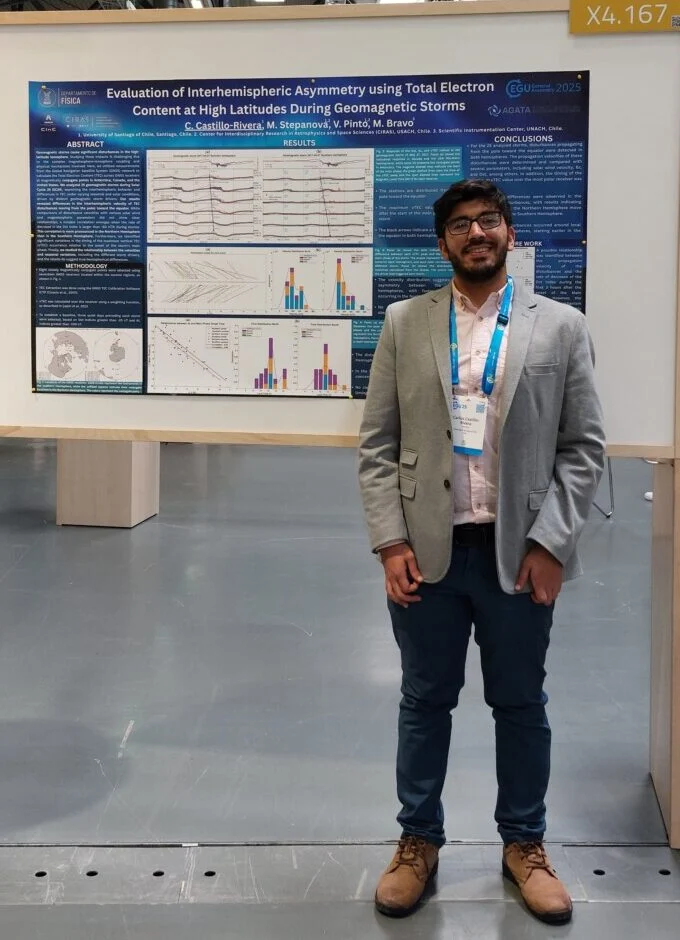
Carlos Castillo-Rivera presenting his poster during the EGU25
In your view, how could your findings contribute to future research developments or real-world applications in your field?
In my view, this work contributes to the understanding of magnetosphere–ionosphere coupling, which is a highly complex system that is still not fully understood. In addition, it may have relevant implications for GNSS performance, particularly in the Antarctic region, where ionospheric conditions can significantly affect signal propagation and positioning accuracy.
Was there any unexpected or especially rewarding experience during EGU that made the participation particularly meaningful for you?
The presentation was especially meaningful for me because I received many questions and very valuable feedback. I remember that my poster session was scheduled from 4 to 6 pm, but I continued discussing my work until around 7 pm. When I finally looked around, I realized that I was the last person in the room—everyone else had already left and all the posters had been taken down. It was a very rewarding experience because it showed me that there was genuine interest in my research, and it gave me the opportunity to engage in deeper scientific discussions than I had expected.
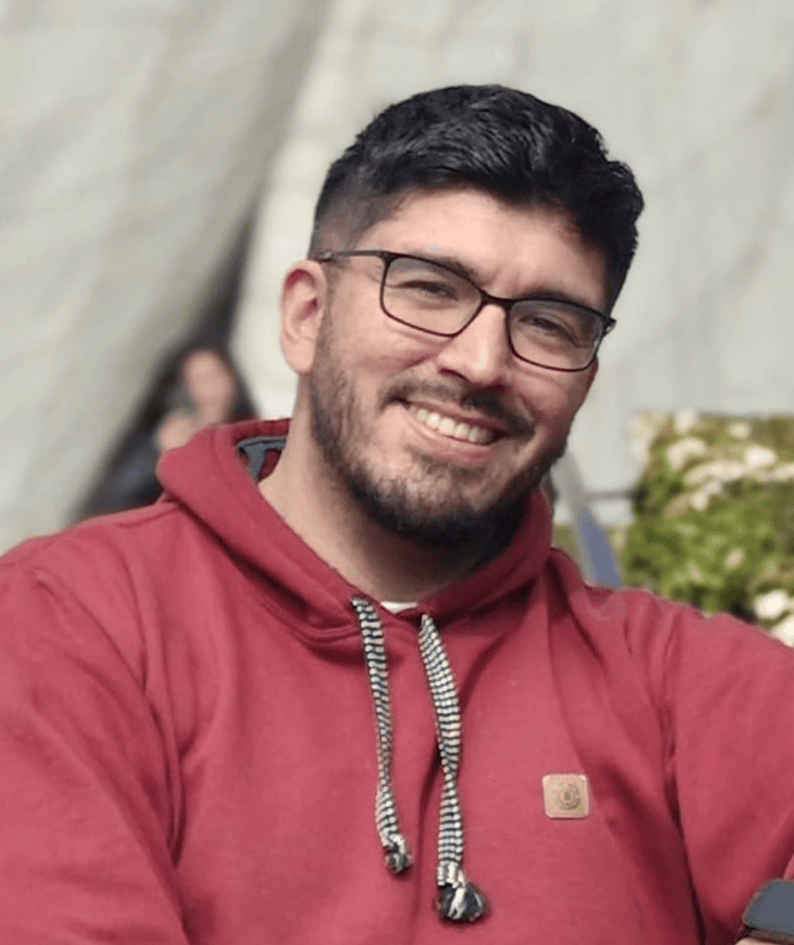
Carlos Castillo-Rivera is currently a PhD student at Sapienza Università di Roma, affiliated with the Istituto Nazionale di Geofisica e Vulcanologia (INGV), Italy. His research focuses on the recently discovered optical phenomenon known as Strong Thermal Emission Velocity Enhancement (STEVE), which is distinct from traditional auroral emissions. In particular, his work investigates ionospheric scintillations associated with STEVE in order to improve the understanding of its physical mechanisms. This is a multi-instrumental study that combines data from GNSS receivers, optical emission measurements, ionosondes, low-Earth-orbit satellites, radar observations, and numerical models.