Saturn is best known for its spectacular rings, but the rings are closely connected to the surrounding Saturnian environment. One of the sources of material in this system is the small icy moon Enceladus. During the Cassini mission, spectacular plumes were discovered erupting from fractures near Enceladus’ south pole, known as the tiger stripes. These plumes consist predominantly of water vapor, accounting for about 90% of the ejected mass, with the remaining ~10% in the form of icy dust grains. The plume material is continuously released into space, and because of Enceladus’ low escape velocity, much of it escapes the moon and spreads throughout Saturn’s magnetosphere.
Enceladus is estimated to release roughly 1028 water molecules s⁻¹, corresponding to about 300 kg s⁻¹ . Once released, these molecules can travel far beyond the moon itself. But where does all of this water eventually go? In our recent study, we investigate how water from Enceladus is transported through the Saturnian system, including how much reaches Saturn’s rings and atmosphere. Once water molecules are ejected from Enceladus at speeds of about 540 m s⁻¹, their motion is influenced by the gravity of both Enceladus and Saturn. After escaping from the moon, most of the molecules remain gravitationally bound to Saturn and gradually spread along Enceladus’ orbit, forming a large doughnut-shaped cloud known as a neutral torus.
As the molecules travel through Saturn’s magnetosphere, they are affected by several loss and transformation processes, including photodissociation, photoionization, electron-impact reactions, and charge exchange with magnetospheric ions. These processes transform the original H₂O into other water-group species, mainly OH and atomic O, while some neutrals are removed by ionization or by collisions with Saturn and its rings. Together, these processes control the lifetime and spatial distribution of H₂O, OH, and O throughout the Saturnian system.
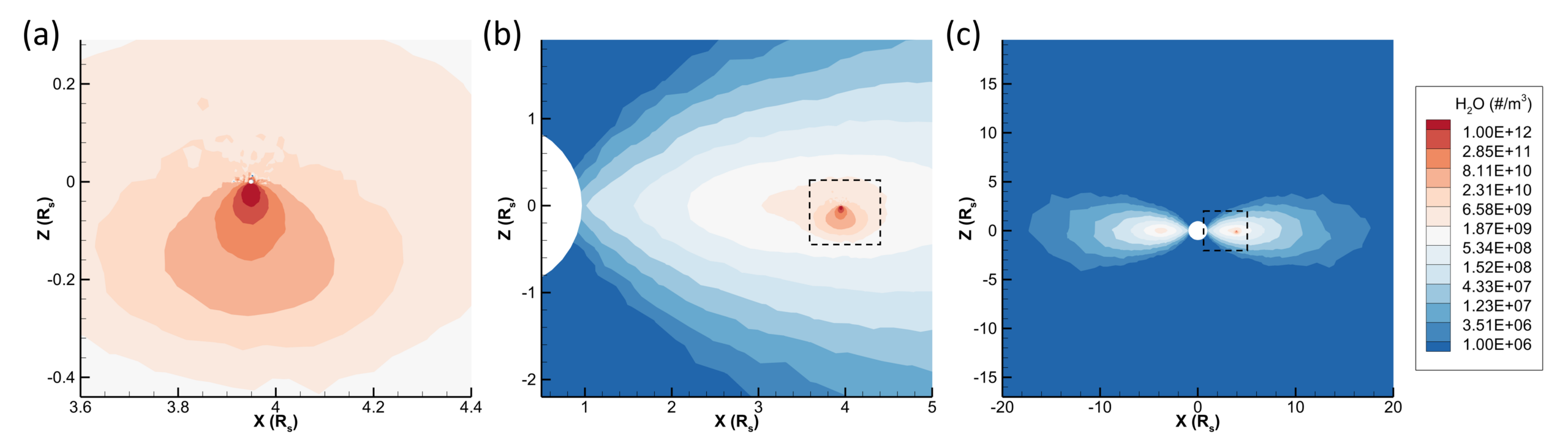
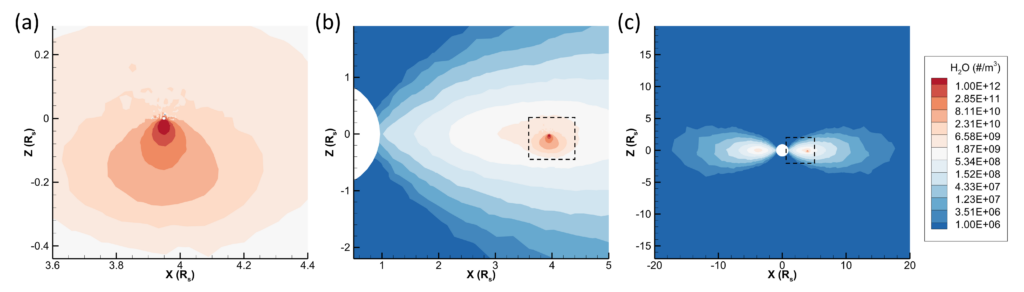
Figure 1. Result of H₂O distribution at three spatial scales: (a) the plume region near Enceladus’ south pole, (b) the local gas cloud around Enceladus, and (c) the large-scale neutral torus around Saturn.
In our recent work, we used the Direct Simulation Monte Carlo (DSMC) method to investigate the transport of water-group species from Enceladus through the Saturnian system. DSMC tracks a large number of simulated particles and treats their collisions statistically, making it particularly suitable for modeling the transition from the relatively dense plume near Enceladus to the much more tenuous environment farther away. Figure 1 shows how H₂O expands from the south-polar plume, spreads around Enceladus, and eventually forms an extended neutral torus around Saturn. The simulated neutral torus is also consistent with previous observations. Near Enceladus’ orbit, our model gives an H₂O column density of about 5×10¹⁷ molecules m-2, comparable to the 4×10¹⁷ molecules m-2 measured by Herschel and the 4.5×10¹⁷ molecules m-2 reported from JWST observations.
Implications for the Saturnian System
The water-group species spread through Saturn’s magnetosphere and eventually follow several different pathways. In our simulation, about 40.5% of the material is removed through ionization processes, while approximately 40.2% of the neutral H₂O, OH, and O eventually impacts Saturn’s main rings. A smaller fraction, about 4%, reaches Saturn’s atmosphere, while about 15% travels outward beyond the simulation domain.
A large fraction of the neutral material therefore ends up on Saturn’s rings. The contributions from H₂O, OH, and O correspond to about 16.4%, 10.6%, and 13.2% of the original Enceladus water source, respectively. The deposition is not evenly distributed across the rings. As shown in Figure 2, the impact flux is generally higher toward the outer part of the ring system, with a strong concentration near the outer edge of the A ring. This continuous deposition of water-group material may influence the surface and chemical environment of Saturn’s rings. In particular, the enhanced influx near the outer A ring provides an additional source of oxygen-bearing material and may contribute to the gradual renewal of icy ring-particle surfaces.
The supply of fresh water from Enceladus may also be relevant when considering the long-term evolution of the rings. Kempf et al. (2023) used the accumulation of non-icy material from micrometeoroid impacts to estimate a relatively young ring age of about few hundred million years. Our results suggest that, in addition to this external contamination, the continuous deposition of water from Enceladus may also need to be considered. As a rough estimate, if the present plume activity were maintained for about 1 million years, the deposited material would correspond to an average layer of about 0.03 mm over the A–C rings. Although this layer is thin, over long timescales such deposition may contribute to modifying the surface composition and appearance of the rings.
Some of the plume-derived material travels inward instead of reaching the rings. Our simulation gives a total neutral water-group influx of approximately 4.0×1026 molecules s⁻¹ into Saturn’s atmosphere. Most of this material reaches Saturn at low latitudes, with the impact flux concentrated within about 30° of latitude. Figure 3 shows that the influx peaks near the equatorial region and decreases toward higher latitudes. This external water supply can also influence Saturn’s ionosphere. Cassini radio-occultation measurements showed that the electron density and total electron content are lower near the equator and increase toward higher latitudes. Previous ionospheric studies have suggested that an influx of water and other neutral species at low latitudes can modify the ion chemistry, converting relatively long-lived ions into molecular ions that recombine more rapidly with electrons. This provides a possible mechanism for reducing the electron density in Saturn’s equatorial ionosphere. The low-latitude distribution found in our simulation is therefore consistent with the idea that Enceladus-derived water contributes to the observed structure of Saturn’s ionosphere.
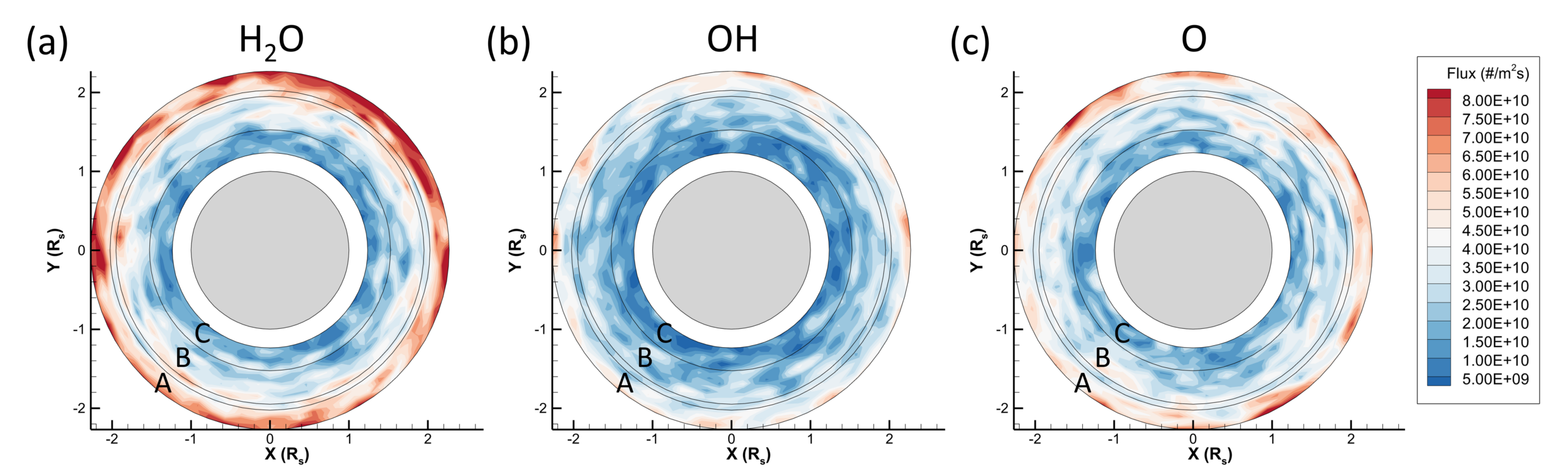
Figure 2. Impact flux distributions of water-group species onto Saturn’s main rings for (a) H₂O, (b) OH, and (c) O. The A, B, and C rings are marked in each panel.
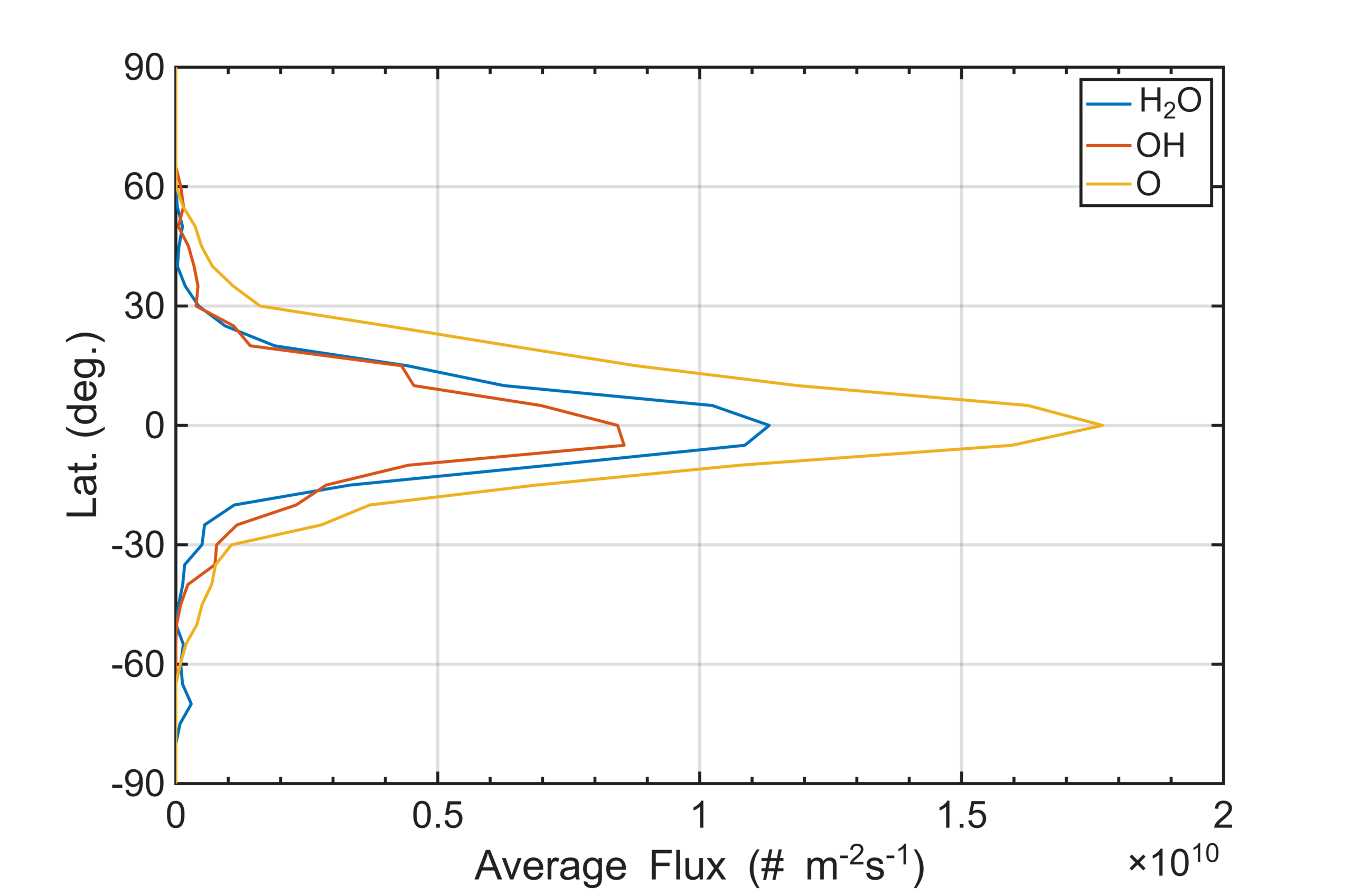
Figure 3. Latitudinal distribution of the mean impact flux of H₂O, OH, and O onto Saturn’s atmosphere. Most of the plume-derived neutral material reaches Saturn at low latitudes, with the largest flux near the equator.
Conclusion
Enceladus plays an important role far beyond its immediate surroundings. Water released from its south-polar plumes spreads throughout Saturn’s magnetosphere, forming a large neutral torus before being redistributed through a combination of chemical reactions and dynamical transport. Our results show that a substantial fraction of this material reaches Saturn’s main rings, while a smaller fraction is delivered to Saturn’s atmosphere. These fluxes may influence the surface and chemical environment of the rings and may also contribute to the structure of Saturn’s upper atmosphere and ionosphere. More broadly, the transport of water from Enceladus shows how closely connected the moon, rings, magnetosphere, and planet are within the Saturnian system.