I didn’t always know that I would become an oceanographer when I grew up, but I knew I would be doing ‘Science’. I was born and raised in Paris, France. While growing up, I was always interested in Science, from watching documentaries about the universe or nature, to attending science events at museums. While Science is very wide and encompasses many fields of research, I wasn’t too cl ...[Read More]
Career Progression – from Academia to Industry
During the summer Liam Brannigan contributed to an EGU careers workshop. Liam has had a diverse career, following his masters in maths at Edinburgh University he worked for several years as an investment consultant. In 2010 however, he fancied a change and embarked on a career in physical oceanography, completing his MSc at Bangor University and his PhD at the University of Oxford. A few post-docs ...[Read More]
Why you (yes, you!) should take part in a hackathon
Back in August, I attended Oceanhackweek 2020. As an oceanographer by trade and free software nerd by heart, I loved the idea of an event that combined the two. I looked forward to learning from other oceanographers and coders, and perhaps giving something back to the free software community. What is a hackweek/hackathon? If you have yet to dip your toes in the wonderful world of free software, th ...[Read More]
Satellite data for ocean reanalysis
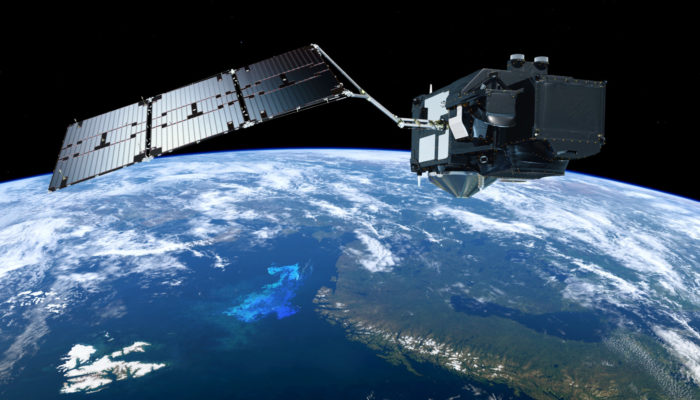
To understand the fundamental behaviour of the ocean, and any changes it’s undergoing, we need to know what the ocean is doing today, and on each day in the recent past. We can do this by creating reanalyses, which use data assimilation to combine state-of-the-art models with observations. The focus is often on ocean physics, but we also need to know about the marine ecosystem and carbon cycle. As ...[Read More]
Eurec4a: Tales from the Tropics
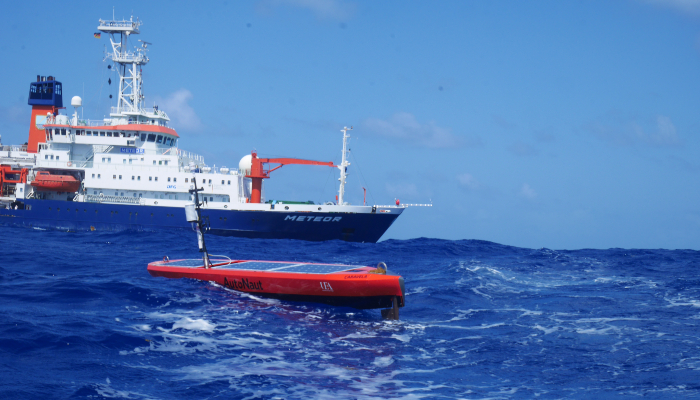
As many seagoing oceanographers find themselves on land for the foreseeable future, we’ve decided to share a tale of a research cruise to fill that ship-shaped void. Back in January 2020, four research vessels ventured out into the Tropical North Atlantic as part of the Eurec4a and ATOMIC campaigns. Eurec4a’s aim: to investigate the couplings between clouds, circulation and convection ...[Read More]
How Climate Models helped uncover the mechanisms behind the North Atlantic Warming Hole
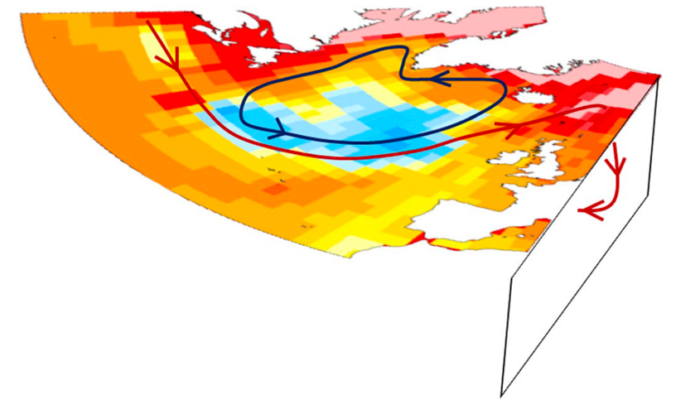
One of the only regions that have been observed to cool over the past century is the North Atlantic cold blob just south of Greenland. In our recent paper, we analyse the cold blob or “warming hole” and the processes that contribute to its creation and evolution. While sea surface temperature has been reliably observed, the underlying mechanisms of changing ocean circulation are only sparsely meas ...[Read More]
Research Cruise in times of COVID-19
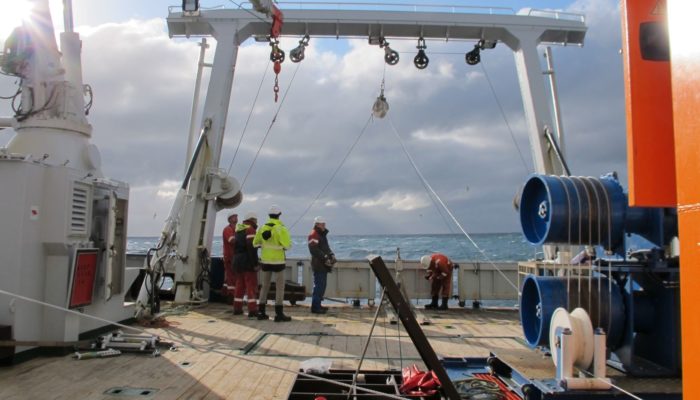
While the whole world is on stand-by we are in the middle of the North Atlantic and I want to explain you, why! During those crazy times cruise planning also slightly changes. The original plan was to depart and arrive back in Reykjavik which would have only included a short transit to our research area, the OSNAP East section. In the end we had a 9 day transit from our homeport Texel, Netherlands ...[Read More]
Why do mesoscale eddies disappear at ocean western boundaries?
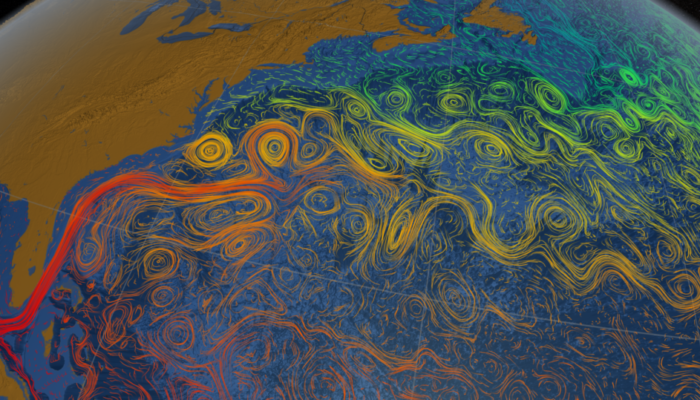
In the ocean, mesoscale eddies are everywhere. In fact, about 90% of the ocean’s kinetic energy is contained within these ubiquitous, ~100 km swirling vortices. We know how these eddies form, through a process known as baroclinic instability, where density surfaces are tilted too steeply and become unstable. What remains unclear however, is what happens to this energy when eddies die. This knowled ...[Read More]
OceanTalk with Frédéric Le Moigne
Frédéric Le Moigne has been awarded the 2020 Outstanding Early Career Scientist Award for the Division of Ocean Sciences and he agreed to be interviewed for our first blog post on the new Ocean Sciences blog. Frédéric can you tell us about your background and education? I was born and raised on the Atlantic coast, near the bay of Brest in Brittany, western France. In Brittany the ocean is an impor ...[Read More]
Welcome to the new Ocean Sciences Division blog!
Hello and welcome to the blog of the EGU Ocean Sciences Division! We are very excited to launch this new blog and finally join the EGU Blogsphere. Here we provide content of interest to the division and especially to the Early Career Scientists. This blog aims to spread our fascination for the ocean and share different aspects of ocean research. We will feature different types of blog articles, in ...[Read More]