
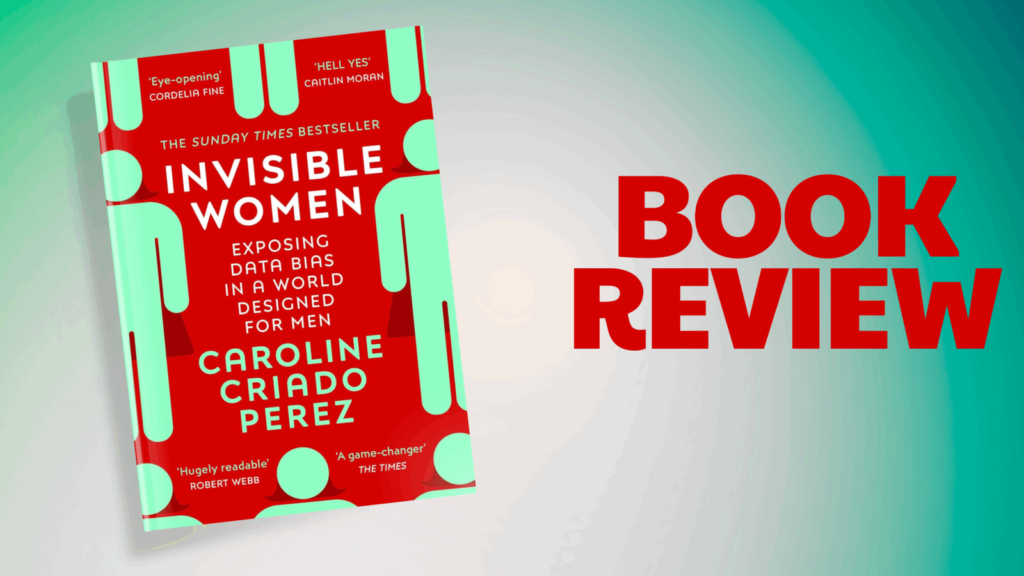
Our previous book recommendations were the nonfiction books Blue Machine – How the Ocean Shapes our World by Helen Czerski and Below the Edge of Darkness by Edith Widder as well as the thriller The Swarm by Frank Schätzing. This time, we are stepping away from the ocean. Our next book recommendation is “Invisible Women: Exposing Data Bias in a World Designed by Men” by Caroline Criado Perez, a nonfiction book published in 2019. While it is not an ocean-themed book, we recommend it nonetheless.
The book reveals how much of the world’s data is based on male norms, resulting in a world primarily designed for men. This causes a range of problems for women across areas like medical research, urban planning, safety, and opportunity. Perez supports her arguments with numerous studies, explores possible reasons behind these gaps, and offers approaches to closing them.
Here we highlight some of the everyday- as well as science-focused issues she raises.
A few familiar examples
Some of the more prominent examples have entered public debate: office temperatures set too low for women, the underdiagnosis of female autism, or the misdiagnosis of women experiencing heart attacks with atypical symptoms.
But Perez documents many more. Equipment — tools, uniforms, seatbelts — designed for male bodies leads to more accidents for women. Voice recognition systems perform worse on women’s voices, even though it should be easier to with womens voices because of speech speed and pronounciations. Public toilets consistently fail to account for women’s longer average bathroom time. Female scientists doing fieldwork in places like Alaska are forced to wear overalls designed for male bodies, putting them at risk of frostbite.
The underrepresentation of women in medical research is particularly alarming. Because women metabolize drugs differently than men, dosages calibrated on male subjects can lead to women being overdosed and some drugs that benefit men may be harmful or even fatal to women.
Bias against women in academia
Bias against female scientists starts early and society has made less progress than we might think:
🎨
“[F]ollowing decades of ‘draw a scientist’ studies where children overwhelmingly drew men, a recent ‘draw a scientist’ meta-analysis was celebrated across the media as showing that we were becoming less sexist. […] Where in the 1960s only 1% of children drew female scientists, 28% do now.”
Nearly three in four children still picture a scientist as male. These biases get encoded into technology too. Perez gives the example of someone searching for ‘computer programmer’ on a program trained on a dataset that associates that term more closely with a man than a woman — the algorithm could deem a male programmer’s website more relevant than a female programmer’s. With the Guardian reporting that 72% of US CVs never reach human eyes, the consequences of such bias are substantial.
The disadvantages add up for women pursuing academic careers. Unpaid domestic work is a good starting point:
🍳
“A 2010 US study […] found that female scientists do 54% of the cooking, cleaning and laundry in their household, adding more than ten hours to their nearly sixty-hour work week, while men’s contribution (28%) adds only half that time.”
This unequal burden has measurable career consequences:
🎓
“Married mothers with young children are 35% less likely than married fathers of young children to get tenure-track jobs, […] and among tenured faculty 70% of men are married with children compared to 44% of women.”
The disadvantage extends to recognition:
📄
“[S]everal studies have found that women are systematically cited less than men. […] Over the past twenty years, men have self-cited 70% more than women[…] — and women tend to cite other women more than men do.”
And even informal evaluations reflect this bias:
⭐
“An analysis […] of 14 million reviews on the website RateMyProfessors.com found that female professors are more likely to be ‘mean’, ‘harsh’, ‘unfair’, ‘strict’ and ‘annoying’. [… M]ale professors are more likely to be described as ‘brilliant’, ‘intelligent’, ‘smart’ and a ‘genius’.”
Physical barriers persist too. Female fieldwork scientists in places like Alaska are forced to wear overalls designed for male bodies, putting them at risk of frostbite.
Perez also makes the economic case: closing the gender data gap isn’t just the right thing to do — it’s a sound investment. Invisible Women is dense with information and covers an important topic. We recommend it highly.