Looking for your next read? 📚
Our previous book recommendations took us through ocean physics in Blue Machine – How the Ocean Shapes Our World, bioluminescence and deep-sea exploration in Below the Edge of Darkness, and ocean-inspired science fiction in The Swarm. Most recently, we ventured beyond the ocean with Invisible Women, exploring data bias and what it means for female scientists.
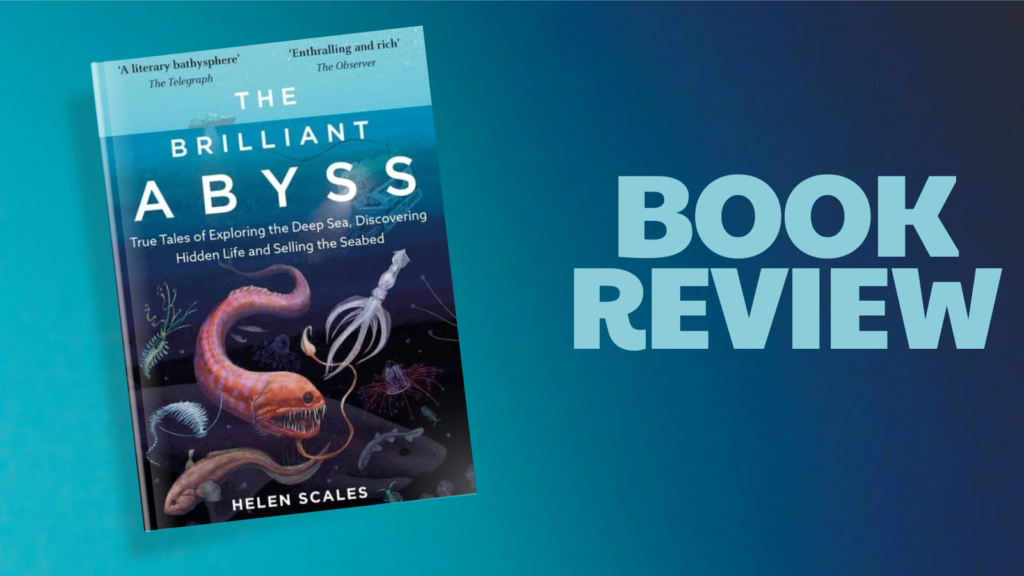
This time, we are diving back into the ocean and all the way down to the seafloor with Helen Scales’ The Brilliant Abyss: True Tales of Exploring the Deep Sea, Discovering Hidden Life and Selling the Seabed.
In The Brilliant Abyss, the author Helen Scales paints a beautiful picture of the deep sea landscape: she writes about hydrothermal vents, seamounts, cold seeps and the extraordinary animals that inhabit them – whole octopus nurseries, hairy yeti crabs, scaly-foot snails and bone eating whales. The landscapes themselves made me want to dive into the darkness and visit and see these places with my own eyes. You should look up Loki’s Castle, a field of hydrothermal vents in the Arctic, or the wonderfully named Forest of the Weird, a community of deep-sea sponges and corals.
The author shows that the deep sea is not a desert devoid of life, but a place full of chemical oases. She shows us a world full of strange life possible through e.g. whale falls, hydrothermal vents and marine snow providing nutrition for many organisms. Bone-eating worms feast on whale carcasses, yeti crabs farm and eat bacteria at hydrothermal vents and deep-sea octopuses rely on nodules to build their nurseries. Did you know that there are more species of deep-sea corals than warm-water corals?
The book made me fall in love with ocean science all over again.
The author also shows that understanding the deep sea is not simply a matter of satisfying our curiosity. Its organisms produce unusual chemicals that may be extremely valuable to humanity e.g. compounds from a deep-sea sponge have contributed to drugs used to fight cancer. Marine natural products show more chemical novelty than land-based life forms. The chemical diversity of deep-sea organisms could lead to more discoveries, including potentially much-needed new antibiotics (as the last new antibiotics class approved for clinical use was discovered more than 30 years ago!).
-
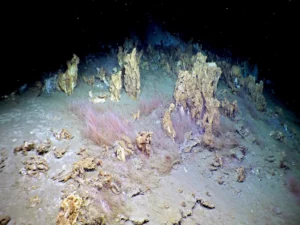
- View of both inactive and active hydrothermal chimneys and associated life at the Barite Field (2400 m depth). Credit: Thibaut Barreyre (distributed via imaggeo.egu.eu, CC BY-ND 3.0)
-
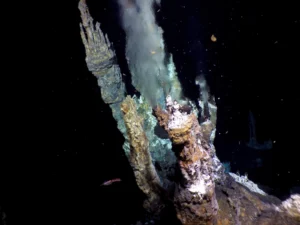
- View of high-temperature fluid venting chimneys on the top of a hydrothermal mound at the Jan Mayen Vent Fields (650 m depth). Credit: Thibaut Barreyre (distributed via imaggeo.egu.eu, CC BY-ND 3.0)
Unfortunately, the deep sea is already threatened and being damaged by overfishing, deep-sea trawling, pollution and the prospect of seabed mining. Orange roughy, for example, can live for hundreds of years and mature only after 20 years, yet overfishing depleted populations within only 15 years. Deep-sea trawlers leave terrifying scars across landscapes that took millennia to form, destroying fragile ecosystems in the process.
The seabed has also been treated as an eternal junkyard: microplastics, oil pollution and mid-century weapons and nuclear waste are being dumped in the deep sea. And now humanity is considering mining polymetallic nodules and other mineral deposits from ecosystems we have barely begun to understand. Helen Scales warns us and explains the danger, consequence and costs of mining and what alternatives exist.
All in all, The Brilliant Abyss is a beautifully written book that made me want to see the deep sea with my own eyes, but also left me with sadness and anger at how much of this astonishing world we are already damaging and how much could be lost through humanity’s actions before we have even discovered it. Have a read! 🐙