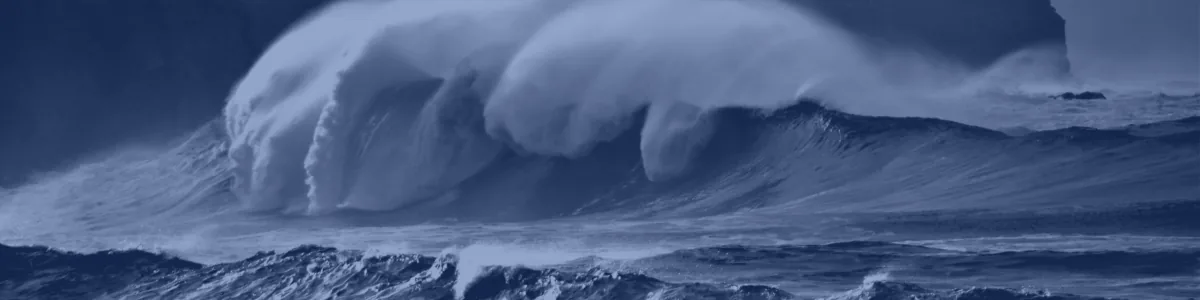
Tinted detail of a photo: Huge breaking wave with spray streaming back from its crest in front of dark cliffs topped by a house and telegraph poles, under a gloomy sky.
OS
Ocean Sciences

About

The Ocean Sciences (OS) Division of the European Geosciences Union (EGU) has the major objective to provide an attractive and productive environment for scientists from Europe and all over the world to gain progress in the various ocean science disciplines and have beneficial interactions with other fields of geosciences.

The European Geosciences Union (EGU) is the leading organisation for Earth, planetary and space science research in Europe. With partner organisations worldwide, EGU fosters fundamental geoscience research, alongside applied research that addresses key societal and environmental challenges. EGU’s vision is to realise a sustainable and just future for humanity and for the planet.

To submit a post, please contact  Jacqueline Behncke at jacqueline.behncke@hereon.de, Maurie Keppens at maurie.keppens@vliz.be, or David Curbelo at david.curbelo@ifremer.fr.

This blog serves as a platform for the ocean science community to share news, events, and activities, as well as updates on the latest research being undertaken in ocean science. Everybody is invited to contribute: please contact the editors below.

Editors

Contact: blog-os@egu.eu

  • Avatar photo
    clarejlewis
  • Avatar photo
    davidc
  • Avatar photo
    Jacqueline Behncke is an ocean biogeochemist based at GEOMAR Helmholtz Centre for Ocean Research Kiel, Germany. She investigates the ocean carbon sink by integrating observations, machine learning, and numerical model simulations to improve understanding and monitoring of marine carbon cycling.
  • Avatar photo
    Jenna is currently a postdoctoral researcher at GEOMAR in Kiel, Germany. Her overall research interest is to better understand what regulates phytoplankton abundance, ecology, physiology and overall marine primary productivity in the ocean. To do so, she uses a combination of fieldwork, phytoplankton culturing experiments and remote sensing. She is also a member of the Postdoc Representative team at GEOMAR and was involved in a few climate policy side projects.
  • Avatar photo
    Maurie Keppens is a PhD candidate at Ghent University and the Flanders Marine Institute (VLIZ), Belgium. Her research explores how the ocean carbon cycle responds to climate extremes, including marine heatwaves. By combining field measurements, satellite observations, and machine learning, she develops high-resolution reconstructions of carbon dynamics to better understand how extreme events shape air–sea CO₂ exchange.
  • Avatar photo
    Sankar Prasad Lahiri
    Sankar Prasad Lahiri is a climate scientist whose research focuses on ocean–atmosphere interactions, monsoon dynamics, large-scale climate teleconnections, and climate model biases. His work combines observations, reanalysis, and numerical models to understand the physical processes governing climate variability and improve climate predictions.
  • Avatar photo
    taniapereira

Disclaimer

The opinions expressed in the Ocean Sciences blog are those of the authors, whose views may differ from those of the European Geosciences Union.