CR
Cryospheric Sciences

Antarctic ice sheet

What Lies Beneath an Ice Shelf

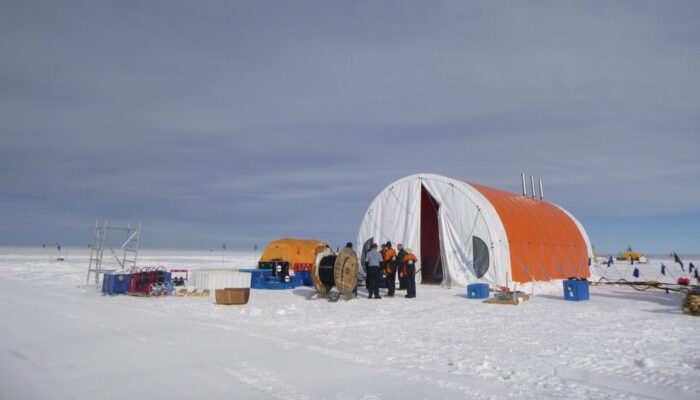
an orange, rugged large tent is in an arctic landscape. researchers in cold-eather gear gather at the mouth of the tent.

Beneath Antarctica’s largest ice shelf lies a hidden ocean—dark, cold, and almost impossible to reach. Scientists drilled through hundreds of metres of ice to access it, revealing a world that plays a crucial role in how ice shelves melt. Years later, we had the chance to explore this unseen environment—not in the field, but through the data that the expedition left behind. Antarctica’s ice shelf ...[Read More]

Recipe to quantify calibration errors in a time-dependent ice sheet model

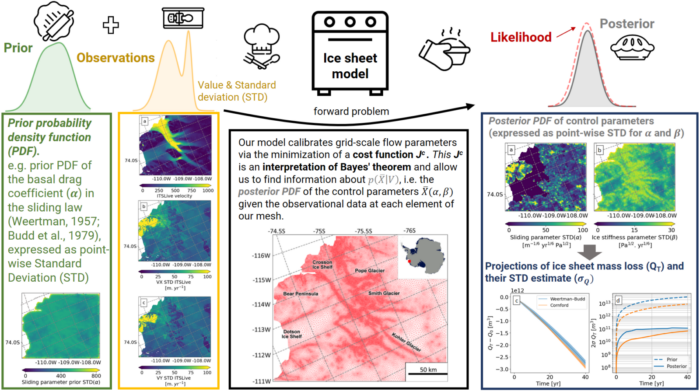
Recipe to quantify calibration errors in a time-dependent ice sheet model

Ice sheet models are awesome tools that help us learn and predict the fate of ice sheets under human-induced climate change. However, all models have errors. What types of uncertainties exist in an ice sheet model and how can we quantify some of them efficiently? Check out our recipe to quantify one type of uncertainty in sea level rise projections: The model calibration error. Not a numerical mod ...[Read More]

Did you know … that liquid water can be held within a glacier?

Hidden below the surface of some glaciers, liquid water can be found within what is called the firn layer – the upper layer of a glacier where snow compacts into glacier ice. Liquid water may persist there for up to many years, forming what scientists call “firn aquifers.” While observations of seasonal firn aquifers have existed since the mid to late 1900s in several mountain glaciers, recent stu ...[Read More]

Hysteresis For Dummies – Why history matters

Hysteresis For Dummies – Why history matters

Perhaps you have stumbled upon the word ‘hysteresis’ before, for example in connection with the stability behavior of our Earth’s large ice sheets and their long-term effect on global sea-level rise, or the long-term stability of the Atlantic Meridional Overturning Circulation, or even in another context outside earth/climate science. Or you might have come across this term during your studies, bu ...[Read More]

How do the ups and downs of the solid Earth influence the future of the West Antarctic ice sheet?

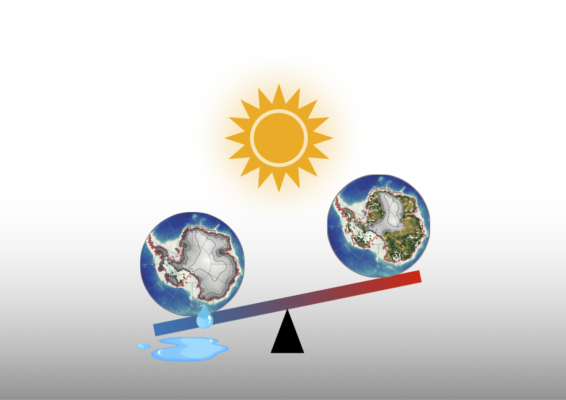
When the Antarctic ice sheet loses mass, the pressure it exerts on the underlying solid Earth decreases. As the ice sheet becomes less heavy, the Earth’s surface is not pressed down as much as before and therefore slowly rises up. In some regions, this rebound process is much faster than previously thought and could stabilise areas of unstable ice retreat. How come? Keep reading to figure it out… ...[Read More]

©LEt’sGO to Antarctica !

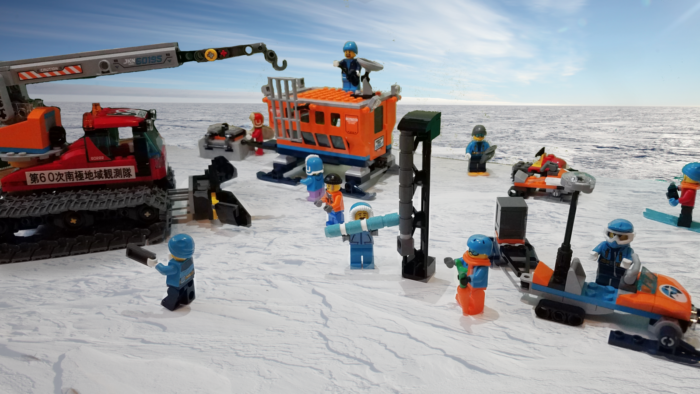
©LEt’sGO to Antarctica !

With the current situation, polar fieldwork might be/have been cancelled and we have a suggestion to remedy your field-blues… Why not use ©LEGO to pretend you’re back in the field with the added bonus that you get to be in the warmth and comfort of your home! Here, we’ve re-enacted radar fieldwork that took place a year and a half ago in Antarctica… But first, let’s start with some backgroun ...[Read More]

Radiocarbon rocks! – How rocks can tell us about the history of an ice sheet…

Radiocarbon rocks! – How rocks can tell us about the history of an ice sheet…

When most people hear the phrase “radiocarbon dating”, they think of measuring carbon to date organic material. But did you know that carbon is also produced within rocks, and that we can use it to learn about the past behaviour of a glacier? About 20,000 years ago it was colder and large parts of the continents were covered by ice. But what did Antarctica – the largest ice mass ...[Read More]

Did you know? – Ocean bathymetry can control Antarctic mass loss!

Ice shelves (the floating parts of the Antarctic ice sheet) play a fundamental role in the stability of the Antarctic ice sheet (see this post) and, therefore, its contribution to global sea-level rise. They lose mass primarily through melting at their bases, which are in contact with the ocean. This thins them and makes them more vulnerable, reducing their stabilising potential and causing more i ...[Read More]

Image of the Week – Delaying the flood with glacial geoengineering

As the climate is currently warming, many countries and cities are preparing to cope with one of its major impacts, namely sea-level rise. Up to now, the mitigation of climate change has mainly focused on the reduction of greenhouse gas emissions. Large-scale geoengineering has also been proposed to remove carbon from the atmosphere or inject aerosols into the stratosphere to limit the rise in tem ...[Read More]

Image of the Week — Quantifying Antarctica’s ice loss

It is this time of the year, where any news outlet is full of tips on how to lose weight rapidly to  become beach-body ready. According to the media avalanche following the publication of the ice sheet mass balance inter-comparison exercise (IMBIE) team’s Nature paper, Antarctica is the biggest loser out there. In this Image of the Week, we explain how the international team managed to weight Anta ...[Read More]