What will happen to the Greenland ice sheet in the future?
To predict the shrinkage of the ice sheet that is caused by melting, we usually run different climate models, but unfortunately, they are computationally expensive. In our recent paper, we show a new fast machine learning-based method that allows us to skip one of the most expensive steps in projecting Greenland’s sea-level rise contribution and enables us to downscale a large amount of global climate model output. This allows us run large ensemble simulations which can ultimately decrease uncertainties.
From coarse climate models to high-resolution ice sheet modelling
Global climate models provide projections of how the climate may change in the future, but these models and their output usually have a relatively coarse spatial resolution, typically around 50–100 km. However, ice-sheet modelling needs much higher resolutions of climate information. Specifically, we need the surface temperature and mass balance at surface from the climate model on a resolution of around 1–16 km to obtain reliable estimates of how much ice will melt. This finer resolution is necessary to resolve the small-scale spatial variability that substantially influences the ice sheet, particularly along the margins, where the majority of melt occurs.
One way to generate such high-resolution fields is to take the low-resolution climate model output and feed it into a specialized regional climate model. These models simulate the climate over a smaller domain, such as Greenland, and produce high-resolution output. This output can then be used by ice-sheet models to estimate the future evolution of the ice sheet. However, this approach has several limitations. One problem is that the model chain is often “offline”: the surface mass balance is calculated independently of changes in the ice sheet itself. This matters because the geometry of the ice sheet can strongly influence the surface mass balance. As the ice sheet thins and its elevation decreases, surface temperatures rise locally, leading to increased melting, a process known as the melt-elevation feedback. A second problem is that regional climate models are computationally expensive. They simulate the climate at high spatial resolution and often use sub-daily time steps, which requires substantial computational resources.
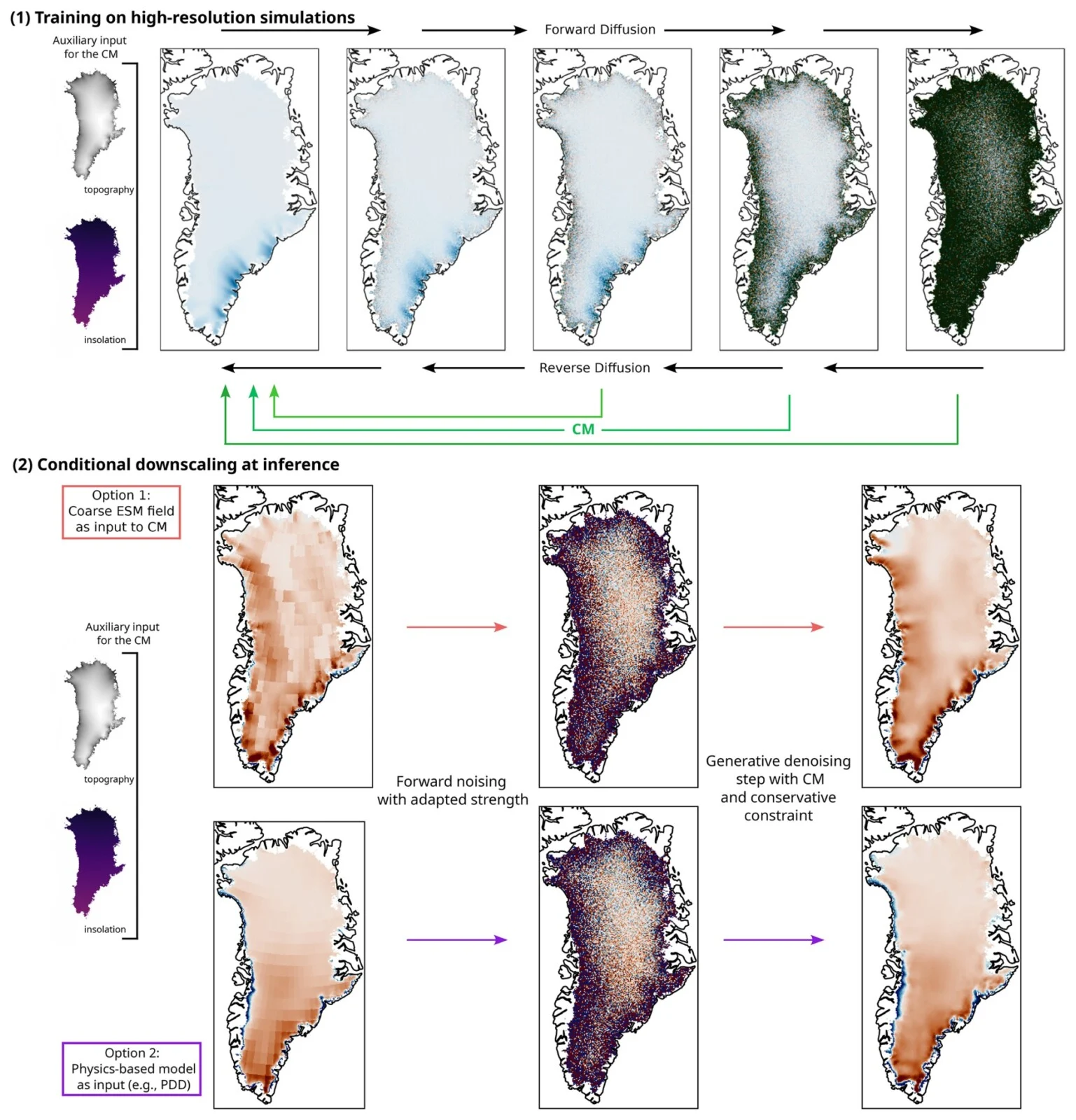
Figure 1. Workflow of our method. The model is trained on high-resolution climate data and learns to remove artificial noise from low-resolution input, thereby filling in the missing spatial details. [Credit: Bochow et al., 2026]
How can machine learning help us?
In our new paper, we propose an alternative approach to tackle the second problem: generative-modelling-based downscaling, which is inspired by AI-based image generation methods that have emerged in recent years. The basic idea behind generative-modelling-based downscaling is to add artificial noise to the coarse climate model output (input for our model) and let the generative model remove the noise (denoise) again while filling in fine spatial details, that it learned beforehand from high-resolution regional climate models (Figure 1).
But why do we add noise at all? The reason is that downscaling is not a one-to-one translation problem. The same coarse climate pattern can correspond to many different fine-scale outcomes. A model that is asked to predict only one fine-resolution map often learns an average of all these possibilities, which can look unrealistically smooth. By adding noise and training the model to remove it again, we give it a way to generate one realistic fine-scale realization among many possible ones. The denoising process guides the model to keep the large-scale climate information from the coarse model while filling in small-scale details that resemble those learned from high-resolution regional climate simulations.
Specifically, we train a so-called consistency model that directly learns a mapping from a noised image to a clean image. In theory, only one evaluation of the model is needed and it is therefore extremely fast. This offers an advantage over other approaches such as diffusion models, which often need several hundred or thousand evaluations to generate realistic output. By deciding how much noise is added to the coarse input, it is possible to control how much pairing or similarity between in- and output there is. In other words, the noise is a knob that controls how much information we want to retain from the coarse fields. When we add minimal noise, the output stays very close to the original coarse climate data, keeping those large patterns intact but missing the small-scale details we care about. Adding a lot of noise gives minimal pairing and the generative model basically does not retain any information from the coarse input. By testing different noise levels, it is possible to determine an ‘optimal’ noising strength that fills in fine details while still having reasonable pairing with the input fields. This balance is important because we do not want the model to simply create realistic-looking fields. We want it to generate fields that are both realistic and physically consistent with the large-scale climate signal from the original climate model.
Once trained, our method can generate high-resolution climate fields much faster than a regional climate model. This makes it possible to explore more climate scenarios, more model combinations, or larger ensembles of projections and helps us to better estimate uncertainties related to the sea-level rise contribution of the Greenland ice sheet.
The future of ice sheet modelling
More and more data-driven and machine-learning methods are explored in the context of ice sheet modelling but process-based models will likely remain the backbone of the field in the near future. It is also important to note, that most machine learning based methods need some training data to learn from, and these are usually coming from process-based models. Machine learning, therefore, will not make classical climate modelling obsolete but rather is a complementary tool.
Read the paper
Bochow, N., Hess, P., and Robinson, A.: Physics-constrained generative machine learning-based high-resolution downscaling of Greenland’s surface mass balance and surface temperature, The Cryosphere, 20, 1841–1866, https://doi.org/10.5194/tc-20-1841-2026, 2026.
References
- Fox-Kemper et al., 2021. Ocean, Cryosphere and Sea Level Change. In Climate Change 2021: The Physical Science Basis. Contribution of Working Group I to the Sixth Assessment Report of the Intergovernmental Panel on Climate Change.
- Morlighem et al., 2017. BedMachine v3: Complete Bed Topography and Ocean Bathymetry Mapping of Greenland From Multibeam Echo Sounding Combined With Mass Conservation.
- Goelzer et al., 2020. The future sea-level contribution of the Greenland ice sheet: a multi-model ensemble study of ISMIP6.
- Feenstra et al., 2025. Role of elevation feedbacks and ice sheet–climate interactions on future Greenland ice sheet melt.
- Hess et al., 2025. Fast, scale-adaptive and uncertainty-aware downscaling of Earth system model fields with generative machine learning.