Beneath Antarctica’s largest ice shelf lies a hidden ocean—dark, cold, and almost impossible to reach. Scientists drilled through hundreds of metres of ice to access it, revealing a world that plays a crucial role in how ice shelves melt. Years later, we had the chance to explore this unseen environment—not in the field, but through the data that the expedition left behind.
Antarctica’s ice shelf cavities – the hidden underside
Antarctica is fringed by ice shelves, formed where ice from the continent flows outward and begins to float on top of the ocean. Some extend only a few tens of kilometers, while others rival the size of major countries. Together, they act as a buffer, slowing the flow of the grounded ice sheet behind them—which holds enough ice to raise global sea levels by many meters.
Beneath these shelves lies a hidden ocean cavity, where relatively warm seawater can circulate and interact with the ice above. This interaction plays a key role in controlling how quickly ice shelves melt, and how effectively they can continue to hold back the ice sheet.
Despite their importance, these environments remain among the least observed parts of the Earth system. Direct measurements from beneath ice shelves are rare, leaving much of this hidden ocean largely unexplored.
Drilling into the unknown
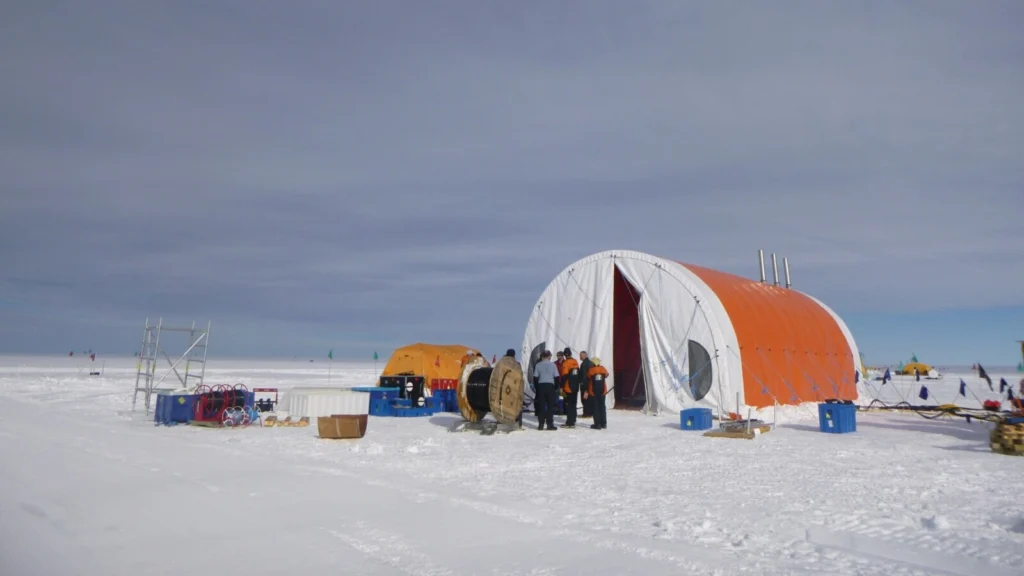
Accessing the ocean beneath an ice shelf is not a small task. At a site on the central Ross Ice Shelf, a team of scientists and engineers used hot-water drilling to melt a narrow borehole—only about 30 cm in diameter—through hundreds of metres of ice.
Through this small opening, they deployed instruments into the ocean below, creating a rare window into one of the most inaccessible environments on Earth. Despite its modest size, this borehole enabled years of continuous measurements beneath the ice.
This site, known as HWD2 (Hot Water Drill site number 2), collected ocean data between 2018 and 2022, capturing how temperature, salinity, and currents change in this hidden environment. Because the site moves with the ice shelf at roughly 550 metres per year, the instruments also drifted with the ice over the course of the measurements.
Figure 1: Instrument deployment through a hot-water–drilled borehole at the HWD2 site on the central Ross Ice Shelf, Antarctica, enabling access to the ocean beneath the ice. [Credit: Craig Stevens/ESNZ]
A glimpse beneath the ice
What does the underside of an ice shelf actually look like?
Through the HWD2 borehole, a camera was lowered into the ocean below, capturing a rare glimpse of this hidden environment. Rather than a smooth, static boundary, the ice–ocean interface appears alive—constantly changing over time.
The footage reveals delicate, plate-like ice crystals forming directly from seawater and accumulating beneath the ice shelf. This process, known as frazil ice formation, shows that the ocean is not only capable of melting the ice from below, but in some places, actively building it. Imagery from this footage has been used in scientific studies to document thin layers of ice crystals at the ice base, providing insight into conditions at the ice–ocean interface.
But while the camera captures these processes in action, it only provides a snapshot. To understand how and why this environment changes over time, we need to look beyond the video.
Figure 2: Camera footage from the HWD2 borehole beneath the central Ross Ice Shelf, Antarctica, showing ice crystals forming at the base of the ice shelf. [Credit: Craig Stevens/ESNZ]
From snapshots to timeseries
This is where the long-term measurements from HWD2 come in. Instruments moored to the ice shelf recorded ocean conditions continuously between 2018 and 2022, including temperature, salinity, and ocean currents. These measurements captured variability across seasons and years, revealing that the ocean beneath the ice shelf is structured and connected, with variability shaped by processes both within the cavity and far beyond it.
One striking result is that conditions beneath the central Ross Ice Shelf are connected to the open ocean hundreds of kilometers away. Our analysis shows that variability within the cavity aligns with changes in the Ross Ice Shelf Polynya—a wind-driven, ice-free region where dense, salty water forms, as shown in our recent study. This connection highlights how distant processes can influence the ocean beneath the ice shelf.
The data also reveal a layered structure within the seawater that fills the cavity, which persists over time but shifts with the seasons, with temperatures often dropping below the local freezing point. First observed decades ago, this structure remains a defining feature today, pointing to a consistent driving mechanism that redistributes heat and freshwater beneath the ice shelf.
Interpreting the mooring data is, in many ways, an expedition of a different kind—one that happens behind a computer screen. By reconstructing variability across seasons and years, we can uncover the hidden dynamics of an environment that remains almost entirely out of reach.
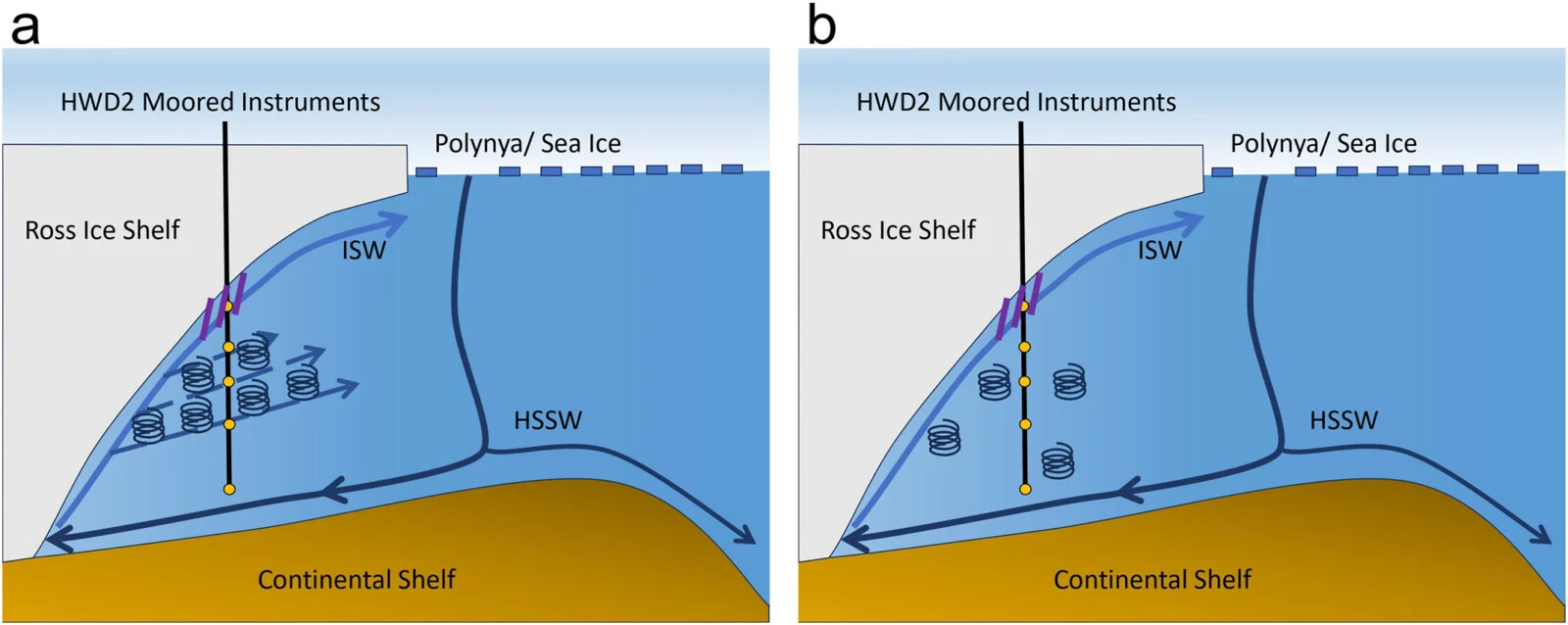
Figure 3: Schematic of ocean circulation beneath the central Ross Ice Shelf, highlighting the connection between the cavity and the open ocean (solid blue lines). Panels a and b illustrate seasonal differences in the layered structure within the cavity. The dark blue spiral symbols represent ocean eddies, swirling motions in the water that can help drive seasonal changes in the cavity structure. Variability in water masses such as Ice Shelf Water (ISW) and High Salinity Shelf Water (HSSW) reflects processes both within the cavity and in the distant Ross Ice Shelf Polynya. [Credit: Reproduced from Xiahou et al. (2026).]
From beneath the ice to the wider ocean
The ocean beneath ice shelves is not isolated—it is connected to the wider ocean system. Our results show that processes far from the ice shelf, such as sea ice formation in the Ross Ice Shelf Polynya, can influence how rapidly the base of the ice shelf melts. This connection provides a pathway through which changes in the open ocean can reach the ice. As sea ice patterns and ocean conditions shift, so too may the balance of heat beneath ice shelves.
These changes extend beyond Antarctica. Over time, shifts in ice shelves and the Southern Ocean can influence global ocean circulation, marine ecosystems, and sea level. Ice shelves may seem remote, but they are part of a connected Earth system. By uncovering how the ocean beneath them behaves, studies like ours help understand not only what is happening under the ice—but what it could mean far beyond it.
Further Reading
- Beneath Antarctica’s largest ice shelf, a hidden ocean is revealing its secrets
- A Long-Term Look Beneath an Antarctic Ice Shelf
Edited by Mirjam Paasch and Mack Baysinger