
Your research deserves recognition beyond your peer-reviewed paper. While academia is often considered the hallmark for knowledge generation, the dissemination of your work should take further steps so that your scientific research can reach the people it is meant to help. Because your audience may not always be experts in your field and may require …[Read More]
Latest posts
Cryospheric Sciences
Cryo Comm – Explaining ice core science with “cool” educational videos
Mastering the art of science communication is becoming more and more important, especially in the realm of climate science! Training and practice can really help PhD students acquire this skill. With this in mind, the DEEPICE project, a training network of 15 PhD students, has developed a wide range of activities to train the DEEPICE …[Read More]
Geochemistry, Mineralogy, Petrology & Volcanology
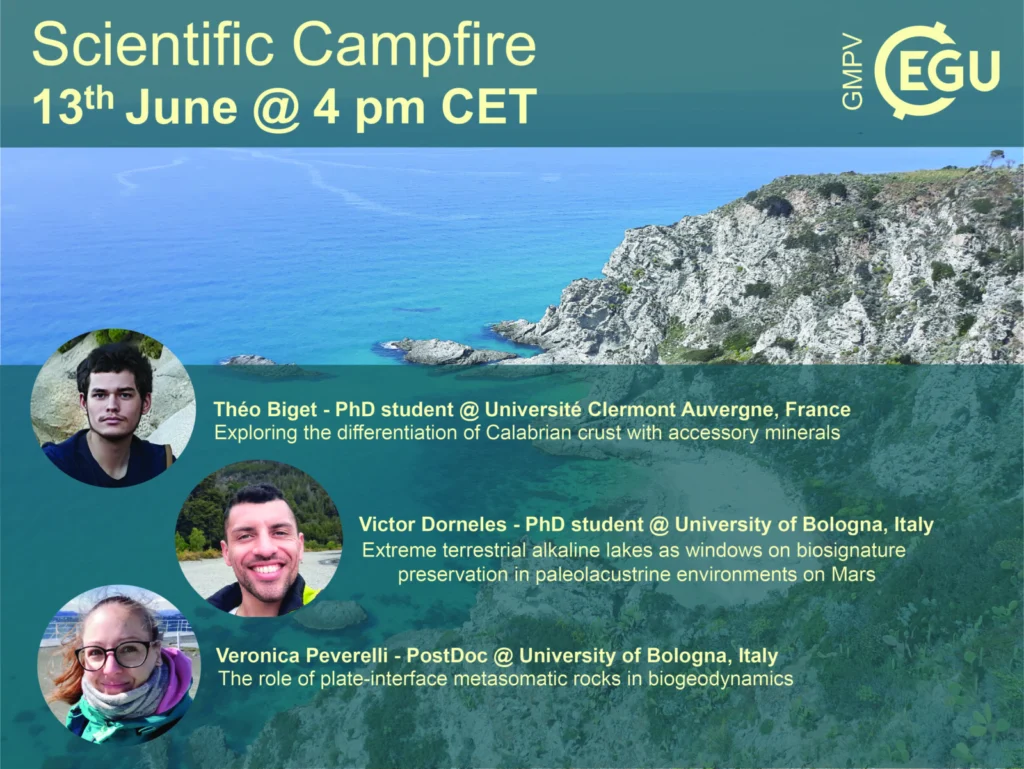
GMPV Campfires – Call for Speakers
GMPV Campfires – Call for Speakers The EGU Geochemistry, Mineralogy, Petrology and Volcanology ECS committee are currently looking for early career scientists to present at and attend our monthly online talk series (EGU Campfires). The EGU Campfires are a free one-hour online seminar consisting of three to four 10-12-minute talks. These quick-fire presentations give …[Read More]
Geodynamics
Biogeodynamics – Let’s model the entire world!
All models are wrong, but some are useful – we all have heard this quote. But it raises several questions (including but not limited to) – What would a model of the entire world look like? Can you couple geodynamical models with climate and biological evolution models? Would these models be useful? In this week’s …[Read More]
GeoLog
The climate crisis: about debates, privilege and the need for action
In this blog post I am expanding on the blog post about the third EGU Climate Great Debate and its survey results on what you thought we can do as scientists. After conducting an interview with Maien Sachisthal, an active member of Scientist Rebellion, I reflected on the Great Debate and scientists within society, sharing …[Read More]
Hydrological Sciences
EGU24 – A Hydrologist’s Look Back
With almost 21,000 participants, the 2024 EGU General Assembly, held from 14-19 April, in Vienna and online, was the biggest one yet. For hydrologists, there were hundreds of sessions to enjoy, networking events to join, short courses to learn from, and colleagues to meet. Here’s a look back at the highlights! A look back at …[Read More]
Tectonics and Structural Geology
TS Must-Read – Wang et al. (2012) Deformation cycles of subduction earthquakes in a viscoelastic Earth
Large subduction earthquakes cause perturbation of the subduction system, whose response depends on its rheological characteristics. The evolution of the subduction system from earthquake to earthquake is defined as subduction earthquake cycle (SEC), and is characterised by three main processes that operate over decades/centuries: postseismic afterslip, viscoelastic mantle relaxation, and fault relocking. Despite the precise …[Read More]
GeoLog
GeoPolicy: 10 things that you can do to start engaging with policymaking today
This months GeoPolicy blog post outlines 10 things that you can do to start engaging with policy today! This list was originally created with the help of the EGU’s Science for Policy Working Group and other Science-Policy experts who attending EGU24. While the below list isn’t extensive, it does provide a good overview of the …[Read More]
Geodesy
EGU General Assembly 2024 — A Brief Recap of our Activities
Thank you all for the great EGU General Assembly (GA) this year! In case you missed EGU24 or some of the events we organised, here is a little recap. So you can stop wondering how it went and get an idea of what to look out for next year. In the Geodesy Divison, we had …[Read More]
Hydrological Sciences
Do-It-Yourself (DIY) in Geoscience Miniseries – Part 3: Getting it all together – Cables, Breadboards and Circuit Boards
You got all your components for your project, so now it’s all about getting it all together. Then it’s great to be able to quickly exchange components and change wiring. That’s where a so-called “breadboard” comes in handy. It’s an easy to use device where you can connect microelectronic components without the need to solder …[Read More]