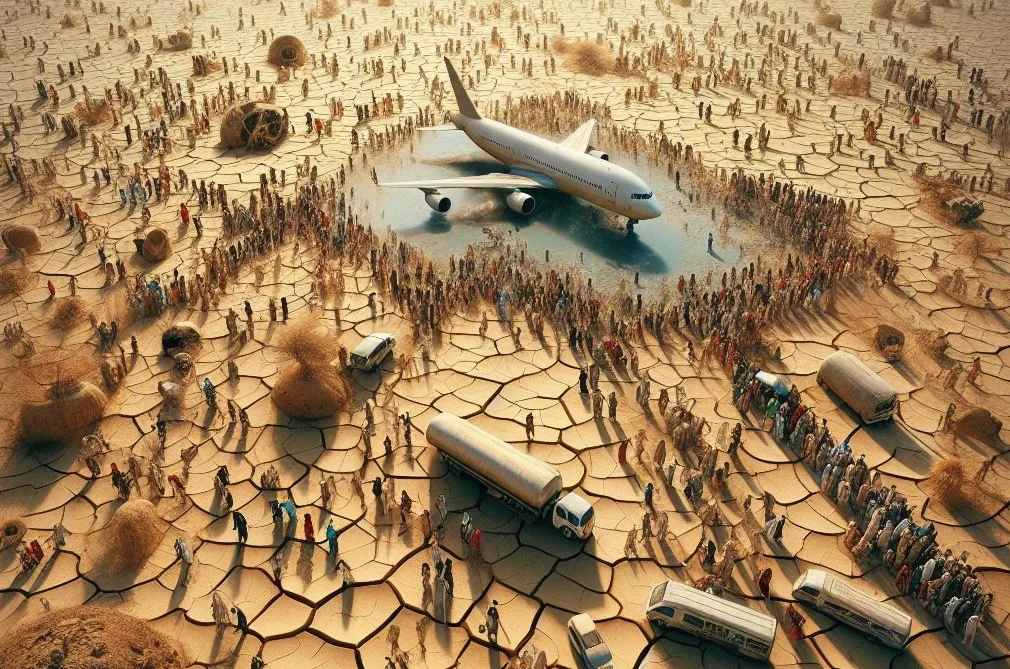
This is not (only) a flood. Inspired by Magritte’s painting: ‘Ceci n’est pas une pipe’ After an alarming dry winter, the European continent has been enduring weeks of a record-breaking heatwave across the southern regions, while coping with scattered, intense precipitation and flash floods. In Zaragoza (Spain), recent flash floods swiftly transformed the previously dry landscape into raging rivers ...[Read More]
If you didn't find what you was looking for try searching again.
Geodynamics
Physics-Based Machine Learning – Curse or Blessing?
The advance of Artificial Intelligence is impacting all spheres of human activity, and Geosciences are no exception. In this week’s post, Denise Degen from RWTH Aachen University, Germany, gives us a glimpse of what this means for Geodynamics. Discussing the advantages and caveats of different approaches, she shows how physics-based Machine Learning may help us investigating and understanding comp ...[Read More]
Geodynamics
On the usefulness of geodynamic numerical models
Within the vast realm of geoscience, the intricate mechanisms governing Earth’s internal processes continually pose challenges for researchers attempting to unveil its mysteries. This blog post acknowledges the inherent limitations of geological and geophysical data while highlighting the important role that geodynamic modeling plays in bridging these datasets. The motivations for this discu ...[Read More]
Tectonics and Structural Geology
Exploring Submap: Subduction Zones Data Mapping and Analysis in just a few clicks
Subduction zones are areas where one tectonic plate dives beneath another one and sinks into the Earth’s mantle, creating powerful earthquakes and volcanic eruptions. Understanding the intricate details of subduction zones can be a daunting task, and retrieving the necessary data often feels like an uphill battle. But fear not! The Geosciences Montpellier Laboratory in France has come to the rescu ...[Read More]
GeoLog
100 years since we learned dinosaurs laid eggs, what do we know now?
In July 1923, 100 years ago this month, scientists and explorers made an extraordinary discovery that forever changed our view of dinosaurs. An expedition to the Gobi Desert in Mongolia unearthed fossilized dinosaur eggs, in a nest, confirming that dinosaurs laid eggs like the reptiles that scientists at the time thought dinosaurs were. The find was announced in newspapers at the time, to much fan ...[Read More]
GeoLog
My reflections of EGU’s evolving General Assembly over the years
The wind, funnelled downwards by the surrounding skyscrapers, whipped along Wagramer Strasse, as early morning traffic thundered by. Past the Orthodox Church and then slightly uphill to the Kaisermühlen VIC underground station, where a stream of one-way traffic was already in full force, everybody proudly displaying their blue lanyards and most carrying the large black poster tubes that are so in ...[Read More]
Geodynamics
Goodbye to 6 years of blogging
Dearest reader, on this day, six years ago, we published our very first blog post, stating our geodynamission: our plans for this new geodynamics division blog. From that day onwards, I have had the absolute privilege of being your Editor-in-Chief. But all good things must end and so does my term of being the Editor-in-Chief. Before I say my final goodbyes, let’s take a trip down memory lane ...[Read More]
Geochemistry, Mineralogy, Petrology & Volcanology
Elemental etymology – what’s in a name?
Like many scientists in the GMPV sphere, I work a lot with geochemistry – using chemical elements and their differing behaviours, abundances or isotopes as tools to understand Earth processes. While staring at the periodic table, something that’s always niggled at me is where the names of these come from: why is the stuff we breath called oxygen and the sand on the beach made of silicon? Even more ...[Read More]
Cryospheric Sciences
Did you know about Antarctic snow megadunes?
When we think of dunes our thoughts automatically go to deserts and sand. But on Earth, as well as on other celestial bodies of the solar system, dunes exist also in a completely different environment. I am talking about gigantic dunes consisting of snow. On Earth they are called megadunes and you can find them only in East Antarctica, where they extend for thousands of km. If you want to know mor ...[Read More]
GeoLog
The varying composition of a single bolt of lightning
Until recently, scientists assumed lightning had a homogeneous distribution of energy inside its channel. But researchers like Damien Bestard, a PhD student with the Sorbonne Université have found that the composition of each bolt is quite variable. Bestard presented his findings at the European Geosciences Union General Assembly EGU23 on Monday (April 24). As part of his research, Bestard measure ...[Read More]