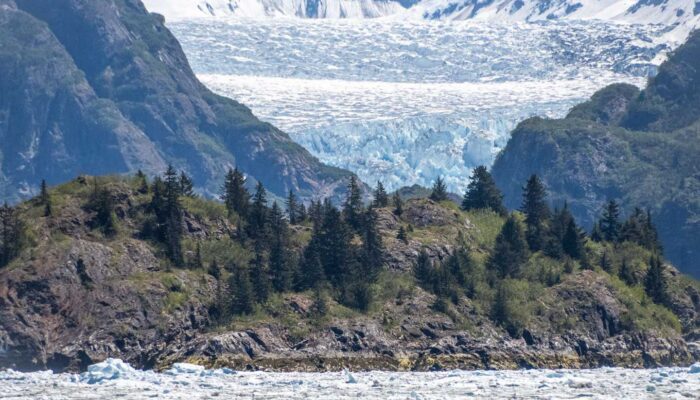
At the edge of the world, a voice tries to make itself heard, a whisper slipping between the threads of an unstable reality. In the remote lands of Svalbard, a few hundred miles from the North Pole, lie millennia-old entities, relics of a disappearing species. They murmur in a language that humans today no longer know how to decipher. And yet, it is in this deafness to the voices around them that ...[Read More]
Hydrological Sciences
HydroTalks: Prof. Laura Richards and Ajmal Roshan on groundwater quality, arsenic, and citizen science
For this month’s episode of HydroTalks, we’re thrilled to welcome Prof. Laura Richards and Ajmal Roshan. Laura is a UKRI Future Leaders Fellow and Professor of Water Resources and Environmental Geochemistry at the University of Manchester. Laura is also the project lead of the AQUAROAD Programme on groundwater quality in the Global South. Ajmal is a Cookson Awardee PhD scholar, and he’s work ...[Read More]
Geodynamics
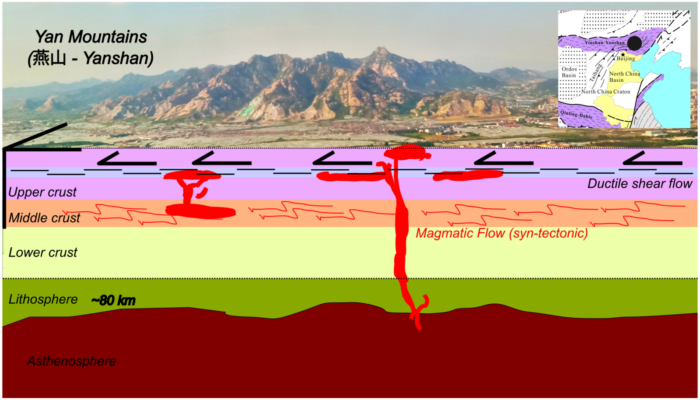
Destruction of North China Craton: through the chronotunnel of time
The Asian continent has fascinated the world for at least 3,000 years with its music, food, and discoveries, as well as its breathtaking landscapes. Most of these incredible landscapes are formed by mountains that can be considered geologically “recent” (such as the Cenozoic formation of the Himalayas). However, there are also ancient terrains, pre-dating the Mesozoic, that pose intrig ...[Read More]
Natural Hazards
Knowing better, but still losing more: why disaster risk reduction breaks down
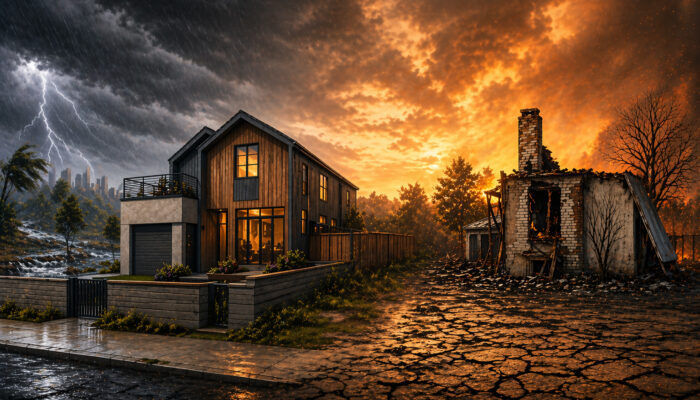
The surviving house in Pacific Palisades became one of the most discussed images from the 2025 California wildfires (Fig. 1). What makes it scientifically interesting, though, is not that it survived. It is that many of the features associated with the house’s survival – a more fire-resistant exterior, stronger windows, and details that reduce ember entry – are already well known. This case points ...[Read More]
GeoLog
AI in science: the ethical experiment we didn’t design
Artificial Intelligence, and its rapid incursion into the (geo)sciences, was already impossible to ignore at last year’s EGU General Assembly. (you can read my reflections then in this blog post) This year, unsurprisingly, it felt equally present. On Thursday, I attended the Great Debate on “The ethics of using AI in Geosciences: opportunities and risks”, a discussion spanning everything from scie ...[Read More]
GeoLog
The post-EGU comedown: An incomplete guide for the geosciences junkies
EGU26 is almost over. The question is: Now what? It is busy during the conference. Finding the way around the convention center, presenting work, learning what others are doing, back-to-back sessions, browsing eye-catching exhibits, not to forget the 20,000+ people to network with! It can feel exhausting, making me crave a still moment to chill from all that thrill. But when I finally walk out of ...[Read More]
GeoLog
Congratulations to the winners of the EGU26 Photo Competition!
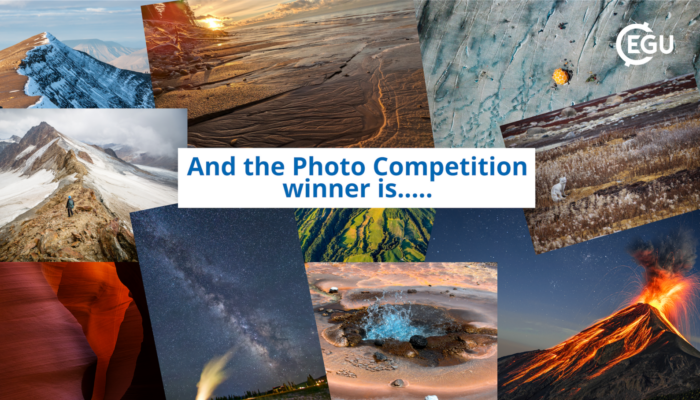
For this year’s Photo Contest, EGU received a number of amazing images capturing a broad spectrum of the geosciences. Since the selection committee whittled the field down to 10 finalists, you have been voting for your favourites throughout EGU26’s week-long conference, both on-site in Vienna at the EGU booth, and online. After an enthusiastic response from voters, we are now ready, and VERY ...[Read More]
Geochemistry, Mineralogy, Petrology & Volcanology
EGU26 Friday Highlights
Hey folks, Today is the last day of the EGU26. Let’s have a quick look at today’s GMPV sessions- Session Code Time & Place Session Title Convenor & Co-Convenors Session Overview GMPV4.3 Oral: 08:30–12:30 Room: K1 What Makes Earth So Special: Global Cycles of Volatiles Convener: Alessia Borghini; Co-conveners: Carla Tiraboschi, Sally Gibson, Michał Bukała The Session will partic ...[Read More]
GeoLog
Connecting worlds of influences? Between art and education at EGU26
Talking to people about their work is always an EGU highlight for me. Being able to nerd out about rivers, rocks, big research vessels crossing the Arctic, maps, mountains anywhere in the solar system, or even beyond? Yes, please! However, while those topics are the things of dreams for me (and I dare to say many other EGU-goers), that enthusiasm isn’t always a given once we leave the confer ...[Read More]
GeoLog
More than meets the eye: What can we learn from non-visual science
Many people exhibit a strong visual orientation, as a significant portion of human neurobiology is dedicated to processing light; however, this reliance is usually as much a product of our visually-centered environments as it is our biology. Science, however, reminds us that important information can come from different senses as well: sound, smell and tactile information all have something to say ...[Read More]