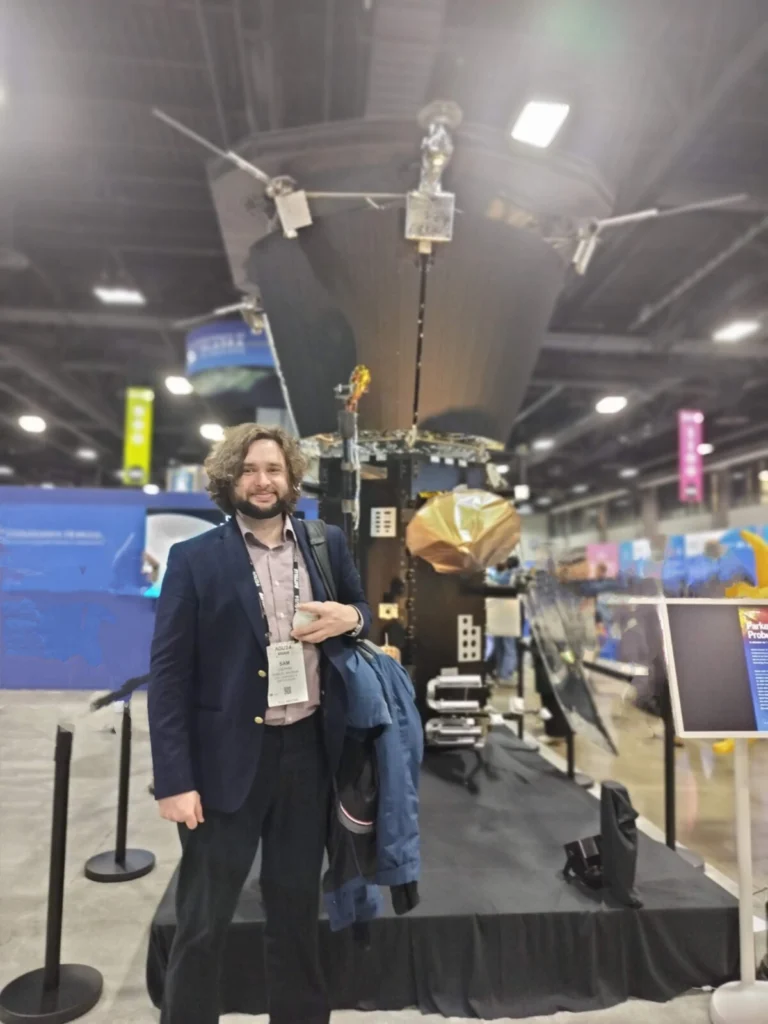
Congratulations on receiving the EGU 2026 ST Division Outstanding Early Career Scientist Award for your outstanding contributions to our understanding of solar wind physics through observations from the Parker Solar Probe and Solar Orbiter. What does this recognition mean to you personally, and how does it impact your work in this fascinating field?
It is an incredible recognition which I am extremely grateful for, both to my nominators and the EGU-ST selection committee, and to all of my incredible colleagues, collaborators and mentors who I have been able to work with to get to this point in my career. It is especially meaningful to be recognised for my work on these specific space missions, which launched during my PhD and have subsequently shaped my entire career. It has been an incredible experience contributing to their early scientific results and working with data that prior generations could only have dreamed of. Looking forward, I am excited to keep building on this work and recognition, and to help others, especially those younger than me, advance in their careers.
Could you share some information about your background and what sparked your interest in your research field?
I come from a fairly rural area in the south west of the UK and grew up living just around the corner from my grandparents, who were secondary school science teachers. I give them a lot of credit for giving me space and physics-related books and games growing up, which made me generally interested in astrophysics for as long as I can remember.
However, my journey into solar and heliophysics as a specific topic in astrophysics was more recent and more serendipitous! When I was in my second year of undergrad, I was going to spend the summer break in Dublin, Ireland, with my other grandparents, and I decided I wanted to find a research internship. I reached out to a couple of groups in Dublin. Although both responded positively, one offered me a stipend for my work that summer, and that just so happened to be a solar physics group, a field I honestly had not intersected with up until that point. Although this may seem like a whimsical decision point, I do think it’s incredibly important to have funded internship programs to enable equitable access to research experiences.
I do think it’s incredibly important to have funded internship programs to enable equitable access to research experiences.
The rest is history, but suffice it to say I loved every minute of the internship, examining and extracting signals from incredibly high-resolution videos of the Sun’s chromosphere (even if I had to use IDL!), presenting a poster at locally hosted conferences, and getting to hang out with the PhD students in the group. After this, I was hooked, and the following summer, I actively sought out internships in the field and eventually applied for PhD programs with research in solar and heliophysics. That landed me at UC Berkeley, where my career ended up on a collision course with Parker Solar Probe.
Could you tell us some of the key challenges you have encountered in your scientific career, and how have you navigated them?
I have always considered myself an introverted and socially awkward person, so for me, the hardest personal challenges have all come down to the realisation that physical science is not just doing maths or coding or writing, but is really a social endeavour where you need other people to succeed. I’ve had to push myself out of my comfort zone to connect with people, to get used to repeated public speaking, and to realise my need to improve my communication skills. One particular challenge was when I was first starting my Ph.D., not having a huge community I knew, especially at conferences, and at times I felt quite isolated. My biggest turning point in this regard was when I started applying for some of the space weather and heliophysics summer schools in the US and met other students who were in the same boat as me. It was really easy to bond and become friends, and the step-change when I next went to conferences and immediately was among people I felt comfortable around is hard to overstate.
… realisation that physical science is not just doing maths or coding or writing, but is really a social endeavour where you need other people to succeed.
However, I do not want to miss this opportunity to also say that as much as I have faced challenges, I am equally conscious of experiences that I have had easier than others. In particular, as a native English speaker and a white man, and as I have gotten to know others from diverse backgrounds, I have become increasingly aware that it can require less effort on my part to be heard, credited or assumed to be correct compared to others around me. A challenge for me is to recognise and act when I see this dynamic playing out in my own environments, and I implore anyone else reading this with my privileges to try and be conscious of this as well.
Your research expertise is exceptionally diverse and wide-ranging. Could you share a brief overview of the key discoveries or milestones that have shaped your career and brought you to this point?
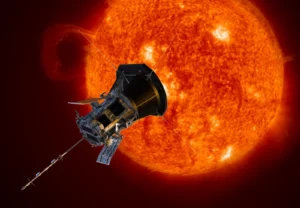
The first big milestone came halfway through my PhD with the launch of NASA’s Parker Solar Probe. With my PhD advisor, Prof. Stuart Bale, as the PI of the FIELDS instrument onboard, I was privileged to be able to participate in the first results push of the mission, seeing data taken somewhere in the solar system and that humans had never been before. Simultaneous to that, I was introduced to open-source software with the public release of the Python package pfsspy by Dr David Stansby. This code meant I was able to learn how to run simple but powerful models of the Sun’s coronal magnetic field. Combining this with the new FIELDS data led to my first paper, which showed that we could associate the spacecraft measurements with specific solar wind sources and even investigate optimal parameters for the coronal models. Not only did this combination of circumstances get me started in my own research, but it also equipped me with a set of tools that meant I was able to contribute to a great many other studies from early Parker Solar Probe data, providing connectivity context. This exposed me to a fantastic breadth of research in heliophysics, providing me with a broad perspective of the field.
The first big milestone came halfway through my PhD with the launch of NASA’s Parker Solar Probe.
The second big milestone was beginning my postdoctoral position at the Center for Astrophysics | Harvard & Smithsonian, where I started to work with my new group there, led by Dr. Michael Stevens. Most critically, I began to collaborate with my then-fellow postdoc, Dr. Yeimy Rivera. Here, my research pivoted: jointly with Yeimy, I began exploring the radial evolution of the solar wind. This led to an enormous early-career milestone of writing a paper that we published in Science in 2024. In that work, we found evidence that the energy flux of magnetic switchbacks was a significant term in the near-Sun energy budget and could explain the evolution from Parker Solar Probe to Solar Orbiter. My contribution to this work included producing an open-source code for producing “Iso-poly” solar wind radial profiles (pioneered by Dr. Jean-Baptiste Dakeyo and Dr. Chen Shi), which was my way of “paying it forward” from my experience with pfsspy, but has also shaped the direction of all my subsequent research to date. As with everything else in science, my milestones and success are the result of having so many talented people around me.
In your experience, what are the most pressing scientific questions in your field, which ones are likely to be solved soon, and why do you believe they hold such urgency?
Something I am personally most excited about is one of the priorities listed in the recent US National Academy of Sciences Heliophysics Decadal Survey, which proposed sending spacecraft with imagers and magnetographs into solar polar orbits for the first time. As someone who has worked with coronal models, I am keenly aware of how important it is to have complete boundary conditions – knowledge of what the Sun looks like all over its surface at any given instance in time. Earth is stubbornly stuck near the Sun’s equator, so we are always missing half the Sun, and we never see it from above or below. I am very excited for this to change with future missions and to see the impact of getting new vantage points of the Sun on our prediction capability for space weather events.
I am also convinced that we have only just scratched the surface of the physics that Parker Solar Probe will reveal in the future, specifically since it has only recently started to dive properly deeply into the open field solar corona. We are now routinely getting back data where the plasma temperature around the spacecraft is truly coronal (Millions of Kelvin), and so we are in an unprecedented position to directly measure the physical processes which are sustaining this “coronal heating”, at least in open field regions!
I am also convinced that we have only just scratched the surface of the physics that Parker Solar Probe will reveal in the future …
How do you envision your research developing over the next 5-10 years, and what major challenges or opportunities do you expect to encounter?
I am interested in both starting to synthesize what we have learned from snapshots over the last 8 years with Parker Solar Probe to start to investigate solar-cycle level trends. I am also keen to connect more with the stellar physics research communities to try to translate what we learn about our star into the broader scope of stellar physics. Beyond that, I hope to work with students more and more, transitioning into a supervisory role rather than always pursuing the nitty-gritty implementation.
A challenge for me in this 5-10 year timeframe comes with the transition of Parker Solar Probe from its prime mission, which has provided me stability spanning my entire career to date, essentially, into an extended mission. At some point, I will need to move beyond my comfort zone to begin focusing on what comes next. I also hope to obtain a permanent position in this timeframe!.
Do you participate in outreach efforts to promote awareness of solar-terrestrial science? If so, what are your preferred ways to share your research with the public?
Yes, I do! There are a few different recurring events I participate in in the Boston area, most notably Cambridge Explore the Universe and NASA’s STEMday@Fenway, and I’m always looking for others to get involved with! Primarily, these are family- or children-oriented, which I think is really important to convey the exciting opportunities and career paths that science, physics and maths can lead to.
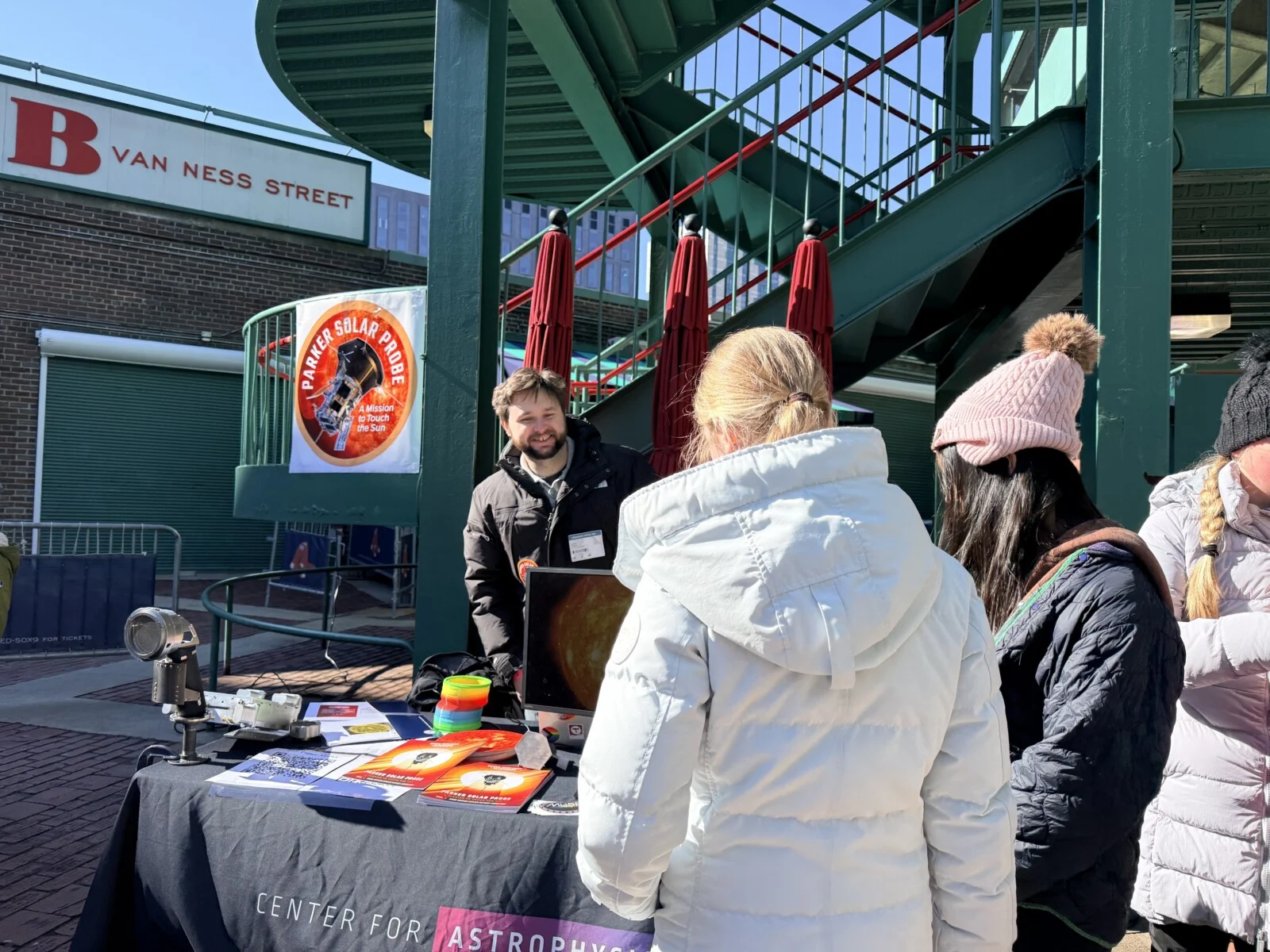
Samuel Badman at STEMDAY@Fenway, Fenway Park, Boston in April 2026. Credit: Yeimy Rivera.
I lean particularly into the organisational and logistical side of these kinds of events. While I enjoy engaging and directly talking to the audiences, I do still sometimes feel nervous or self-conscious that I am not articulating very well, so I try to lean into my strengths of planning and making events happen to support a bigger team, which includes really strong communicators.
What advice would you give to Early Career Scientists seeking to succeed in this field, and is there a particular skill or mindset you believe is crucial for success in solar-terrestrial research?
I can think of several, but I believe the most important one is developing a network and community. Science in the 21st century, and especially in space science, is not done by individuals; it is the result of huge teams, collaboration, sharing open-source tools and building on others’ insights. Surrounding yourself with people you work well with, have complementary skills to you, and support you is so important to achieving that. And it’s not only in the service of doing excellent science, but it is critical to being resilient. Being a scientist can at times be really hard psychologically, with tough reviews, proposal rejections and sceptical questions, and we all experience feelings of failure of some description. Having people around you to build yourself back up, talk through things, provide positive feedback and see other perspectives is truly essential to bouncing back and learning from the experience.
Science in the 21st century, and especially in space science, is not done by individuals; it is the result of huge teams, collaboration, sharing open-source tools and building on others’ insights.
I would advise early career scientists to take advantage of networking events at conferences, to apply for any summer schools they see, and to seek out connections with your cohort wherever you study or work.