Oh, but you should know that…
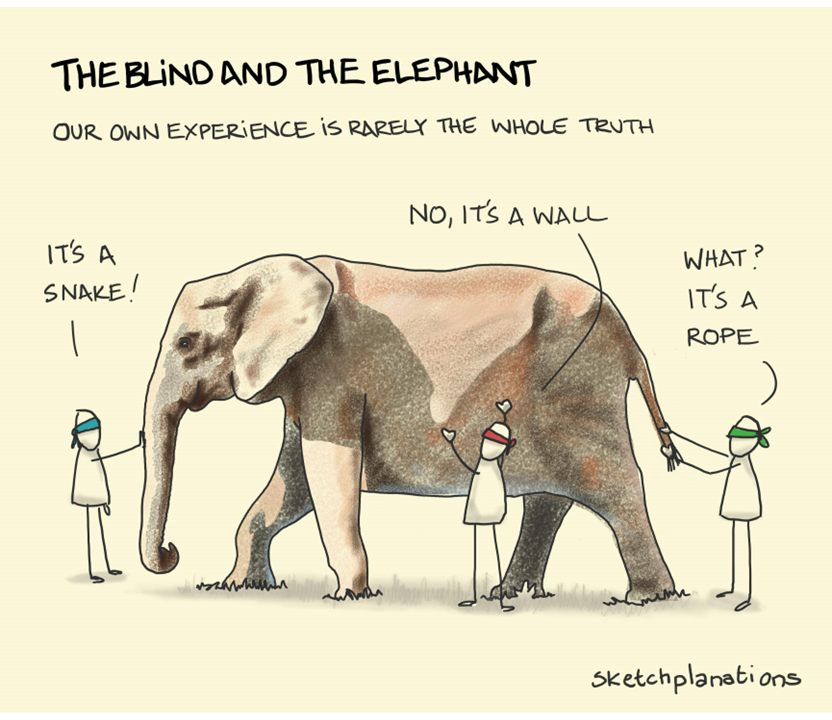
It is a short sentence, often spoken with good intentions. Yet in interdisciplinary conversations, it can bring a discussion to a complete halt. The moment someone says, “Oh, but you should know that,” they assume that what is obvious in their discipline must be obvious to everyone else. Hearing this phrase repeatedly in scientific discussions made me realise how much harder than what we often anticipate interdisciplinary communication may be. The challenge is not a lack of expertise, but quite the opposite. Researchers from different disciplines bring valuable but distinct perspectives to the same problem. Like in the well-known story of the blind men and the elephant, each person experiences only part of the whole. One feels the trunk, another the leg, another the tail—and each describes something different. Only by bringing these perspectives together can they recognise the elephant for what it is.
Interdisciplinarity sits at the heart of biogeosciences. Even the name itself — bio-geo-sciences — reflects the need to connect different disciplines to understand the Earth system as a whole. This integration is becoming increasingly important as the challenges we face, from climate change to biodiversity loss, are deeply interdisciplinary by nature. For example, understanding how carbon cycles through ocean, land and atmosphere helps us better understand the consequences of climate change – but this includes biological, chemical and physical processes that act jointly. Understanding how plants and animals interact with each other and their physical environment helps us understand how we as humans impact biodiversity – this again includes ecological, physical and even social dimensions. Understanding these problems and finding solutions requires us to work across disciplinary boundaries.
To combine expertise, the first step is communication.
Sometimes the challenge is language itself. A single word can mean completely different things depending on the field. Take the term particle: for a biogeochemist, a particle may refer to sinking organic matter transporting carbon into the deep ocean through the biological carbon pump, a key pathway for carbon storage in the ocean. For a Lagrangian modeller, a particle may simply be a virtual, often massless tracer transported by currents. Same word, entirely different concept. But the issue goes beyond terminology. Every discipline also brings its own assumptions, standards and research culture. Different disciplines often approach uncertainty, evidence and interpretation in distinct ways. Ask an environmental physicist and a field ecologist what counts as a “good correlation”, and you may receive very different answers…
So how can we communicate more effectively across these boundaries? Here are five practical ways to strengthen interdisciplinary communication skills in scientific collaborations. This is not about outreach science communication, but communicating across different disciplines in the geoscientific context.
-
Know your limits – and state them openly
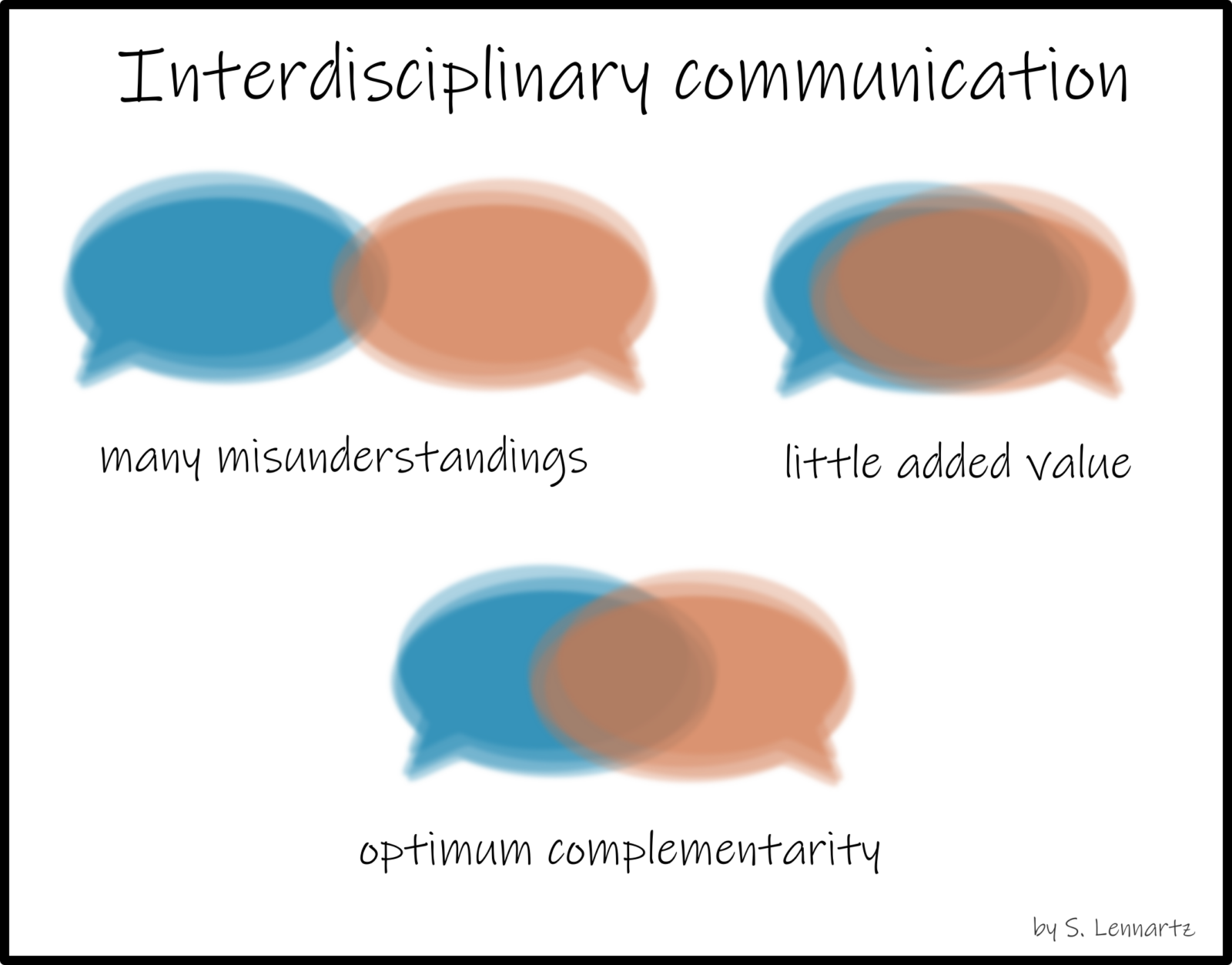
Successful interdisciplinary collaborations are not built on everyone knowing everything. The strength of interdisciplinarity comes precisely from bringing together different areas of expertise. A useful way to think about this is as overlapping circles in a Venn diagram. Each collaborator contributes their own specialised knowledge, while sharing enough common ground to communicate effectively. The broader the combined expertise, the greater the overall potential of the collaboration. This means that not having the same knowledge on a topic as the other person is not a weakness but an advantage. It means the other person has spent their time gathering experience in a different topic than you bring to the table – so the answer should not be “Oh, but you should know that!” (see above), but a concise summary.
Being open about the limits of your own knowledge can help create a more constructive working atmosphere. It also reminds us that concepts we consider central in our own discipline may not play the same role in another field. Explicitly acknowledging these boundaries, especially as a more senior researcher, can encourage others to do the same and make conversations more open and productive.
-
Create psychological safety
Admitting “I don’t know” does not always come naturally in academia. Yet interdisciplinary collaboration depends on people feeling comfortable enough to ask questions, clarify concepts and challenge assumptions. This requires psychological safety: an environment where participants feel able to speak openly without fear of being judged for gaps in knowledge. Sometimes small changes can make a big difference. At the start of a meeting or workshop, it can help to explicitly acknowledge that everyone brings different expertise to the table, especially if you are a senior person in the room. What may seem obvious to one person may be completely unfamiliar to someone else — and vice versa.
-
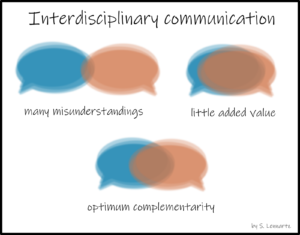
Venn diagram of optimal background expertise for efficient interdisciplinary communication. Too little or too much overlap leads to inefficient interdisciplinary communication. Best effects result from a common core understanding, and added expertise knowledge. Source: own.
Practise active listening
In interdisciplinary discussions, people can sometimes talk past each other for quite a while without realising it, especially when they use the same terminology with different meanings behind it. This is where active listening becomes incredibly valuable. Originally originating from work with patients in hospitals, active listening involves paying close attention, asking open questions and making sure you genuinely understand the other person’s perspective. One particularly useful technique is paraphrasing: repeating back what someone said in your own words to confirm understanding.
-
Be specific — even at the sentence level
Specialists within the same discipline often communicate efficiently through shorthand, abbreviations and jargon. What is needed to make communication efficient within one discipline can quickly become confusing in an interdisciplinary setting. Acronyms are a classic example. Every field has them, and may sometimes overestimate how common these acronyms are. When communicating across disciplines, clarity matters more than speed.
A few simple habits can help:
- Use fewer abbreviations whenever possible. Yes, even the ones that you think are standard.
- Explain your reasoning step by step rather than assuming shared background knowledge.
- Define important concepts explicitly.
-
Provide context for information, such as “this finding was a revolution in the field because…”, “back then, our methods did not allow to…”, “this is relevant/surprising/interesting because…”
-
Provide structure when you speak, i.e. “there are three main reasons why this hypothesis was put forward, first…second…third”, or “there are pros and cons for this method,…”
-
Build connections and explore unfamiliar topics
Interdisciplinary communication becomes much easier when people share a common goal and develop personal connections over time. But you do not need to start with a large collaboration project to broaden your perspective. Conferences such as the European Geosciences Union General Assembly offer excellent opportunities to step outside your usual research area. Try attending a session that initially seems unrelated to your work. Listen for unfamiliar concepts, methods or perspectives, and ask yourself whether there might be unexpected connections to your own research.
A worthwhile investment
While it may take time to invest in improving interdisciplinary communication skills, it is worth it. When becoming stuck in a research problem, a change of perspective can bring unprecedented insights. Improving interdisciplinary communication starts with our own approach: our language, our openness and our willingness to engage with perspectives outside our expertise. A closer look on how we communicate across disciplines teaches us humility, curiosity and the ability to see problems through someone else’s perspective — skills that are valuable not only in science, but also beyond it.
Written by Sinikka Lennartz, edited by Lucia Layritz