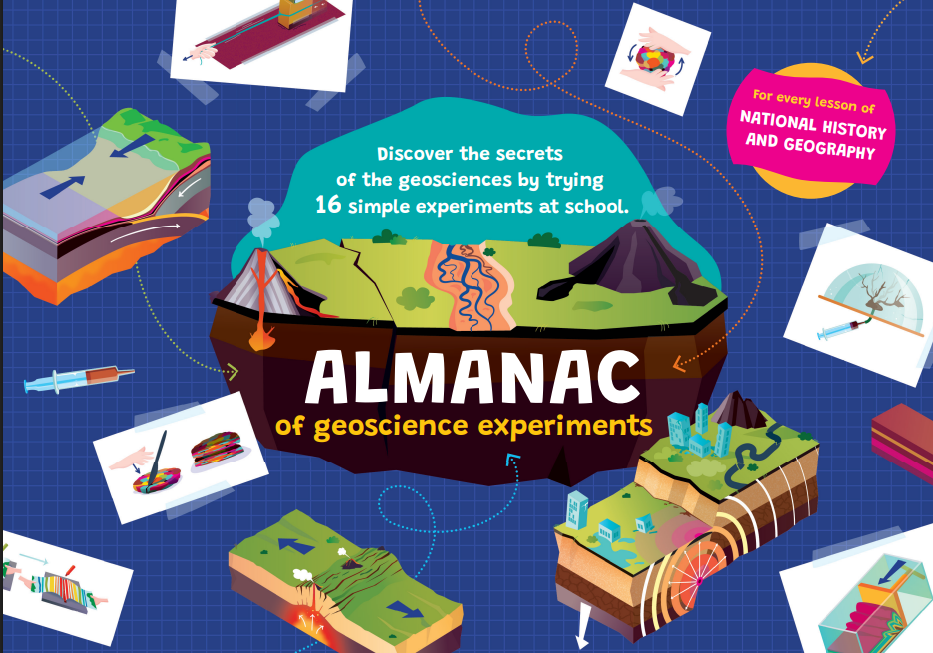
For more than a decade, I have spent a large part of my time not only doing research in planetary science, but also visiting schools, science festivals, public events, and talking to children, teachers, and everyone interested in geosciences. During these outreach activities I repeatedly encountered the same problem. People were genuinely curious about volcanoes, earthquakes, plate tectonics, or the interior of our planet, but when teachers asked me where they could find simple experiments to demonstrate these processes in the classroom, I often realized that I did not have much practical material to recommend.
There are, of course, many excellent educational resources available online. However, a large fraction of them either require expensive laboratory equipment, are too complicated to prepare within normal school conditions, or focus more on entertainment than on explaining the actual geological process behind the experiment. At the same time, I repeatedly realised that many available materials were not truly simple, visually attractive, scientifically correct, or easy to prepare and perform almost anywhere.
Nevertheless, my experience clearly showed that this was exactly what the public (especially teachers) were looking for. Whenever I brought some of our large physical models, like barrel organ of plate tectonicsm, developed together with Matěj Machek, my colleague at the institute, people immediately became more engaged. Suddenly abstract concepts such as plate tectonism, explosive volcanism, or the geomagnetic field became understandable because visitors could directly observe simplified analogues of these processes with their own eyes.
And this eventually led me to the idea of creating an open-access almanac of geoscience experiments!
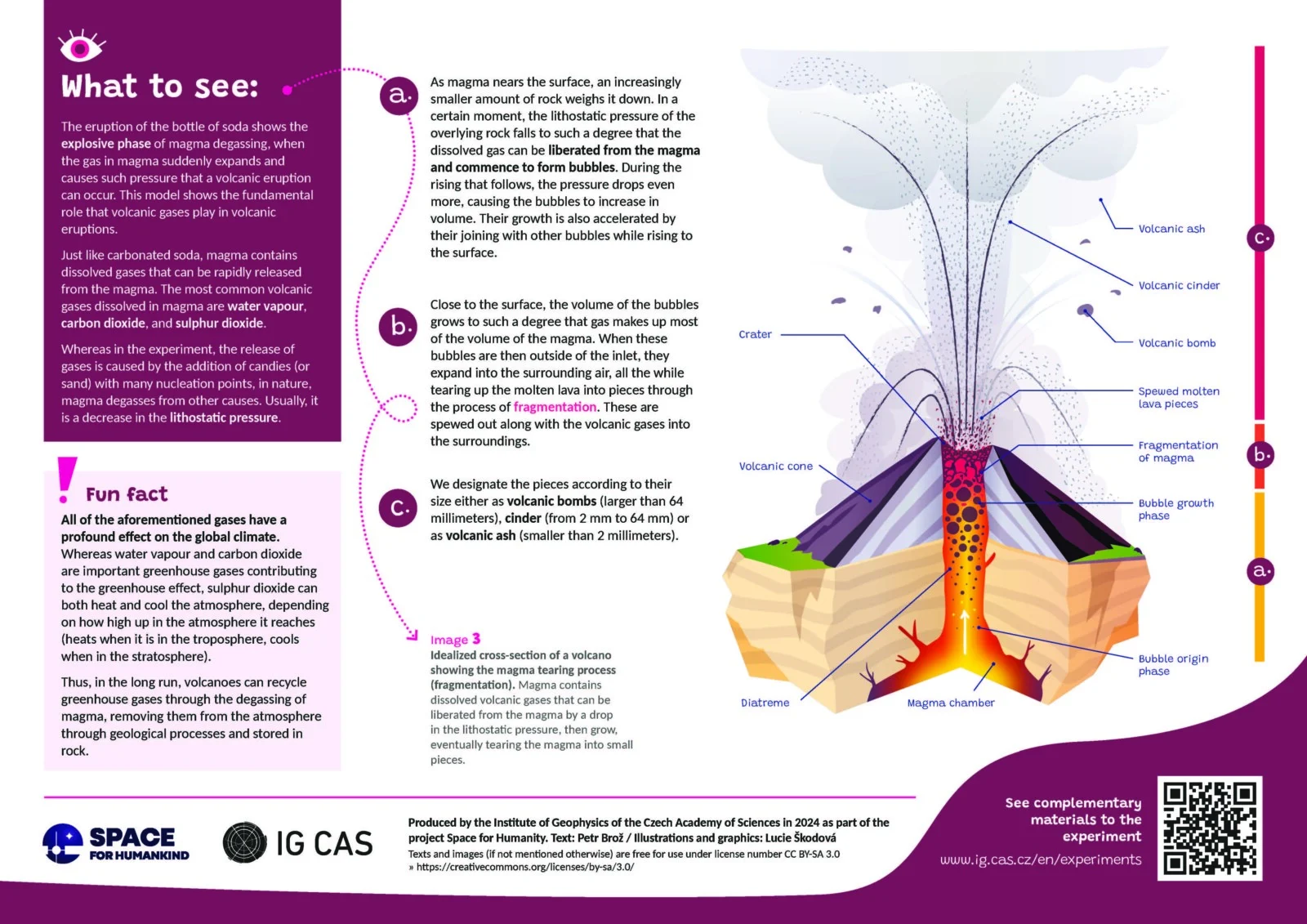
Example of one outreach sheet from the almanac of geoscience
Together with the very talented illustrator Lucie Škodová (Ajeejee) and several colleagues from the Czech Academy of Sciences, we started to assemble a collection of simple geological experiments suitable for classrooms. We wanted experiments that would be scientifically meaningful, visually understandable, inexpensive, quick to prepare, and usable with only minimal equipment and preparation.
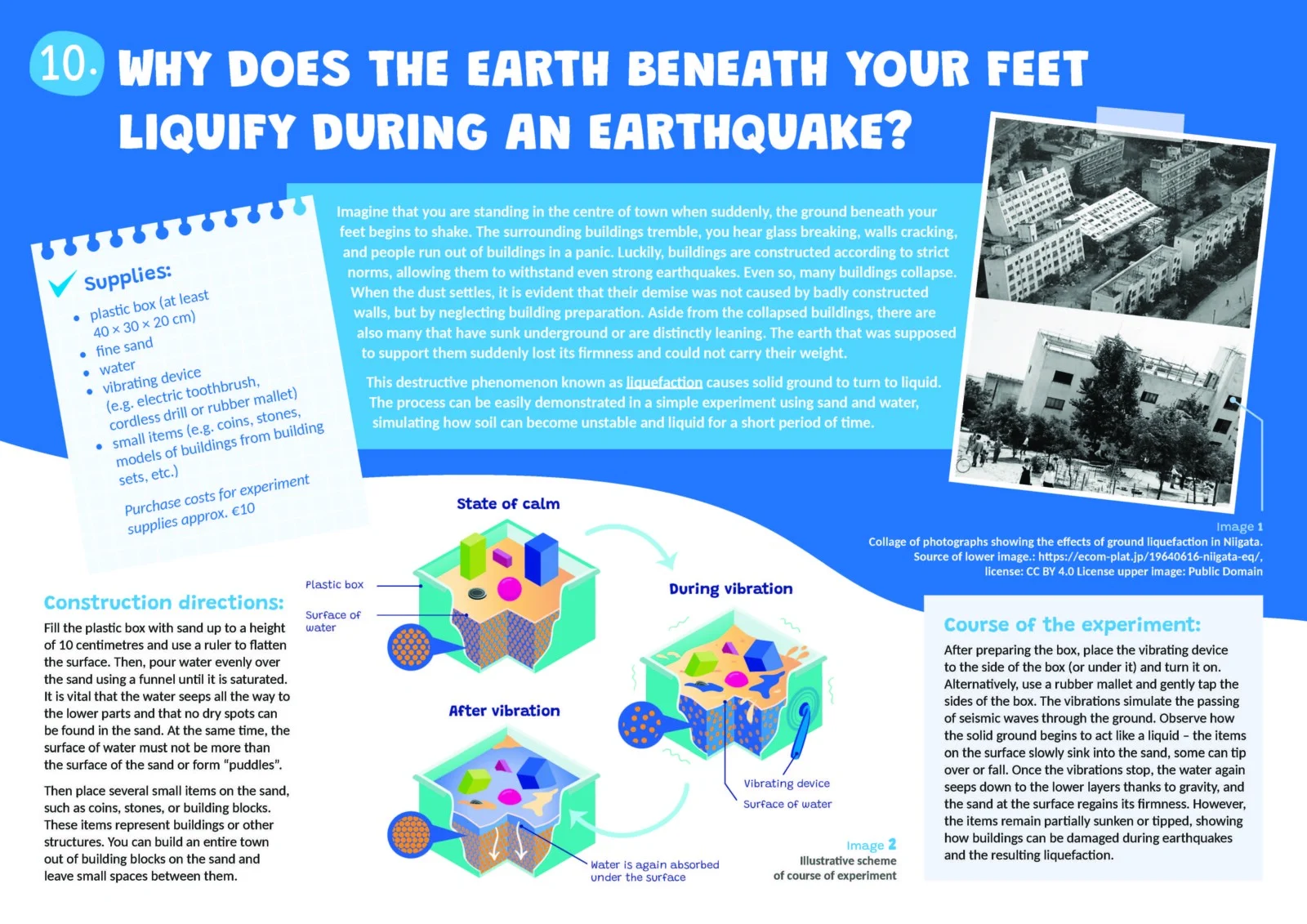
Example of one outreach sheet from the almanac of geoscience
Many geological processes are inherently difficult to reproduce in classroom conditions because they operate on enormous spatial and temporal scales. You cannot simply create a real volcano, tectonic plate, or lava flow inside a classroom (although I am quite sure many children would enjoy that — unlike the school director!). Therefore, we had to search for simplified physical analogues that preserve at least some of the key principles of the natural process while still remaining understandable and practical for teachers and students.
At the same time, we tried to avoid experiments that only “look cool” but do not actually explain much scientifically. The goal was always to connect the demonstration directly with real geological processes. Every experiment therefore includes not only instructions, but also an explanation of what is happening physically and why the observed behaviour resembles processes operating on Earth or other planetary bodies.
The final almanac contains sixteen experiments focused on volcanism, earthquakes, plate tectonics, rock deformation, atmosphere, and river behaviour. Most of them can be prepared from common household materials within several minutes. In many cases, the experiments use objects that people already have at home but would probably never associate with geoscience education.
Another important aspect for us was accessibility. We wanted the experiments to be freely available to anyone. Therefore, the almanac was released as open access under a Creative Commons license, allowing teachers, outreach coordinators, museums, and science communicators to freely use, adapt, translate, and distribute the materials. So anyone can freely download the almanac and use it in essentially any way they find useful. Personally, I would also be extremely happy to see the almanac spreading further around the world and gradually being translated into additional languages, making these experiments accessible to even more teachers, students, and outreach enthusiasts.