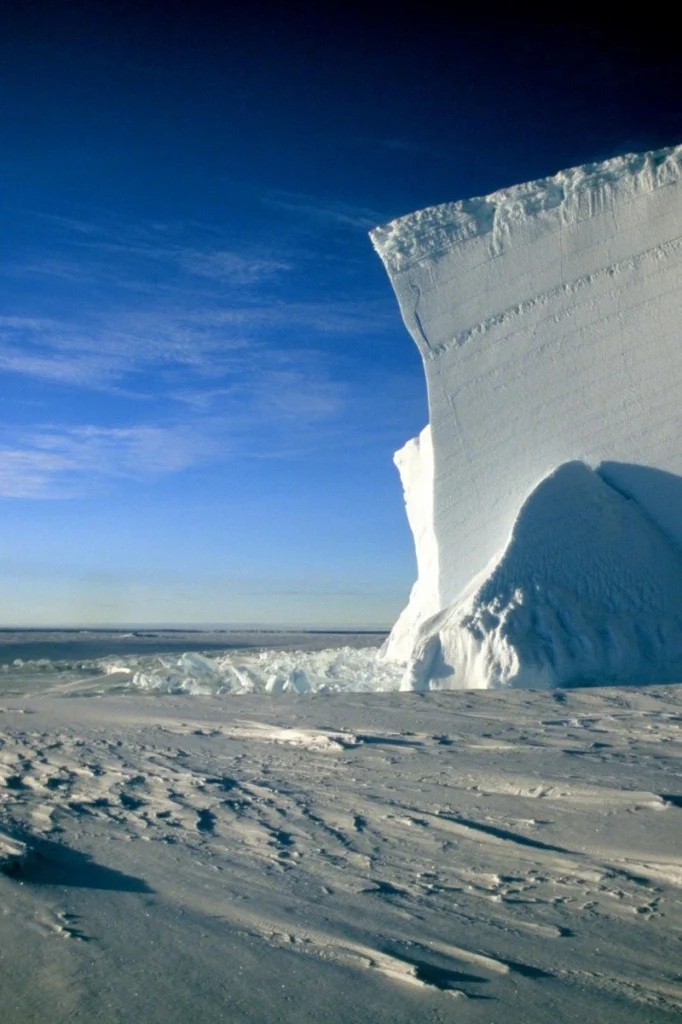
Standing on the vast expanse of gleaming white sea ice of the Atka Bay, Michael Bock took this stunning picture of an Antarctic iceberg. The days, during the Antarctic summer, are never ending. Despite capturing the image at midnight, Michael was treated to hazy sunlight. “Clearly visible [in the iceberg] are the annual snow accumulation …[Read More]
climate
GeoTalk: Nick Dunstone, an outstanding young scientist
Nick Dunstone, the winner of a 2014 EGU Division Outstanding Young Scientists Award, who studies the Earth’s climate and atmosphere, including how they are impacted by natural variation and anthropogenic emissions talks to Bárbara Ferreira, the EGU Media and Communications Manager, in this edition of GeoTalk. This interview was first published in our quarterly newsletter, …[Read More]
Geosciences Column: Did Mediterranean salt change the global climate?
The latest Geosciences Column is brought to you by Annabel Slater, who describes a time of dramatic change in the Mediterranean. Slater shares the results of a recently published Climate of the Past study and sheds light on how – in the context of global climate – a little salt can go a long way… Many of …[Read More]
Geosciences Column: Meshing models with the small-scale ocean
The latest Geosciences Column is brought to you by Nikita Marwaha, who explains how a new generation of marine models is letting scientists open up the oceans. The new technique, described in Ocean Science, reveals what’s happening to ocean chemistry and biology at scales that are often hard to model… Diving into the depths of …[Read More]
Imaggeo on Mondays: Long-lived lakes have a lot to tell
The world’s oldest, deepest freshwater lake lies in southeast Siberia: Lake Baikal. Stretching some 600 kilometres across the Russian landscape, Baikal marks what the very early stages of a new ocean – an ancient rift that cleaved the centre of Asia apart throughout the Palaeozoic, Mesozoic and Cenozoic. Today, there are still signs of tectonic activity …[Read More]
Climate-proofing the Netherlands
Emerging Leaders in Environmental and Energy Policy (ELEEP) fosters transatlantic relations, forges dialogue, and promotes leadership across energy and environmental policy landscapes. Former EGU Science Communications Fellow and ELEEP member Edvard Glücksman reports back from the Netherlands, where citizens manage the continuous threat of climate-related devastation through a combination of creatively adapted urban spaces and innovative …[Read More]
GeoEd: An African GIFT Experience
This year the EGU embarked on a new journey into Africa to deliver its renowned Geosciences Information for Teachers (GIFT) programme to teachers in South Africa and neighbouring countries in collaboration with UNESCO and the European Space Agency (ESA). The topic: Climate Change and Human Adaptation. Jane Robb reports on the week’s events… Set in ‘the windy city’ …[Read More]
Imaggeo on Mondays: Exploring the East African Rift
This week’s Imaggeo on Mondays is brought to you by Alexis Merlaud, an atmospheric scientist from the Belgian Institute for Space Aeronomy. While the wonders of the African atmosphere feature in his photography, the East African Rift has a much bigger tale to tell. Drawing from all aspects of geoscience Alexis shares its story… This …[Read More]
Geosciences Column: Shifting the O in H2O
Wherever you are in the world’s oceans, you can identify particular bodies of water (provided you have the right equipment) by how salty they are. You can get a feel for how productive that part of the ocean is by measuring a few chemical components in the water column. And, year on year, you will …[Read More]
Imaggeo on Mondays: How sea urchins can help mitigate climate change
This week’s Imaggeo on Mondays stars the humble sea urchin – a creature suffering from the effects of climate change, but one that could also provide a way to sequester some of the CO2 responsible… Carbon dioxide and water react to form carbonic acid – a mixture of bicarbonate and hydrogen ions. Sea urchins bag …[Read More]