A note from the Natural Hazards Division editorial team
We would like to open this blog post with our sincere condolences in response to the devastating multi-hazard flash flood that occurred in Nepal and Tibet in late August. In the face of such suffering, messages like this risk sounding hollow. Still, we, as the Natural Hazards Division editorial team, wish to express our solidarity with all families and communities affected and with those making huge sacrifices to support the recovery effort.
This blog post broadly discusses the question, “Are all disasters recorded equally?”, and its implications for inclusion in disaster risk reduction (DRR). To do so, the piece first explores how the manifestation of disasters is shaped by risk – the relationship between hazard, vulnerability and exposure. Following this, I explore how these underlying conditions influence which impacts communities experience, and how inclusive DRR can support more equitable preparation for and recovery from disasters.
What gets recorded?
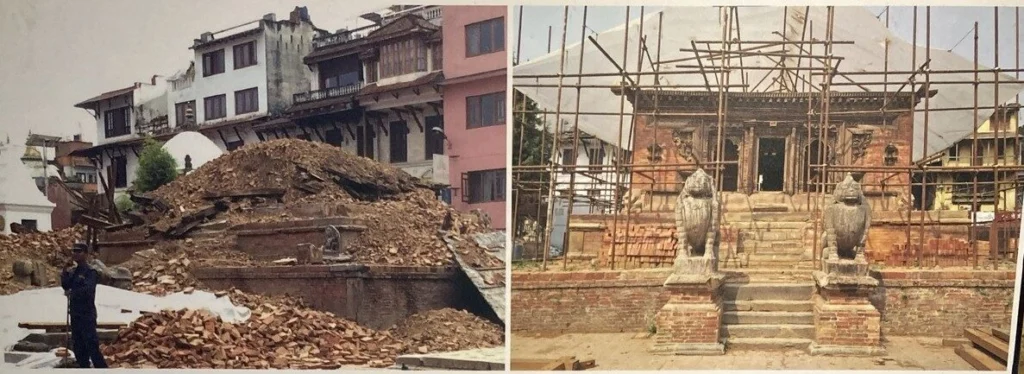
The magnitude 7.8 Gorkha earthquake hit Nepal’s Gorkha District on 25 April 2015, causing almost 9000 fatalities, injuring approximately 18,000 people, and affecting over 5.5 million people [1]. As Nepal’s deadliest disaster since 1934 [2], the event received international media attention, humanitarian assistance and funding for recovery and reconstruction efforts. Small-scale events, such as frequent river inundation of the Bagmati River into informal riverside settlements in the Kathmandu Valley during the annual monsoon season, cause significant disruption to the lives of residents. For instance, the September 2024 floods in the Kathmandu Valley caused floodwater to rise to “2.5 times the bankfull water extent”, resulting in devastating damage to homes, infrastructure and transport [3]. However, despite the widespread disruption, this was not reflected in the scale of reporting and assistance during and after the event.
Understanding the difference in the scale of and response to these two events can be characterised by the concept of intensive and extensive risk. In the context of DRR, a broadly accepted definition of risk is:
“The potential loss of life, injury, or destroyed or damaged assets which could occur to a system, society or a community in a specific period of time, determined probabilistically as a function of hazard, exposure, vulnerability and capacity.” [4]
Building on this definition, intensive risk (such as that associated with the Gorkha 2015 earthquake) relates to higher-severity, low- to mid-frequency events that have a high overall impact. Conversely, extensive risk (associated with regular monsoon-triggered flooding in the Kathmandu Valley) concerns lower-severity, high-frequency events that often have a devastating impact on affected communities yet may be localised in spatial or temporal extent [5]. Figure 1 illustrates this distinction on simplified axes of frequency and impact [6].
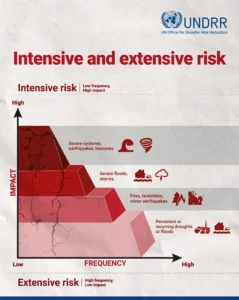
Figure 1: Illustration of intensive and extensive risk on axes of frequency and impact (Image credit: UNDRR, 2026).
Intensive risk can be shaped by high population density and the exposure of assets during high-magnitude events, such that it is dependent upon how hazard, exposure, vulnerability and capacity change over time. On the other hand, extensive risk is closely interlinked with underlying drivers of risk, including poverty and deprivation, that disproportionately affect marginalised communities through indirect impacts. These types of impacts result from the ripple effects of direct impacts across space and time, affecting multiple sectors, but may not be observed equally.
What becomes visible?
According to the Centre for Research on the Epidemiology of Disasters, 110.2 million people were affected by natural hazards in 2025 [7]. However, this represents only a snapshot of the total global impact of disasters, owing to a reporting bias towards higher-magnitude, lower-frequency events. The reporting of impacts that are difficult to quantify or are poorly captured by conventional disaster impact assessments, including cultural, social, and environmental impacts, represents a significant proportion of the total impact caused by disasters, as captured in Figure 2 [8].
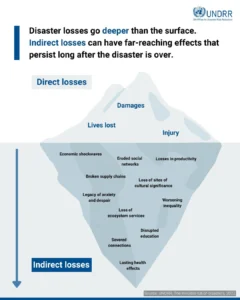
Figure 2: Ilustration of the indirect disaster impacts that may be overlooked (Image credit: UNDRR, 2022).
What receives attention and funding?
Underreporting of indirect impacts associated with extensive disasters is significant because the events that hazard managers, funders, and the wider public discuss and prioritise directly inform DRR strategies and, most significantly, who is protected from future harm. Although the cumulative impact of extensive events causes significant damage, these events are often understudied due to factors including lower priority status and a lack of funding [9]. Indeed, over time and space, the incremental impacts of smaller disasters can be equal to or greater than those of larger disasters [10], such that the ripple effect of an event spreads far beyond the initial direct impacts. To better understand how communities are affected by smaller disasters and indirect impacts, a more comprehensive approach to disaster management is critical: inclusive DRR.
Whose risk is addressed?
DRR provides a crucial framework to reduce disaster impacts. This is particularly important for impacts resulting from extensive events that disproportionately affect marginalised communities who may be more vulnerable. According to the United Nations Office for Disaster Risk Reduction (UNDRR):
“Disaster risk reduction is aimed at preventing new and reducing existing disaster risk and managing residual risk, all of which contribute to strengthening resilience and therefore to the achievement of sustainable development.” [11]
Marginalised communities that are often excluded from mainstream DRR include, but are not limited to, the following groups:
- elders,
- ethnic minority groups,
- Indigenous groups,
- LGBTQIA+ people,
- migrants, refugees and/or people seeking asylum,
- people with disabilities,
- women, and
- young people.
Members of these groups may be socio-economically marginalised, particularly when individuals or groups have overlapping intersectional social identities which can compound exclusion and, in turn, the severity of impacts experienced [12]. Marginalised groups, including those listed above, may already experience infringement of their rights, have barriers to full engagement with civic life, and be limited from engaging in DRR processes, all of which contribute towards overlapping social vulnerabilities and systemic barriers to inclusion [13]. These challenges are exacerbated by current threats such as discriminatory bias in AI tools, rising populism and polarised politics which undermine support for inclusive DRR practices more broadly [13].
As such, it is clear that a tailored approach to DRR is required to ensure that no one or no community is left behind in developing effective strategies – this is where inclusive DRR comes in. This approach to DRR is significant in that inclusion of marginalised groups is centred at all stages of the development and implementation process, as opposed to being an “optional add-on” [13]. Inclusive DRR is significant, as it recognises that the development of a disaster is far less about the hazard event itself and more about the socio-economic and political context which shapes how impact manifests.
Why does this matter?
Given these pressing challenges, it is crucial to centre inclusion whilst developing and refining effective DRR strategies. Existing practices can be tailored to support inclusion by centring traditional and community knowledge in decision-making processes, ensuring sustainable involvement of affected groups in the development of DRR strategies, partnering with existing community organisations to support change, and sharing learnings and expertise across social movements [14]. Inclusive DRR is not only about reducing the impacts of individual disasters, but also about addressing the underlying drivers of risk and the cumulative impacts of multiple extensive events.
The interconnections between extensive risk and inclusive DRR strategies in reducing disaster impacts are significant, not only for those most affected by disasters but for society at large. By developing more inclusive, community-centred actions, the impact of events can be mitigated, driving the shift towards genuine inclusion in preparing for and responding to disasters.
References
[1] Tonnelier, M., Delforge, D., Bhandari, M.P., Devleesschauwer, B., Haathat shapes how impacts manifest, Speybdoes this matterk, N., and Charalampous, P. Years of Life Lost due to the 2015 Gorkha earthquake in Nepal. BMC Public Health. 2026; 26(1): 1444. doi: 10.1186/s12889-026-27054-4.
[2] Sapkota, S. N., Bollinger, L., and Perrier, F. Fatality rates of the M w ~8.2, 1934, Bihar–Nepal earthquake and comparison with the April 2015 Gorkha earthquake. Earth Planets and Space. 2016; 68(1): 40. doi: 10.1186/s40623-016-0416-2.
[3] Talchabhadel, R., Panthi, J., Pandey, V.P., Rakhal, B., Ghimire, G.R., Bista, S., Bhattarai, S., Poudel, S., Bhattarai, Y., Prajapati, R., Thapa, B.R., Nepal, B., and Sharma, S. Yesterday’s extremes, today’s new normal: flood risk in the Kathmandu Valley, Nepal. Natural Hazards. 2025; 121, 19409–19423. doi: 10.1007/s11069-025-07524-5.
[4] United Nations Office for Disaster Risk Reduction (UNDRR). The Sendai Framework Terminology on Disaster Risk Reduction: Definition: Disaster risk. 2017 [cited 9 August 2026]. Available from: https://www.undrr.org/terminology/disaster-risk.
[5] Hallegatte, S., Vogt-Schilb, A., Rozenberg, J., Bangalore, M., and Beaudet, C. From Poverty to Disaster and Back: a Review of the Literature. Economics of Disasters and Climate Change. 2020; 4(1), 223–247. doi: 10.1007/s41885-020-00060-5.
[6] United Nations Office for Disaster Risk Reduction (UNDRR). Intensive and extensive risk. 2026 [cited 10 August 2026]. Available from: https://www.preventionweb.net/understanding-disaster-risk/key-concepts/intensive-extensive-risk.
[7] Delforge, D., Below, R., Wathelet, V., Tonnelier, M., Alonso, A., and Speybroeck, N. 2025 Disasters in Numbers. Brussels, Belgium: Centre for Research on the Epidemiology of Disasters (CRED). 2026 [cited 2 August 2026]. Available from: https://files.emdat. be/reports/2025_EMDAT_report.pdf.
[8] United Nations Office for Disaster Risk Reduction (UNDRR). The invisible toll of disasters. 2022 [cited 10 August 2026]. Available from: https://www.undrr.org/explainer/the-invisible-toll-of-disasters-2022.
[9] Osuteye, E., Johnson, C., and Brown, D. The data gap: An analysis of data availability on disaster losses in sub-Saharan African cities. International Journal of Disaster Risk Reduction, 2017; 26, 24 33. doi: 10.1016/j.ijdrr.2017.09.026.
[10] Brennan, M.E. and Danielak, S. Too small to count? The cumulative impacts and policy implications of small disasters in the Sahel. International Journal of Disaster Risk Reduction. 2022; 68, 102687. doi: 10.1016/j.ijdrr.2021.102687.
[11] United Nations Office for Disaster Risk Reduction (UNDRR). The Sendai Framework Terminology on Disaster Risk Reduction: Definition: Disaster risk reduction. 2017 [cited 2 August 2026]. Available from: https://www.undrr.org/terminology/disaster-risk-reduction.
[12] Crenshaw, K. Demarginalizing the Intersection of Race and Sex: A Black Feminist Critique of Antidiscrimination Doctrine, Feminist Theory and Antiracist Politics. University of Chicago Legal Forum. 1989; 1–31. Available from: http://chicagounbound.uchicago.edu/uclfhttp://chicagounbound.uchicago.edu/uclf/v ol1989/iss1/8.
[13] Blanchard, K. Intersecting Emergencies: Understanding Emerging Risks and Inclusive Futures. 2025 [cited 2 August 2026]. Available from: https://www.drrdynamics.com/publications.
[14] Pertiwi, P.P. Unpacking collaboration in disability-inclusive disaster risk reduction. In S. Grech, S. and Weber, J., editors. An Introduction to Disability Inclusive Disaster Risk Reduction: Intersecting Terrains. Abingdon, Oxon: Routledge; 2026. ISBN: 9781003353188.
Post edited by: Hedieh Soltanpour and Navakanesh M Batmanathan