Few climate phenomena affect as many people as the Indian Summer Monsoon (ISM). Between June and September, it delivers most of the annual rainfall over the Indian subcontinent, supporting agriculture, water resources, and livelihoods for more than a billion people. Yet predicting how the monsoon will respond to climate change remains a major scientific challenge because it is shaped by complex interactions between the atmosphere and the surrounding oceans.
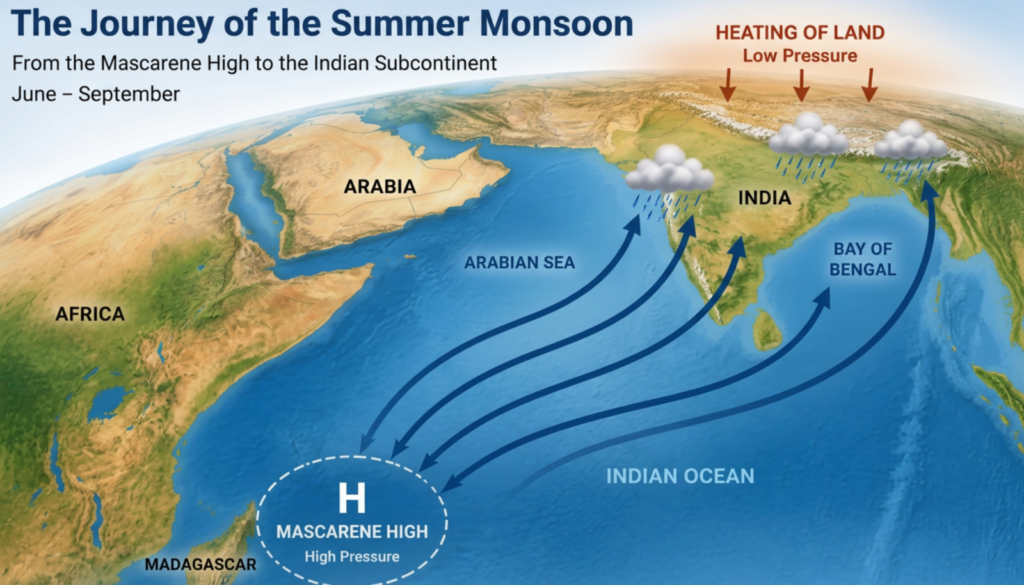
Among these, the Indian Ocean plays a particularly important role. The ISM is driven by southwesterly winds that originate near the Mascarene High in the southern Indian Ocean and travel northward toward the Indian subcontinent (Figure 1). As these winds cross the Arabian Sea and Bay of Bengal, they gain moisture and are influenced by sea-surface temperatures, upwelling, and other oceanic processes before making landfall over India. Climate projections from the Coupled Model Intercomparison Project Phase 6 (CMIP6) generally suggest a stronger monsoon by the end of the century, but the underlying mechanisms remain debated. While some studies propose that a warmer Arabian Sea enhances atmospheric moisture and rainfall, others suggest that it weakens the monsoon by reducing the land–sea thermal contrast. Moreover, many CMIP6 models continue to exhibit substantial regional biases, raising an important question: could ocean biases be contributing to errors in monsoon simulations?
A recent study published in Environmental Research Letters provides new insight into this question. The study shows that CMIP6 models exhibit a pronounced cold sea-surface temperature (SST) bias in the northern Arabian Sea, alongside reduced rainfall over the west coast and northeast India. Using a regional coupled atmosphere–ocean numerical model and targeted sensitivity experiments, the study demonstrates that this cold SST bias can delay the monsoon onset over Kerala by 6-7 days, weaken low-level monsoon winds, reduce moisture transport, and suppress rainfall (Figure 2). It also slows the northward progression of monsoon rainfall, influencing the timing of active and break phases. These findings highlight how SST biases in the northern Arabian Sea can strongly affect monsoon onset, progression, and rainfall variability, emphasizing the need to reduce regional ocean biases to improve future monsoon projections.
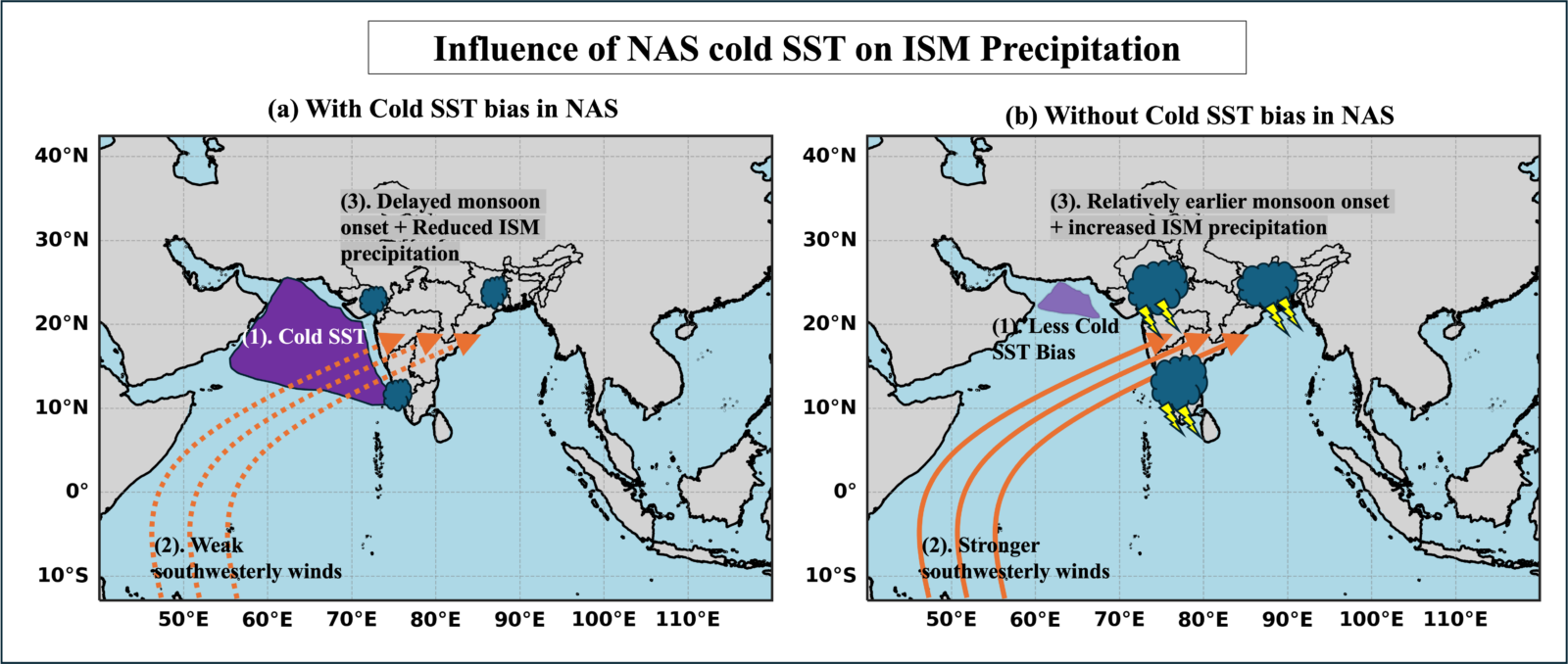
Figure 2 Schematic illustration of the influence of the NAS cold SST bias on ISM characteristics. (a) ISM characteristics under conditions of a pronounced NAS cold SST bias, and (b) ISM characteristics after correction of the NAS cold SST bias. Dashed (solid) arrows indicate weaker (stronger) winds, while smaller clouds (larger clouds with lightning) represent reduced (enhanced) precipitation. The numbered sequence illustrates the chronology of the processes, which are described in detail alongside each panel (source: Lahiri and Pant 2026).
References:
- Lahiri, S. P., & Pant, V. (2026). Role of the northern Arabian Sea cold SST bias in delaying monsoon onset and weakening Indian summer monsoon circulation. Environmental Research Letters (2026). https://doi.org/10.1088/1748-9326/ae8460
- Roxy, M., Ritika, K., Terray, P. et al. Drying of Indian subcontinent by rapid Indian Ocean warming and a weakening land-sea thermal gradient. Nat Commun 6, 7423 (2015). https://doi.org/10.1038/ncomms8423
- Sharmila, S., Joseph, S., Sahai, A. K., Abhilash, S., & Chattopadhyay, R. (2015). Future projection of Indian summer monsoon variability under climate change scenario: An assessment from CMIP5 climate models. Global and Planetary Change, 124, 62-78.
- Sulochana Gadgil. 2003. The Indian Monsoon and Its Variability. Annual Review Earth and Planetary Sciences. 31:429-467. https://doi.org/10.1146/annurev.earth.31.100901.141251.