

Few climate phenomena affect as many people as the Indian Summer Monsoon (ISM). Between June and September, it delivers most of the annual rainfall over the Indian subcontinent, supporting agriculture, water resources, and livelihoods for more than a billion people. Yet predicting how the monsoon will respond to climate change remains a major scientific challenge because it is shaped by complex in ...[Read More]
Can the Ocean Explain Why Climate Models Struggle with the Indian Monsoon?
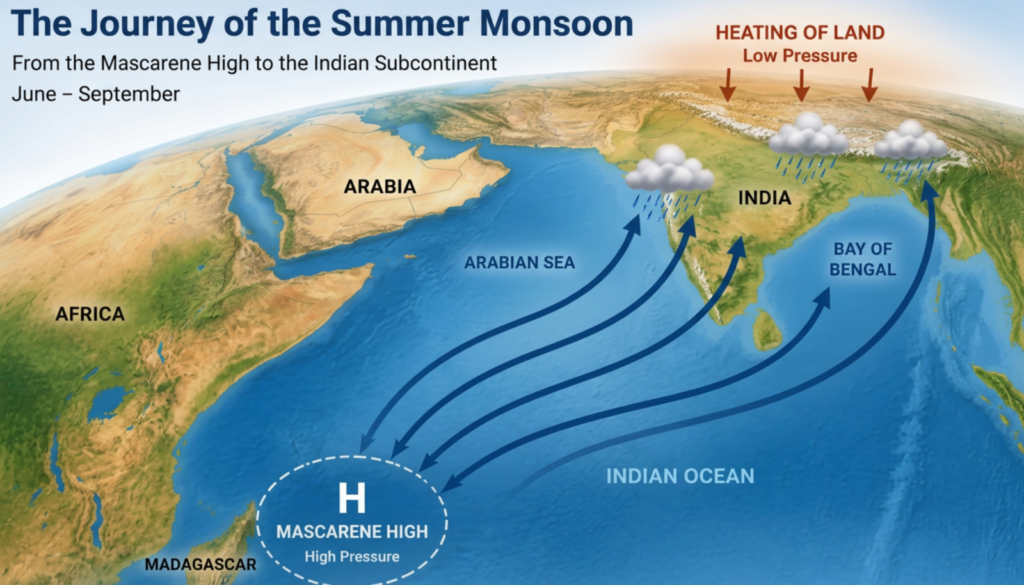
Figure 1 Schematic illustration of the Indian Summer Monsoon circulation. During boreal summer, southwesterly winds (blue arrows) originating near the Mascarene High in the southern Indian Ocean travel across the Arabian Sea and Bay of Bengal toward the Indian subcontinent. Along their path, the winds acquire moisture from the ocean before producing widespread rainfall over South Asia. Image created with the assistance of ChatGPT-5.