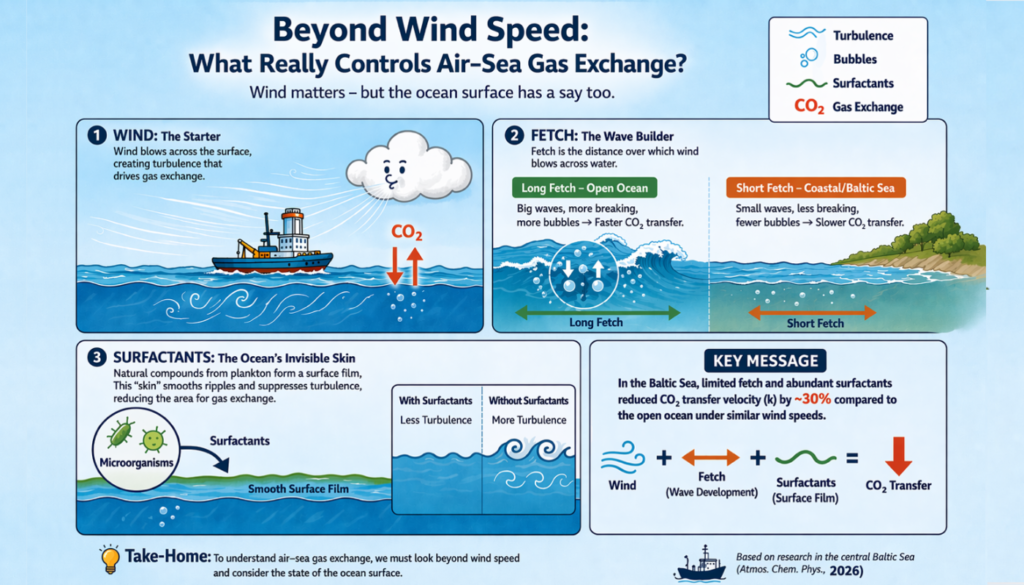
When we think about what drives air-sea gas exchange (such as CO2), wind usually gets all the credit. Strong winds stir the surface, enhance turbulence, and speed up gas transfer. But a new study in Atmospheric Chemistry and Physics shows there is more to the story: CO2 exchange does not just follow the wind, it is also directly affected by surface conditions (Fig. 1).
Using the eddy covariance technique in the central Baltic Sea, researchers directly measured the CO2 transfer velocity (k) and found it to be, on average, about 30% lower than in the open ocean under similar wind speeds (Fig. 2). This difference is mainly explained by two surface-related factors: fetch and surfactants.
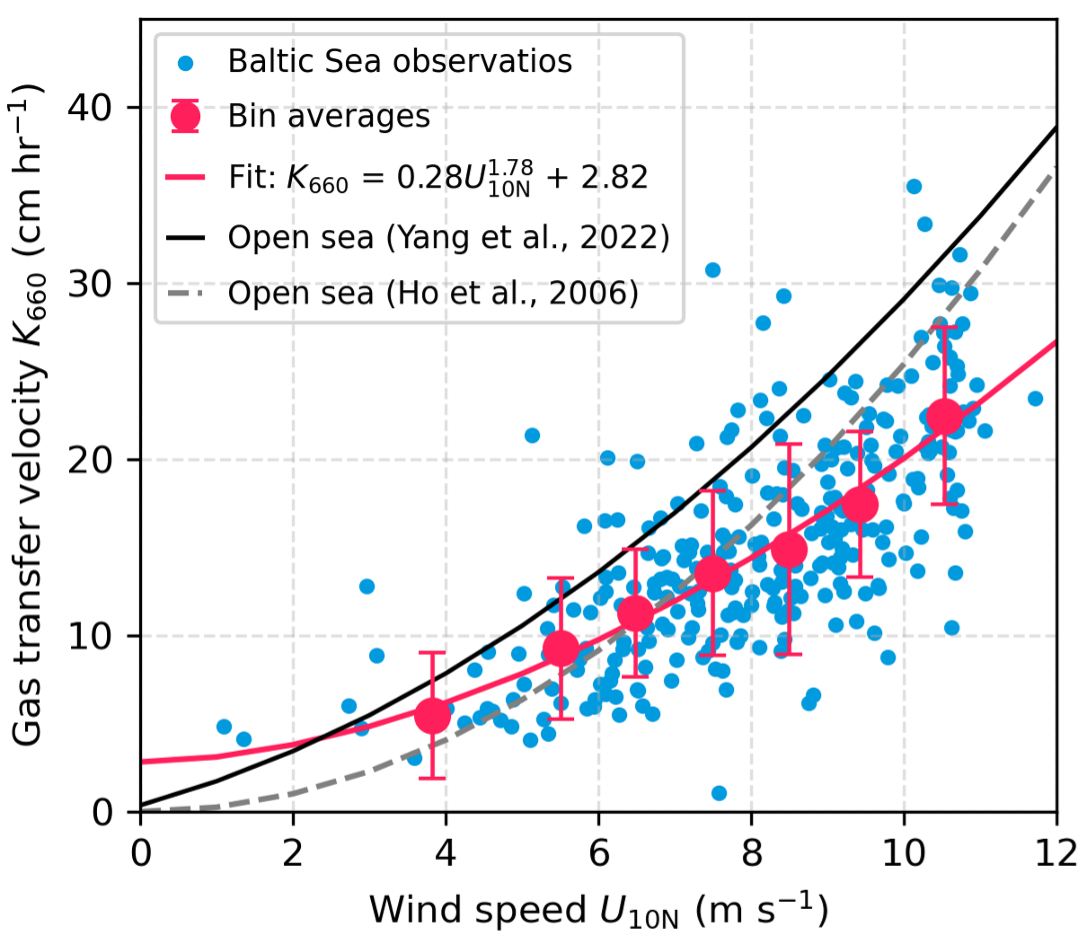
Fig. 2 The observed CO2 transfer velocities in the Baltic Sea (blue points) are significantly lower than the open ocean eddy covariance (black line) or dual-tracer (gray-dashed) data-based parameterisations. Blue points represent K660 derived from the 10-min eddy covariance air-sea CO2 flux observations during the CenBASE cruise, with red points denoting the 1 m s-1 wind speed bins. Red line is the power fit according to the red points. (Figure from Dong et al., 2026)
Fetch is the distance over which wind blows across the water. In the open ocean, long fetch allows waves to fully develop. In contrast, the semi-enclosed Baltic Sea is fetch-limited, and waves remain relatively small, with less breaking and fewer bubbles, reducing bubble-mediated gas transfer (Fig. 3A).
Surfactants produced by plankton and other biological activity are particularly abundant in coastal waters (Fig. 3B). These natural organic films accumulate at the surface, dampening small-scale turbulence and partially blocking the air–sea interface. During the Baltic Sea campaign, the combined effect of limited fetch and elevated surfactants reduced CO2 transfer by about 30% (Fig. 3).
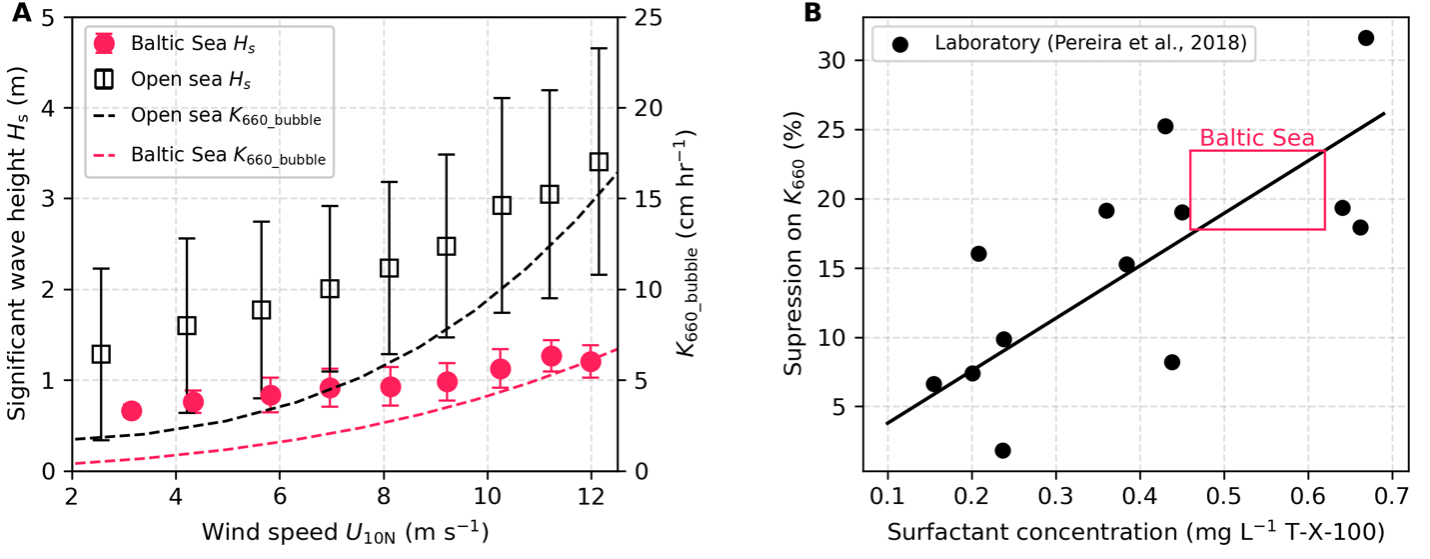
Fig. 3 A: Significant wave height is much lower in the Baltic Sea than in the open ocean under comparable wind speeds, which results in smaller bubble-mediated gas transfer velocity (K660_bubble) according to a sea state-dependent model (Yang et al., 2024). B: Abundant surfactants in the Baltic Sea is expected to suppress the K660 by ~20% according to a laboratory study (Pereira et al., 2018). (Figure from Dong et al., 2026)
The implication is clear: two regions with the same wind speed, such as the open ocean and coastal seas, can exhibit very different gas exchange rates. Standard wind-based parameterisations, largely developed in the open ocean, may therefore overestimate CO2 fluxes in coastal and biologically active regions.
Why this matters for coastal carbon budgets and mCDR
These findings are particularly relevant for the carbon budget in the coastal ocean, where fetch is often limited and surfactants are abundant.
This also has direct implications for marine carbon dioxide removal (mCDR). Many mCDR approaches, such as ocean alkalinity enhancement, are implemented in coastal waters. Reliable, site-specific assessments that account for surface conditions are therefore essential.
Funding and support
This research was led by scientists at GEOMAR Helmholtz Centre for Ocean Research Kiel, including Yuanxu Dong, Christa A. Marandino, Josefine Karnatz, and Anja Engel. The project also involved collaborators from University of Hawaiʻi at Mānoa (Ryo Dobashi, David T. Ho), Leibniz Institute for Baltic Sea Research Warnemünde (Gregor Rehder, Henry C. Bittig, Bita Sabbaghzadeh), and University College London (Helen Czerski). Data analysis by Yuanxu Dong was supported by funding from the Alexander von Humboldt Foundation.
References
- Dong, Y., Marandino, C. A., Dobashi, R., Ho, D. T., Rehder, G., Bittig, H. C., Karnatz, J., Sabbaghzadeh, B., Czerski, H., and Engel, A.: Mechanisms of air–sea CO2 exchange in the central Baltic Sea, Atmos. Chem. Phys., 26, 5567–5587, https://doi.org/10.5194/acp-26-5567-2026, 2026.
- Yang, M., Moffat, D., Dong, Y., & Bidlot, J.-R.: Deciphering the variability in air-sea gas transfer due to sea state and wind history, PNAS Nexus, pgae389, https://doi.org/10.1093/pnasnexus/pgae389, 2024.
- Pereira, R., Ashton, I., Sabbaghzadeh, B., Shutler, J. D., & Upstill-Goddard, R. C.: Reduced air-sea CO2 exchange in the Atlantic Ocean due to biological surfactants, Nat. Geosci., 11, 492–496, https://doi.org/10.1038/s41561-018-0136-2, 2018.