
On Monday 4 May, Tillys Petit delivered the OS Division Outstanding Early Career Scientist Award Lecture at EGU 2026 in Vienna. We chatted with her about the hidden engines driving the Atlantic Meridional Overturning Circulation, and why that matters for the future of our climate. Spoiler: it’s not just about the Labrador Sea!
🌊 Can you share your career journey with us? Did you always dream of becoming an oceanographer, and what inspired you to pursue this path?
Growing up, I was always fascinated by research and understanding the natural world — particularly in areas like climate, the ocean, and health sciences. My aunt, a research scientist in microbiology, gave me an early glimpse into what a scientific career could look like, and that really stuck with me.
That said, my path into oceanography wasn’t entirely straightforward. I initially studied biology before developing a stronger interest in Earth processes, which led me to geology. It was really during my master’s degree that I discovered a passion for ocean sciences and decided to specialise.
After a PhD in France on the large-scale Atlantic Meridional Overturning Circulation (AMOC) in the subpolar North Atlantic, I moved to the US for my first postdoctoral position on the OSNAP project, where I focused on the mechanisms driving AMOC variability using observation-based datasets. Building on that experience, I joined the SNAP-DRAGON project in the UK to work on the intercomparison of key parameters across climate models. I’m currently at the National Oceanography Centre (NOC) in the UK, where I’m a co-investigator on the international RAPID project — which monitors ocean circulation at 26°N.
🌊 Could you describe the research that led to you receiving this award?
My research focuses on improving our understanding of the AMOC: a system of ocean currents that plays a crucial role in our climate by transporting heat, freshwater, carbon, and nutrients throughout the Atlantic Ocean. For Europe in particular, it acts as a kind of heat pump, redistributing warmth from lower to higher latitudes and influencing everything from sea level to the weather patterns we experience day to day.
To investigate this, I combine observational datasets and climate models, which allows me to cross-check findings and build a more complete picture. The core of my work has been to help shift the perspective on where and how dense waters are formed in the subpolar North Atlantic — a process that is a crucial driver of the AMOC. Before the OSNAP programme, the field was largely dominated by a Labrador-centric view. But results from the OSNAP observing system revealed that deep water production in the Labrador Sea is actually quite small, raising the question of where these waters are actually formed.
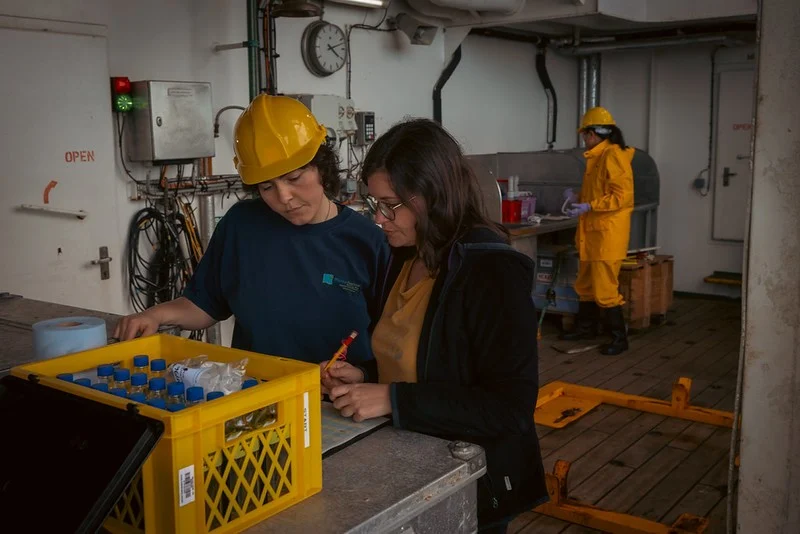
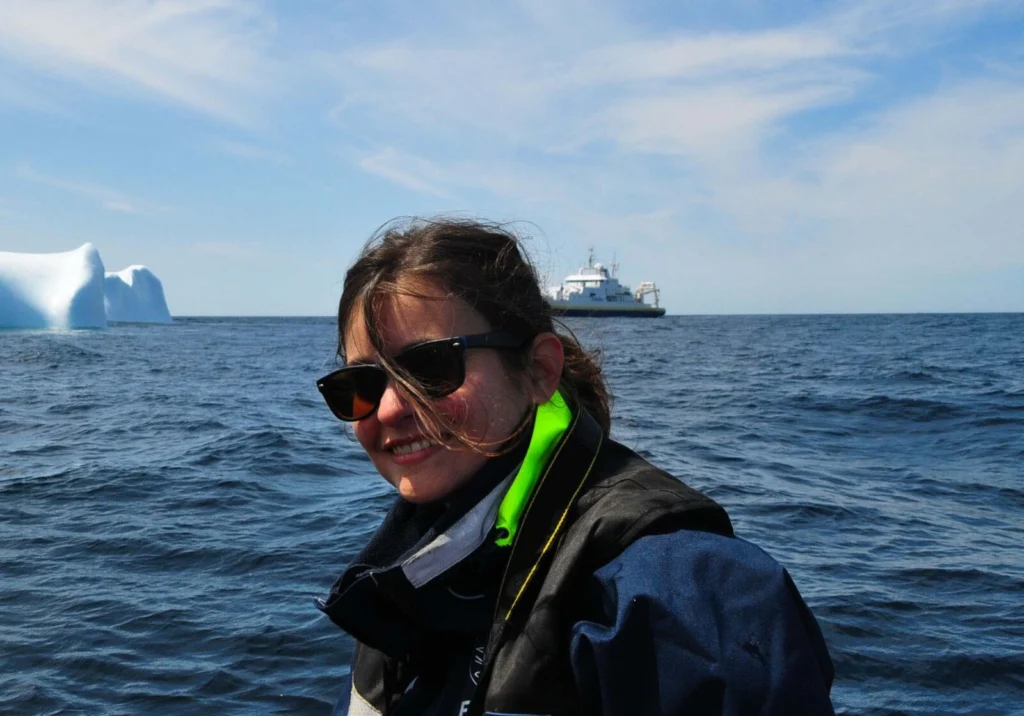
Image: Tillys on a field campaign.
My 2020 paper — which built directly on the landmark Lozier et al. 2019 OSNAP results — showed that these dense waters are largely formed outside the Labrador Sea, primarily through buoyancy forcing in the Irminger and Iceland basins. This implies that atmospheric forcing over these basins is likely a more important predictor of AMOC variability than forcing over the Labrador Sea, at least on observational timescales. That has significant implications — for climate modellers trying to improve projections of AMOC evolution, and for palaeoceanographers interpreting records of past AMOC variability who have so far focused mainly on the Labrador Sea.
🌊 What does this recognition mean to you, both personally and professionally?
I was surprised and truly delighted to receive this award! On a personal level, it feels like a reflection not just of my own work, but of the many collaborations and interactions that have shaped it over the years, through my PhD, my postdocs, and my current position. Research is very much a collective effort, and I’ve been fortunate to work with supportive colleagues, mentors, and collaborators who have all contributed in different ways.
Professionally, it is both encouraging and motivating at this stage of my career. It provides visibility within the ocean sciences community and reinforces the importance of the research we are doing at the NOC.
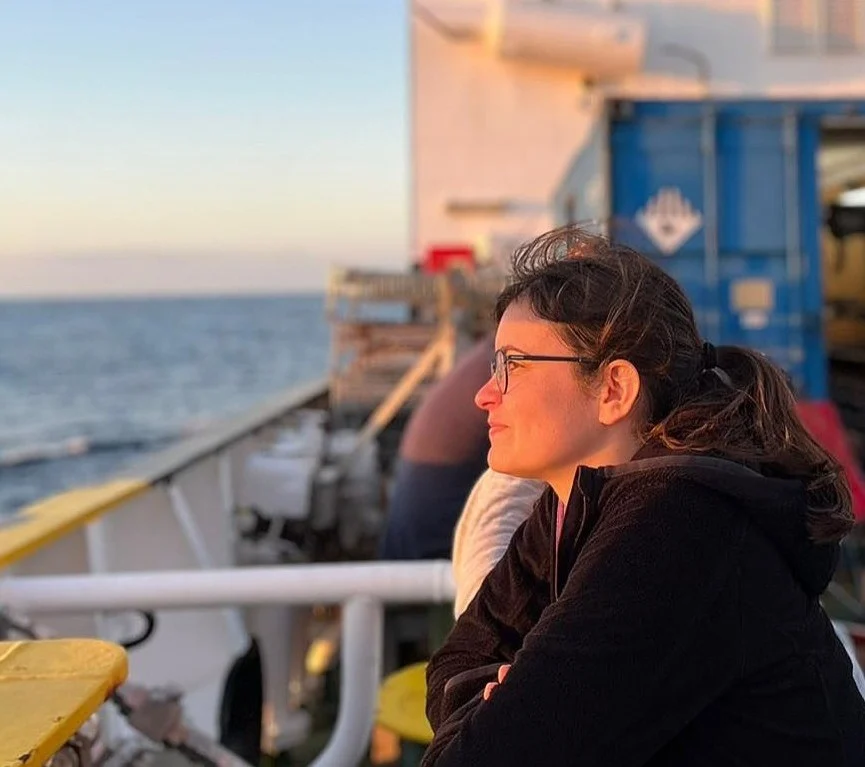
Image: Tillys on a field campaign.
🌊 What have been some of the biggest challenges in your career, and were there key moments that shaped your path?
One of the main challenges has been working on a system as complex as ocean circulation, where processes occur across a wide range of spatial and temporal scales and are inherently difficult to observe directly. This requires combining different approaches — models, observations, reanalyses — while constantly navigating and communicating uncertainty. My answer to that has largely been collaboration: seeking out colleagues with complementary expertise and learning from them.
I’ve been fortunate in that respect. The AMOC research community, while specialised, is one where people know each other well. There are many workshops and conferences where you can build new connections, and that culture of openness has been invaluable to me. In many ways, the collaborations I’ve built across my postdoctoral positions have been the defining thread of my career so far.
🌊 Looking ahead, what are the most important questions about the Atlantic overturning circulation that you are excited to tackle?
One of the most pressing open questions (and one that has been making headlines in recent years) is whether the AMOC could undergo a significant, or even abrupt, weakening as a result of anthropogenic climate change. This has been suggested by many climate models, but it remains difficult to observe directly. The longest continuous record we have is the RAPID time series, spanning the last 20 years, which is still not long enough to detect a statistically robust trend.
And yet the stakes are high: even a relatively modest weakening of the AMOC could have substantial impacts on climate in Europe and beyond. Understanding by how much, and on what timescale, this weakening might occur is therefore one of the most urgent questions in our field.
Answering it requires sustained, reliable observations. Arrays like RAPID and OSNAP are essential infrastructure. They allow us to monitor changes in real time, deepen our understanding of this complex system, and better assess potential risks. That is why I am genuinely excited to contribute to this effort through my role as co-investigator on the RAPID project.
🌊 What advice would you give to young scientists who want to make a difference in ocean circulation and the wider ocean sciences?
Stay open to new ideas and don’t be afraid to follow an unconventional path. Ocean science is highly collaborative, and there is a real need for fresh perspectives and diverse skills. Fields like machine learning and AI are increasingly finding their way into ocean sciences, and that creates exciting opportunities for scientists who are willing to be curious and bring their own ideas to the table.
I would also encourage early career researchers to seek out international experiences where possible. Immersing yourself in different scientific environments and ways of thinking can be genuinely transformative. It often leads to the collaborations that end up shaping your research for years to come!
Thank you, Tillys, for the interview and for sharing your career insights and advice!
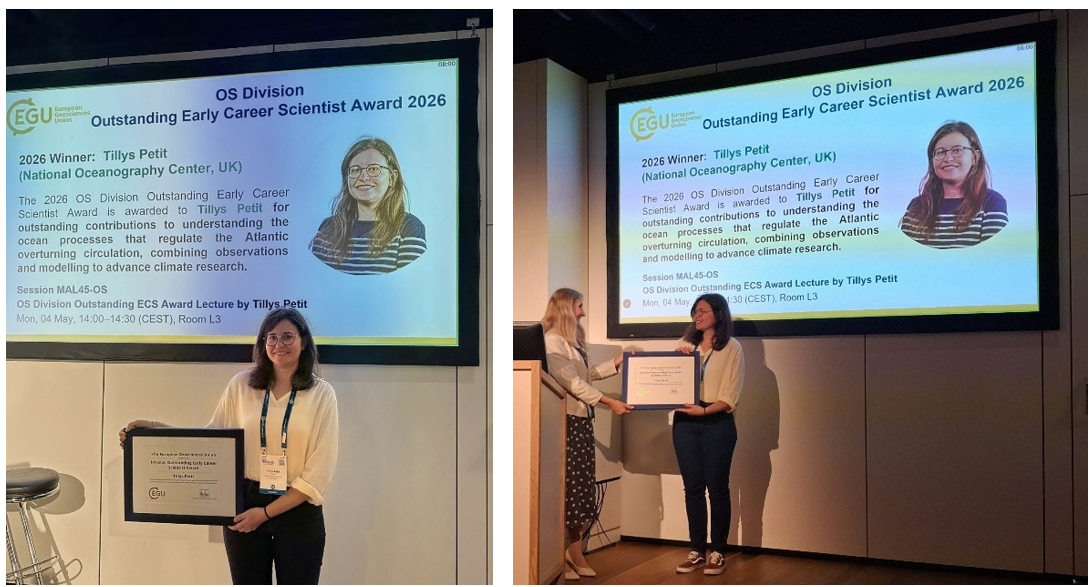
Image: Tillys giving her award lecture and receiving the OS Division Outstanding ECS Award!
Read more:
Google Scholar profile of Tillys Petit
Interviewed and edited by M. Keppens
