

When we think about what drives air-sea gas exchange (such as CO2), wind usually gets all the credit. Strong winds stir the surface, enhance turbulence, and speed up gas transfer. But a new study in Atmospheric Chemistry and Physics shows there is more to the story: CO2 exchange does not just follow the wind, it is also directly affected by surface conditions (Fig. 1). Using the eddy covariance te ...[Read More]
Beyond wind speed: what really controls air-sea gas exchange?
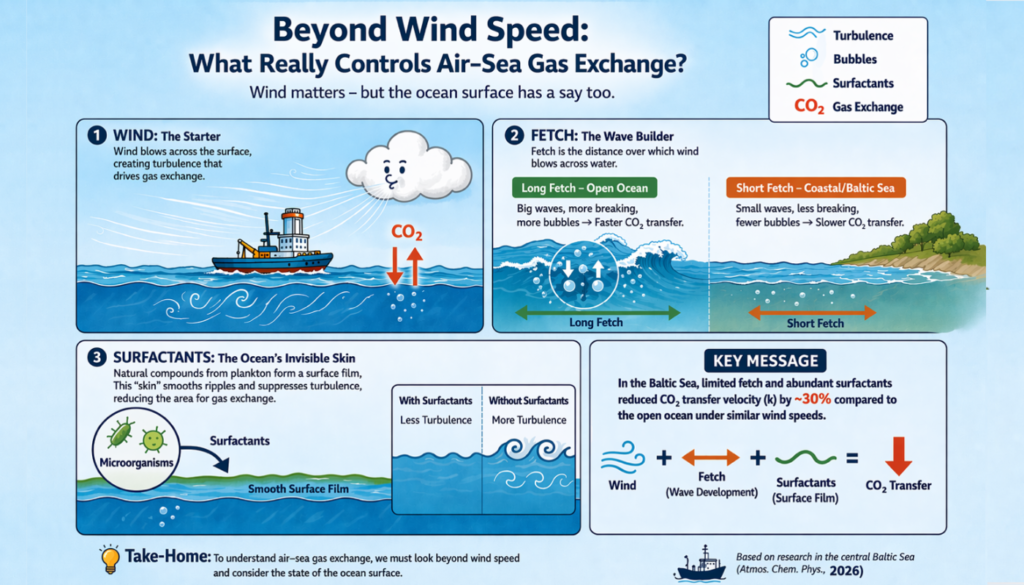
Fig. 1 Limited fetch and elevated surfactant concentrations suppressed the CO2 transfer velocity by ~30% in the central Baltic Sea during the CenBASE cruise. Although illustrated here for CO2, the processes are broadly applicable to other greenhouse gases. Figure created with the assistance of ChatGPT 5.