This year, Anne Klosterhalfen has received the Biogeosciences Division’s Outstanding Early-Career Scientist Award. The BG team warmly celebrates this well-deserved recognition! We talked to her about her scientific journey and research contributions, with the hope of inspiring the next generation of biogeoscientists.
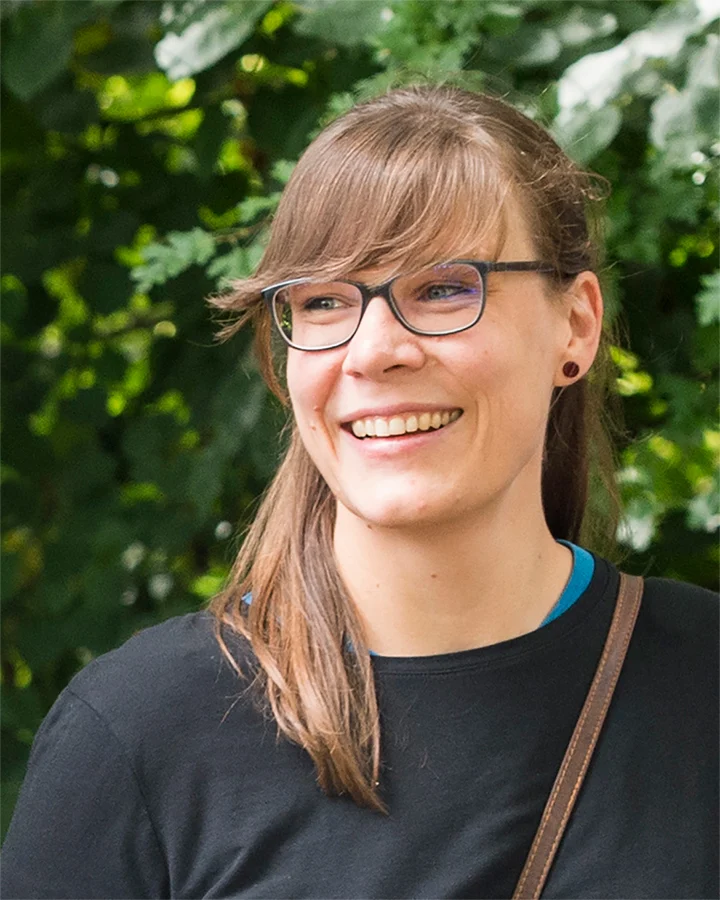
Anne Klosterhalfen
Could you tell us a bit about yourself and what inspired you to pursue a career in biogeosciences?
Everything happened by chance. I studied Geography at the University of Bonn in Germany, and I loved to gain general knowledge about the Earth system, but also about human impacts. I also had to do several internships, one of which was at the Research Center Jülich in Germany. There, I got in contact with biogeosciences for the first time. My supervisor taught me how to code and introduced me to soil carbon modelling. After my master thesis, I was offered a research assistant position, where I extended the soil carbon model to an ecosystem carbon model for cropland or grassland. For my PhD, I shifted topic slightly: While before I had used eddy covariance flux data for model validation, for my PhD studies I concentrated fully on eddy covariance data and on so-called source partitioning methods. Because you can only measure the net balance of CO2 and water vapor fluxes with the eddy covariance technique, but you need to apply source partitioning methods to obtain the different flux components. I wanted to know how much CO2 is assimilated by plants, how much is released by the soil, how much H2O is transpired, and how much is evaporated.
After my PhD and a short PostDoc position in Jülich, I worked at SLU in Umeå, Sweden, on the topic of tall-tower eddy covariance measurements. And now I am a PostDoc here in the Bioclimatology Group in Göttingen, Germany. So, in all my positions since my PhD, I always worked with the eddy covariance method and studied flux data. Now in Göttingen, I also maintain with a team of technicians and scientists up to nine flux tower sites in various ecosystem types. Together with my colleagues, I obtain a lot of different data, not only meteorological and flux data, but also biomass and soil data, we conduct forest inventories, etc. The study sites give us opportunities for many different collaborations with colleagues from other institutions and from various disciplines, such as modellers, remote sensing and plant physiology. So, I am kind of involved in this entire field of biogeosciences.
Could you briefly describe your research area and your specific contributions to the field?
My general research area now is land-atmosphere interactions – mainly in forest ecosystems, since I am working at the Forestry Faculty of the University of Göttingen. I study how ecosystems exchange CO2, water vapor, and energy with the atmosphere above, what are the feedback processes, and how ecosystems are impacted by climate change and extreme events. I also investigate the resilience of ecosystems towards climate change and disturbances, as well as the interaction with human systems.
Perhaps one big contribution to the field is that I maintain these study sites with eddy covariance towers together with my team. We try to obtain high-quality data and long time series, so other scientists can use them for their model simulations and so on. In my own work I concentrate on improving the methodology and post-processing approaches for eddy covariance data to lower uncertainty and on improving process understanding across scales. With the eddy covariance technique, we work on the ecosystem scale, but then we cooperate with plant physiologists that work on tree scale and with a lot of remote sensing scientists that work on even larger scales. Overall, we want to know how to increase the resilience of our forests and find a way to make our findings applicable.
What key knowledge gaps still need to be addressed in this area?
There are still a lot of open questions about process understanding. Some colleagues in the group work in the field of micrometeorology and on the improvement of measurement techniques for trace gases and isotopes and understanding of turbulence. We also investigate the interaction between the water and carbon cycle, and the stomatal regulation. While plants do photosynthesis, they lose water which has a positive, cooling effect on the one side, but can also have a negative effect on the other side, for instance during droughts. We still need to investigate this interaction further.
Another gap is how these processes translate across different temporal and spatial scales. What are the interactions during the day and night, what are the different drivers on a daily or annual scale, and how do they change over time? How do the processes on tree scale influence the interactions on ecosystem level, and how does the resilience of a landscape depend on its heterogeneity?
And related to eddy covariance stations: most of the first flux towers were established about 20 or 30 years ago. For instance, our ICOS flux site in the Hainich National Park was established in 1999, so we now have more than 25 years of data. The time series are finally quite long which gives us the opportunity to investigate extreme events and legacy effects etc. with a suitable reference period. There are a lot of new statistical methods coming up, so we can really dive much deeper into time series analyses. Moreover, a lot of new methods of measurement techniques and data analysis approaches in different disciplines have been advanced very quickly lately. So we have additional possibilities to investigate some key knowledge gaps, for instance with laser scans for forest structure, drone surveys, several new remote sensing products, and machine learning approaches.
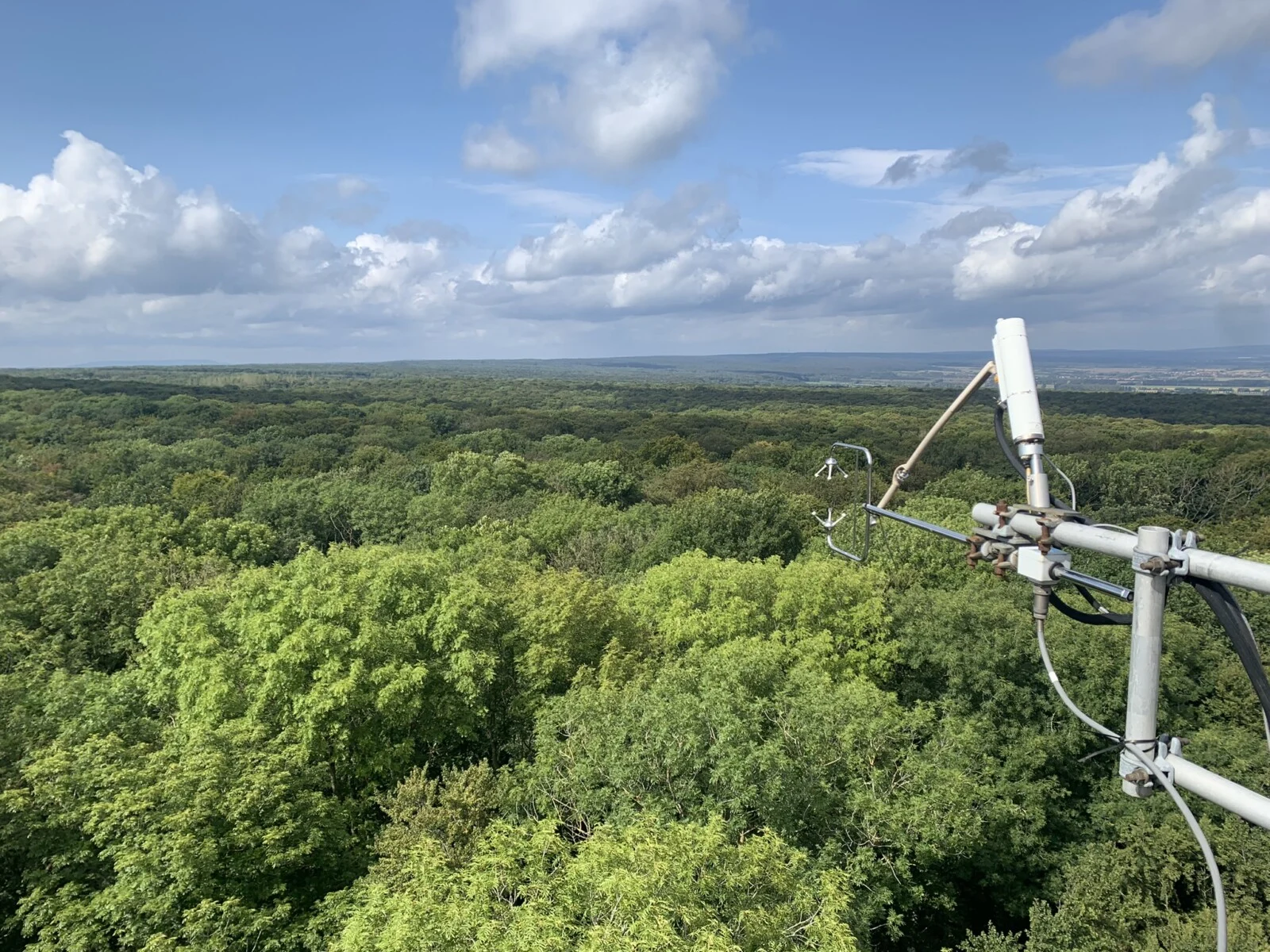
Hainich Eddy Covariance System (Author: Anne Klosterhalfen)
What have been the biggest challenges and the greatest opportunities in your career so far?
I am still struggling with time management and to keep deadlines. I have several roles: On the one hand, I am teaching, supervising students, doing administrative tasks etc., for which you have quite strict deadlines. If I have to give a lecture on Monday, it has to be ready by then. But then other tasks for my own science, such as writing project proposals or my own publications, the deadlines are not so strict and thus these tasks barely become a priority. To have time for my own scientific work is quite challenging for me!
Connected to that, saying “No” is also something difficult for me. As I said, as a geographer I am interested in a lot of topics and when people ask me to collaborate or supervise theses on an interesting topic, even though the work is only loosely related to my own or does not directly advance my own career, it is really hard to say “No”. I still have to learn that I cannot do everything.
Also outreach activities are challenging because we need to communicate correctly. In my opinion it is really important to communicate our findings to other people. I do not only want to present a lot of information, but people should understand and remember our work, findings, and messages. I think this is a very important purpose of our scientific work and we have to communicate properly.
Regarding my greatest opportunities: I have to say I had and have really great supervisors and mentors, I learnt and I am still learning a lot from them, not only scientifically but also on how to lead a group – how to interact with scientists, but also with the other important parts of staff, such as technicians and administration, how to handle finances and plan ahead, and so on. My supervisors always provided a lot of opportunities, such as going to conferences or doing an international research stay. I worked at four different institutions with different employee numbers and group sizes, so I got to know different systems. Also I came in contact with the measurement networks FLUXNET and ICOS quite early in my career and at my first EGU conference, my PhD supervisor, Alexander Graf, introduced me to so many eddy covariance people. These circumstances have helped me build a strong network and led to quite a few collaborations.
What are your next goals, both scientifically and professionally?
Professionally in the near future, I want to write my own project proposals to advance my own scientific interests. I would like to establish my own little group within the department. Currently, I am supervising two PhD students and I would like to increase this number.
Scientifically, I am writing a data paper about our flux station in the Hainich National Park, describing the datasets and variables we obtain and making them more visible. And then, I would like to dive more into understanding the coupling between H2O and CO2, and the stomatal regulation of the trade off between cooling effect and water loss at different spatial scales. And how this influences the resilience of various forest ecosystems.
What general advice would you give to early-career scientists?
We scientists have to realise and accept that failure is a big part of science: you fail during field work (instruments break, you forgot the battery, something gets stolen etc.), your paper gets rejected and you have to re-do everything, or somebody deleted data by accident. These things happen to everyone. We have to accept that and learn how to live with that. And we should remember the great and successful moments and celebrate properly.
We should always try to network or communicate with others, get help and support when needed. It is not only important to communicate with your peers about science, but also about your experiences, hard and good times, if you are struggling, about your well-being, and so on. Exchanging with others usually helps me to keep up my motivation and reminds me of the purpose of our work. Personally, I am very lucky that I have a lot of fun with my job, I love it. So I would say, have fun!