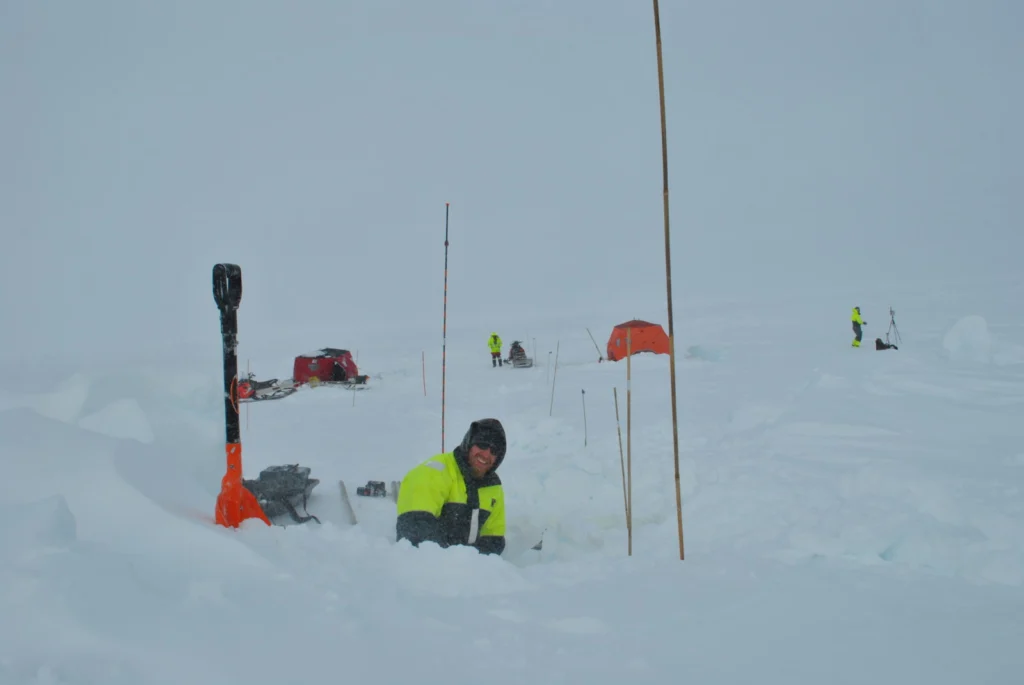
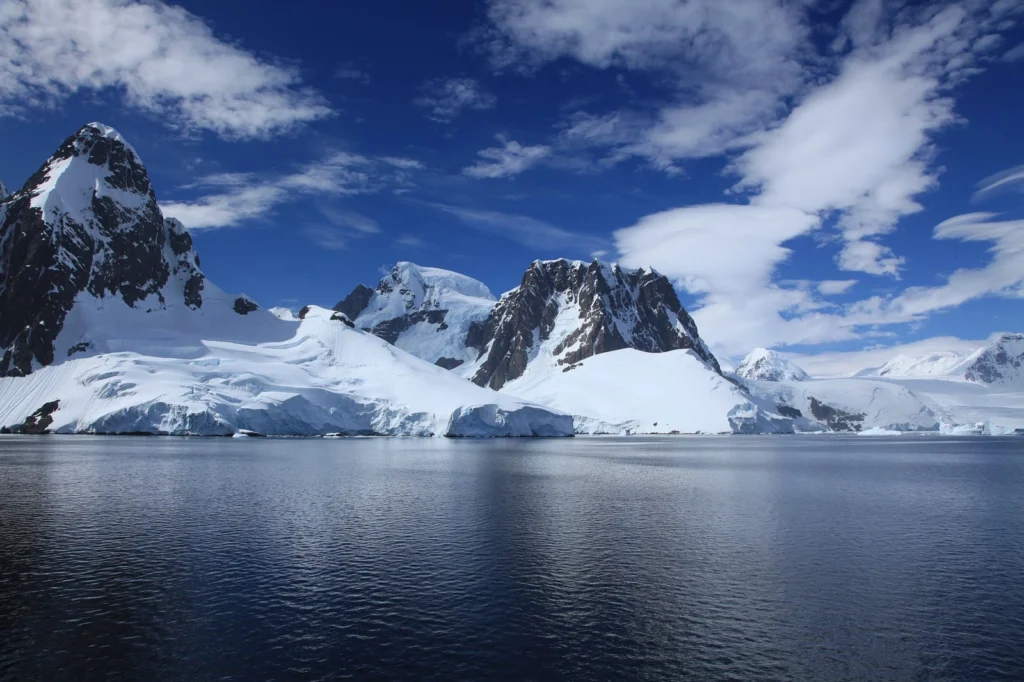
An email from Giuliana Panieri, a geology professor at the Arctic University of Norway (UiT) in Tromsø, cracked my pandemic bubble late last year. She invited me to join an unconventional expedition (AKMA OceanSenses) to the Arctic Ocean, where scientists worked hand-in-hand with other societal actors, to integrate different kinds of knowledge and create tools …[Read More]
Latest posts
Cryospheric Sciences
Wake up every one – permafrost microbes feasting – greenhouse gases go
I really like to combine science and art. This puts science in a larger perspective and can help understand it in different ways. And perhaps more importantly, it evokes emotion. I wrote haikus and created stencils for every chapter of my PhD thesis. I created these artworks to illustrate the dimensions of the permafrost region …[Read More]
Geodynamics
Magnets are cool, and….. so is the Earth!
Magnets are cool, who does not like them? And the planet that we live in, the Earth, itself is a huge magnet. Not only does the Earth’s magnetic field protect us from harmful radiation from space, but it can also help us reveal some of the secrets of our planet. Local variations in the magnetic …[Read More]
GeoLog
Sustainable Energy Geoscientist reflects on UN’s COP27
This year, from 6 to 20 November, the United Nation’s COP27 took place in Sharm el-Sheikh in Egypt. The conference hosted several high-level and side events, key negotiations and press conferences, attended by more than 100 Heads of State and Governments and over 35,000 participants who deliberated climate action strategies around the world. I had …[Read More]
Climate: Past, Present & Future
A glimpse into the INTIMATE’s summer school of 2022
The Earth’s climate has been rapidly changing in the last decades. That’s a fact! Virtually, every one of us has been experiencing those changes in person, but how do we know that Earth’s climate has changed in the past beyond the instrumental data of the last ~200 years? From ancient manuscripts to geologic records, there …[Read More]
GeoLog
Imaggeo On Monday: Computing for a blank globe
A tribute to the computational geosciences. A mix of computer infrastructure, a modern workstation, and a simple globe with coastlines. Found this scene at the back of room at Miraikan – the National Museum of Emerging Science and Innovation in Tokyo, Japan. The computers, screens, and globe are behind a plexi-glass and while not intended …[Read More]
Geodynamics
G-ADOPT: a next generation computational modelling framework for geodynamics
Schematic illustrating core components of G-ADOPT, an Australian based cross-NCRIS project, principally developed at the Australian National University (ANU), with partners at the University of Sydney and Imperial College London. G-ADOPT is supported by the Australian Research Data Commons (ARDC), with co-investment from AuScope, the National Computational Infrastructure (NCI) and Geosciences Australia. The Geodynamic ADjoint …[Read More]
Cryospheric Sciences
Discover the CordillerICE project!
In high-school, I learned in a textbook that glaciers are melting. My teacher said that what was written in that textbook was right, and that was it. There was no proof, no explanation, no scientist’s testimony. All of that, I discovered much later during my studies in the geosciences. Yet as the global temperatures keep …[Read More]
Geodynamics
The Sassy Scientist – Pick Your Battles
As I already mentioned in the past, anonymity can lead to bad reviews. A state of namelessness can empower younger scientists to criticize manuscripts from potential future employers. But it also allows unaccommodating reviewers to stall a perfectly good submission for…reasons? Meia has encountered, or heard of such buffoons, and wonders: How to deal with …[Read More]
GeoLog
GeoPolicy: A new step to build robust science-for-policy ecosystems in Europe
On 25 October, The European Commission published a Staff Working Document that aims to help Member States build capacity to use scientific knowledge more effectively in their policymaking processes. This month’s GeoPolicy Blog post provides a summary of the Staff Working Document that outlines key science for policy challenges and the EU instruments, resources and …[Read More]