GeoLog

Jupiter

Why are NASA scientists holding eggs? The surprising new physics of Jupiter & the latest briefing on Juno’s mission
Why are NASA scientists holding eggs? The surprising new physics of Jupiter & the latest briefing on Juno’s mission

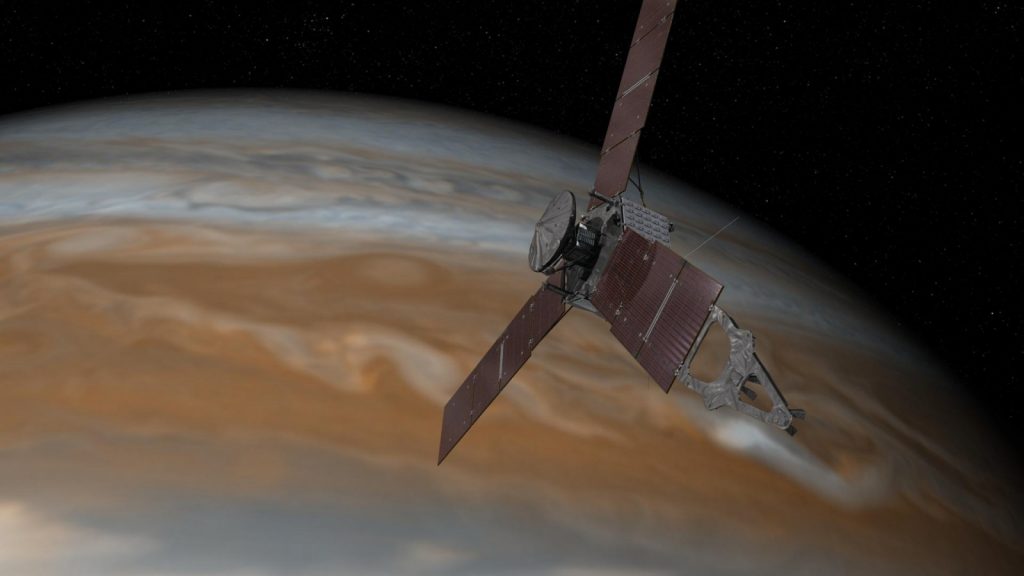
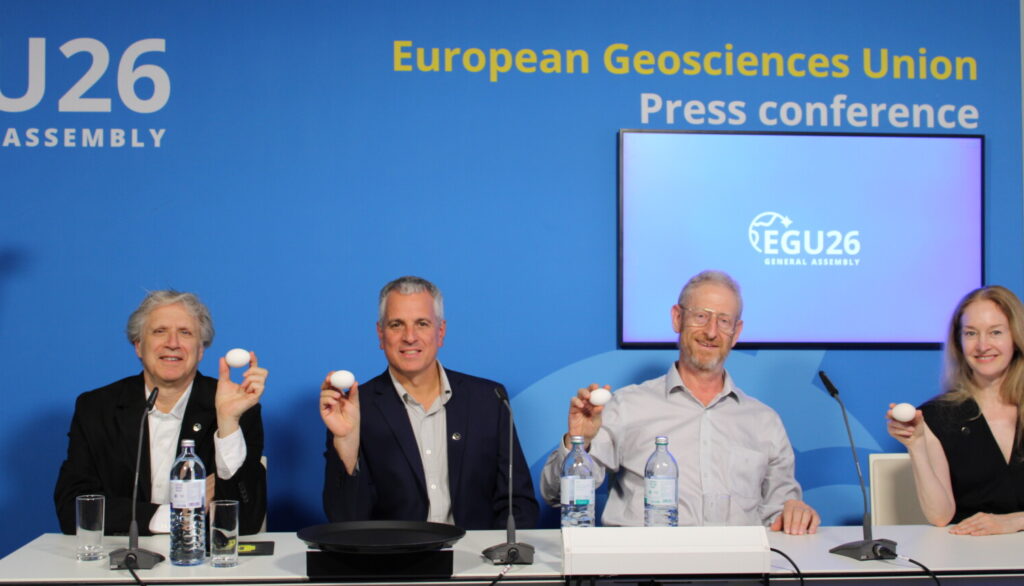
The latest NASA Juno briefing was presented at EGU26 yesterday. Speakers introduced unprecedented results that not only deepened our understanding of Jupiter but also invited us to reflect on the future of scientific methodology. Whether you’re a space geek or a tech enthusiast, hop in, as we’re about to take you on an exploratory journey to learn about how neural networks, serendipitous cameras, ...[Read More]

Io: a spongy world consumed by molten rock

Io: a spongy world consumed by molten rock

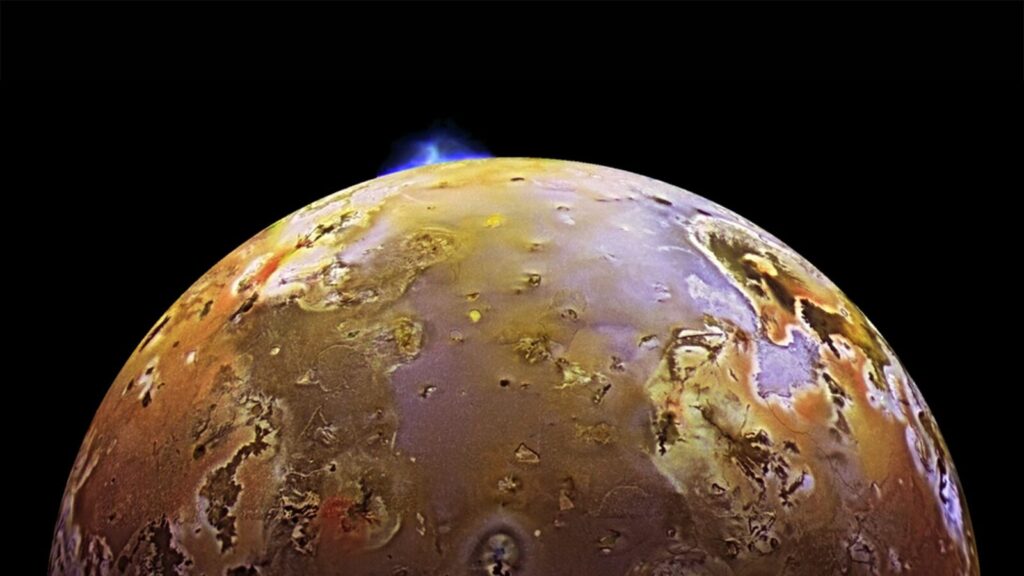
Jupiter’s moon Io is the most volcanically active world in our solar system, with hundreds of volcanoes that constantly erupt on its ever renewing surface. Although Io always points the same side toward Jupiter in its orbit around the gas giant, two other Galilean moons, Europa and Ganymede, pull Io’s orbit into an irregularly elliptical one. Thus, in its widely varying distances from ...[Read More]

GeoTalk: meet Georgia Moutsiana, researcher of Jupiter’s magnetosphere!

Georgia Moutsiana

Hello Georgia – welcome to GeoTalk! Could you tell our readers a little bit about yourself and your background? Thank you, Simon! I’m Georgia Moutsiana, a space scientist and PhD candidate at the National and Kapodistrian University of Athens, Greece. My research focuses on understanding the processes that accelerate and transport charged particles in planetary magnetospheres. My key message is th ...[Read More]

Tectonics on Ice…. learning about Jupiter’s Icy Moons and the JUICE mission.

Tectonics on Ice…. learning about Jupiter’s Icy Moons and the JUICE mission.

In April this year a new mission is being launched by the European Space Agency, called JUICE, which stands for the Jupiter Icy Moons Explorer. This mission aims to make detailed observations of the giant gas planet Jupiter and its three large ocean-bearing moons – Ganymede, Callisto and Europa – with a suite of remote sensing, geophysical and in situ instruments. But beyond the excitement of a ne ...[Read More]

NASA’s Juno mission reveals Jupiter’s magnetic field greatly differs from Earth’s

NASA’s Juno mission reveals Jupiter’s magnetic field greatly differs from Earth’s

NASA scientists have revealed surprising new information about Jupiter’s magnetic field from data gathered by their space probe, Juno. Unlike earth’s magnetic field, which is symmetrical in the North and South Poles, Jupiter’s magnetic field has startlingly different magnetic signatures at the two poles. The information has been collected as part of the Juno program, NASA’s latest mission to unrav ...[Read More]

April GeoRoundUp: the best of the Earth sciences from the 2018 General Assembly

April GeoRoundUp: the best of the Earth sciences from the 2018 General Assembly

The 2018 General Assembly took place in Vienna last month, drawing more than 15,000 participants from 106 countries. This month’s GeoRoundUp will focus on some of the unique and interesting stories that came out of research presented at the Assembly. Mystery solved The World War II battleship Tirpitz was the largest vessel in the German navy, stationed primarily off the Norwegian coastline as a fo ...[Read More]

Imaggeo on Mondays: That spot there? It’s 143,000 kilometres across

This week’s Imaggeo on Mondays highlights an amazing view of the night sky at new moon. Christian Klepp took this photo while at Waterton Glacier in the Rocky Mountains – it’s an incredible feat of determination to spend the night beside a glacial lake in the Rockies, let alone to capture such a photo! The centre of the Milky Way lies just over the horizon, shrouded by clouds of interstellar dust. ...[Read More]