The latest NASA Juno briefing was presented at EGU26 yesterday. Speakers introduced unprecedented results that not only deepened our understanding of Jupiter but also invited us to reflect on the future of scientific methodology. Whether you’re a space geek or a tech enthusiast, hop in, as we’re about to take you on an exploratory journey to learn about how neural networks, serendipitous cameras, and a few spinning eggs are cracking the secrets of the solar system’s biggest giant.
The EGU26 General Assembly continues to showcase a vast array of geoscientific research, which spans from terrestrial soil science to the frontiers of planetary exploration. A primary highlight of yesterday’s proceedings was a press conference featuring four distinguished NASA scientists. The panel provided a comprehensive update on the Juno mission and delivered unprecedented data on Jupiter’s complex internal dynamics and structure.
If this is your first time hearing about Juno, just know that it is a solar-powered robotic probe studying Jupiter, the largest planet in our solar system. It’s probably a bit too far to go and say hello, but you can meet it virtually thanks to this interactive diagram.
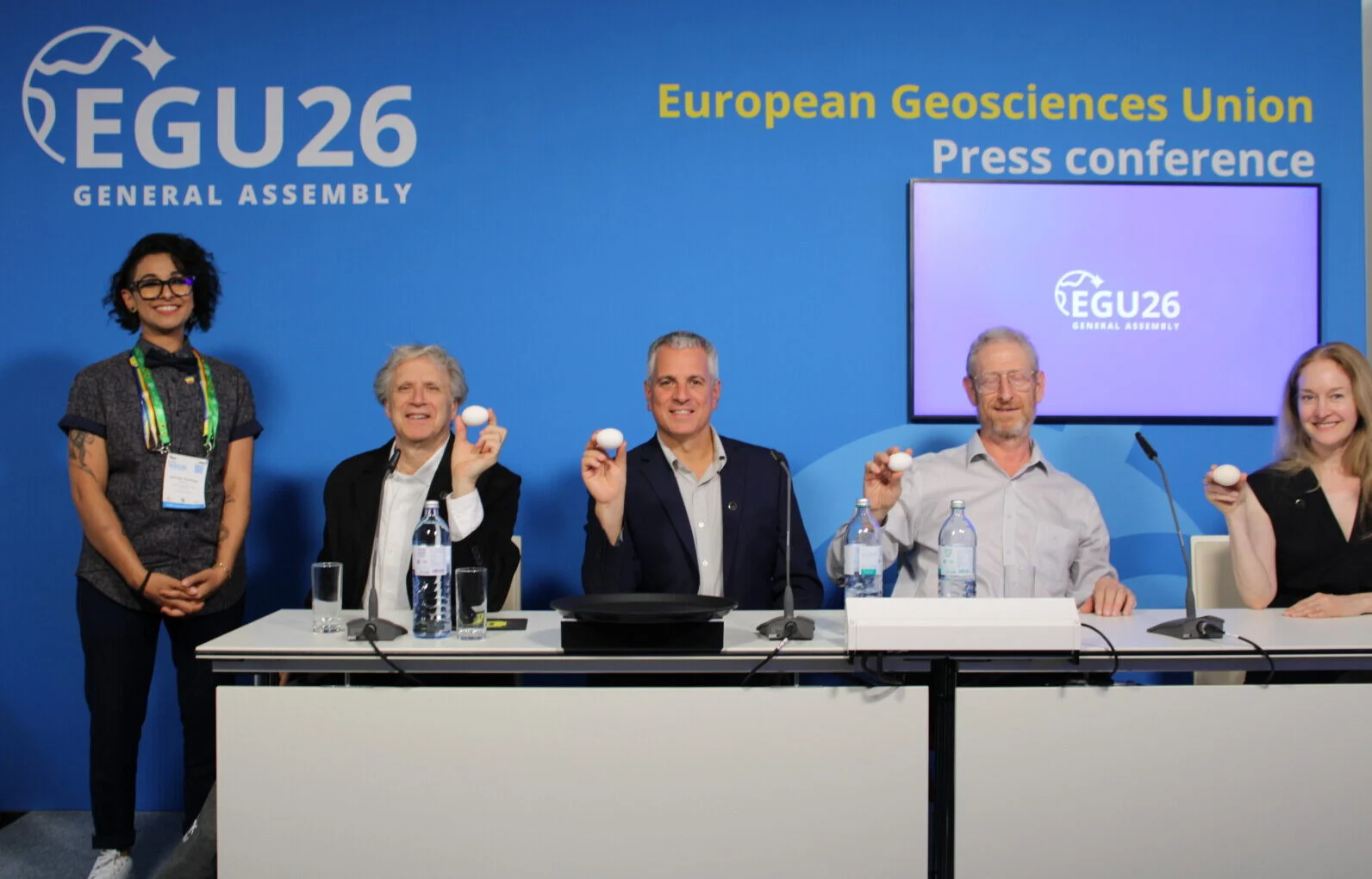
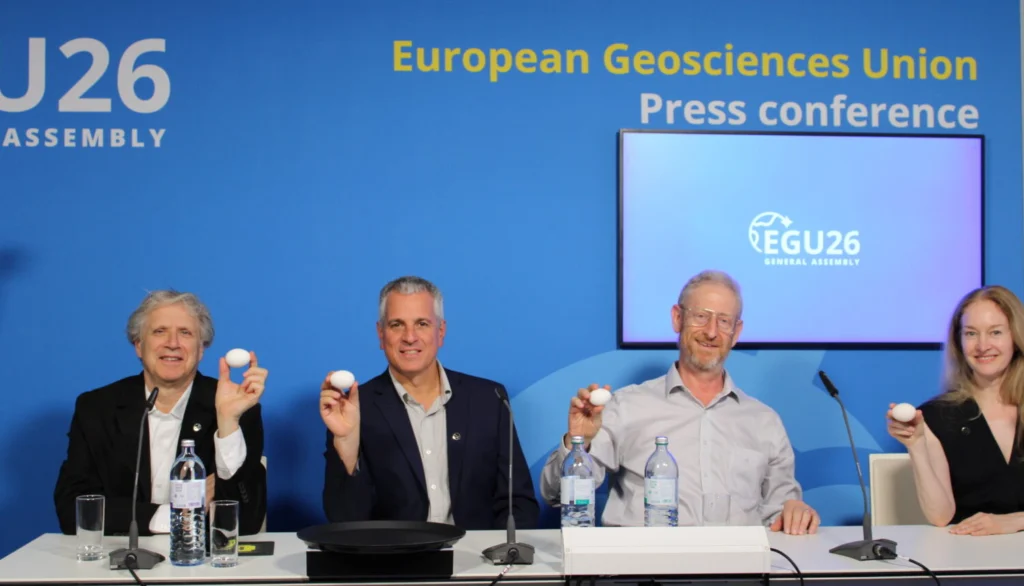
Speakers at the Press Conference. From left to right: Scott Bolton (Southwest Research Insitute,); Yohai Kaspi (Weizmann Institute of Science), Steve Levin (Jet Propulsion Laboratory); Heidi Becker (Jet Propulsion Laboratory). Why are they holding up eggs, you ask? Keep reading! Photo credit: Kaisa Säkkinen
Juno arrived near Jupiter in 2016, after a 5-year long journey. It has been scanning and mapping the planet ever since, orbiting around its poles, and getting closer than any other probe before it. Juno’s data collection is facilitated by a suite of scientific instruments. A notable component of this payload is the Stellar Reference Unit (SRU), a high-precision engineering camera. While the SRU was originally designed for attitude determination (navigating the spacecraft by imaging star fields) it has since proven to be a versatile tool for broader scientific discovery. However, as Heidi Becker explained, its ability to capture ultra-low-light images almost serendipitously helped study Jupiter’s dust ring and the surfaces of some of its moons:
A lot of people don’t even know that Jupiter has a ring because it is not like Saturn’s ring, that’s very bright and shiny because it is made of water ice and reflects the sun. [Jupiter’s ring] it’s made of dust from meteoroid impacts on its tiny moons. It’s a place that still has a lot of mystery to it. said Heidi.
Newly released data from the Juno mission shared during this briefing offered critical insights that are currently helping to decipher these complex scientific questions. Among them a beautiful close up shot of Phoebe (a small outer moon of Jupiter) and the recording of what sounded like an extraterrestrial sandstorm, but was, in fact, space dust continuously hitting on the spacecraft.
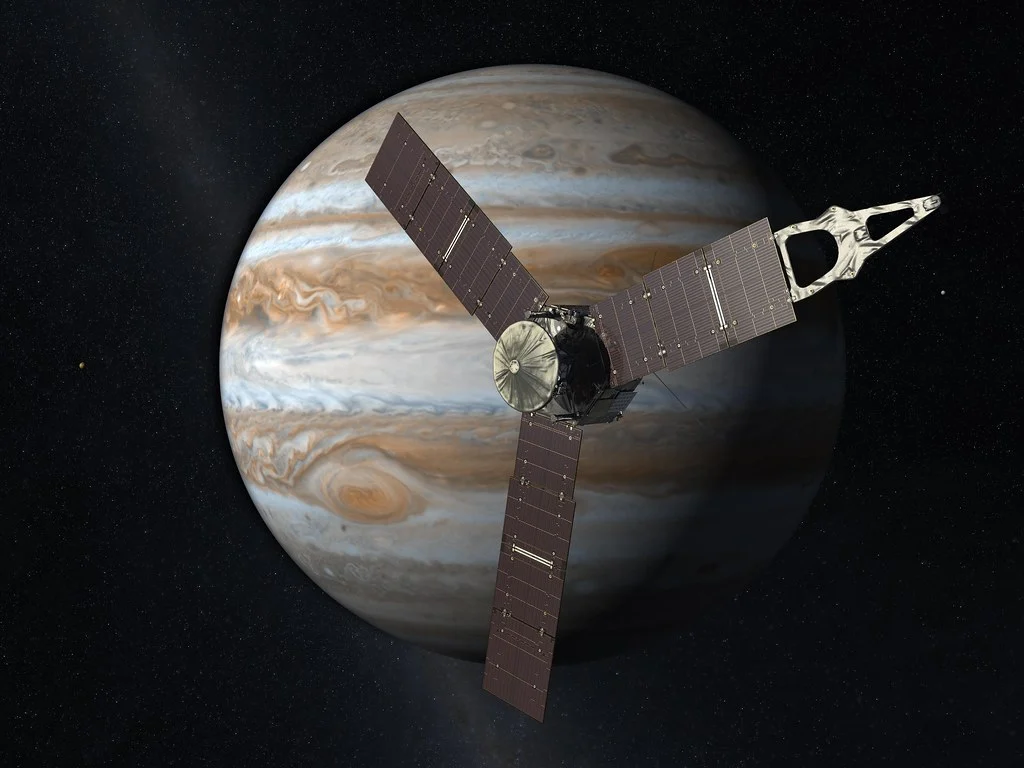
Image credit: NASA
While Jupiter’s immense mass has never been a secret, the way that weight is actually distributed has remained a closely guarded mystery, until Juno decided to crash the party. Forget the classic sci-fi trope of a fluffy gas cloud hiding a tiny rocky pebble, because the reality is far more couture let’s say, since it features a complex, onion-like arrangement of concentric layers that define the planet’s true internal silhouette. The real intrigue lies in the math of those layers, and that’s where things get surprisingly domestic. As Yohai Kaspi demonstrates during the press conference (see 10:33 of the Press Conference recording) you don’t need a telescope to understand the physics of a gas giant, you just need to watch it spin. Much like testing whether an egg is raw or hard-boiled on a kitchen counter, the specific way Jupiter rotates under the hood betrays exactly how much of its interior is fluid, how much is solid, and where the heavy lifting is actually happening.
For nearly a decade, the Juno mission has refined our understanding of Jupiter’s internal structure. Data suggest the planet features a diluted core, potentially harboring a tiny, compact center, surrounded by a cold, light envelope.
How AI / machine learning helped accelerate our understanding of Jupiter
You might wonder why these breakthroughs didn’t surface sooner, especially since the raw data was already in hand. The delay stems from the volume and surgical precision of Juno’s datasets. Processing this information using traditional methods, while accounting for every complex variable, would have been a computational nightmare, literally taking centuries to resolve! The advent of AI and machine leaning changed everything: Now it allows for most of the discoveries that we just discussed. The team estimates that using AI-driven data analysis, especially in the form of custom-built neural networks, helped boost the mission’s computational efficiency by a factor of 100,000. To put that in perspective, a calculation that previously required 100,000 hours can now be completed in just one. It is the mathematical equivalent of finishing an entire Ph.D. thesis in 20 minutes. Sounds too good to be true, doesn’t it?
The use of AI tools always receives mixed reactions in academic environments. This is understandable because artificial intelligence, especially in its generative applications, can pose real pressing ethical questions. At the same time it enables breakthrough discoveries like those presented here to be made and will likely allow to tackle even more complex problems in the future. Fear is a valid feeling and we all worry about being replaced by AI or about its potential misuse. For scientific applications like the ones presented, however, Scott Bolton suggested a different perspective that might be worth to chew on as we conclude this post:
I think it’s important to realize that AI is not going to replace the scientist by itself, that will actually be working together. It’s another team member, so to speak that’s doing all the hard work and pulling things out. But you will still need to look at the data, like even in the data that we’ve used, and say “Oh well wait a minute that doesn’t make sense. Let’s look at that program again and try to figure this out “ like we did with the dust. So it’s very important to have a a loop with humans in the system. But AI it is a great aid that enables new things.