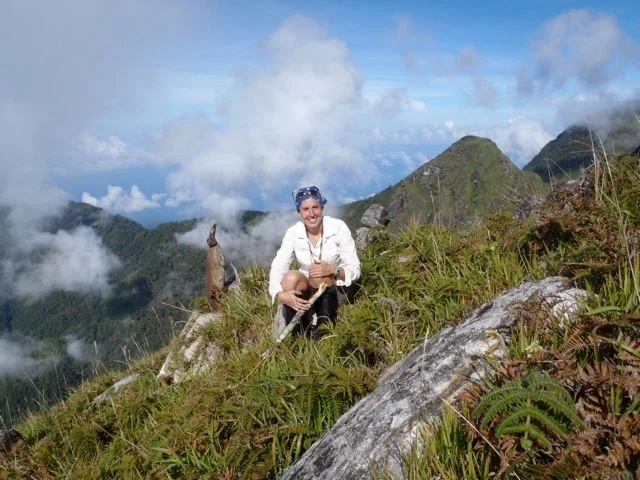
Geotalk is a regular feature highlighting early career researchers and their work. Following the EGU General Assembly, we spoke to Stacia Gordon, the winner of the Tectonics and Structural Geology Division Outstanding Young Scientist Award, 2014. First, could you introduce yourself and tell us a little more about your career path so far? My name …[Read More]
Geoscientific Methods
GeoEd: Citizen Geoscience
In this month’s GeoEd column, Sam Illingworth tells us about the growing use of Citizen Science within research as a means of acquiring data. Whilst the practice is novel and offers exciting opportunities as to volumes of data collected Sam highlights the importance of appropriately crediting the work of the willing volunteers. Citizen Science is …[Read More]
Imaggeo on Mondays: Plate it up – a recipe for sea ice errors
Last week, a team of cryospheric scientists published a paper in The Cryosphere that showed how tiny plates of ice can lead to spurious estimates of sea ice thickness. This week, we’re featuring their findings, as well as some spectacular sea ice images in the latest in our Imaggeo on Mondays series… Viewing the poles from above is …[Read More]
Geosciences Column: Meshing models with the small-scale ocean
The latest Geosciences Column is brought to you by Nikita Marwaha, who explains how a new generation of marine models is letting scientists open up the oceans. The new technique, described in Ocean Science, reveals what’s happening to ocean chemistry and biology at scales that are often hard to model… Diving into the depths of …[Read More]
Real life Minesweeper
Reading GeoLog when you should be working? We are all guilty of a little procrastination, but, sometimes, the parallels between science and the games we play to postpone the next write-up are closer than you’d think. Victor Archambault, a scientist from US Radar, reveals how playing Minesweeper mimics the way geoscientists analyse data in the field… …[Read More]
Imaggeo on Mondays: Quartz lawns and crystal flowers
Petrologists spend a large part of their time peering down microscopes at wafer thin slices of rock to work out what they’re made of and how they were formed. What lies on the other side of the lens can be an incredibly beautiful pattern, a kaleidoscope of colour, or stark bands of black and white, …[Read More]
GeoTalk: Steven Smith on fossil faults and fantastic faulting
This week in GeoTalk, we’re talking to Steven Smith, a Lecturer from the University of Otago. Steven takes us on an Earth-shaking journey, explaining how ancient faults reveal what’s happening under the Earth’s surface and delving into the future of fault zone research. First, could you introduce yourself and tell us a little about what …[Read More]
GeoTalk: The mantle and models and measurements, oh my! Talking geophysics with Juan Carlos Afonso
This week in GeoTalk, we’re talking to Juan Carlos Afonso, a geophysicist from Macquarie University, Sydney. He explains how a holistic approach is crucial to understanding tectonic processes and how a little “LitMod philosophy” can go a long way to achieving this… First, could you introduce yourself and tell us a little about what you …[Read More]
Imaggeo on Mondays: Friends in the field
Out in the field you encounter all sorts of wildlife and while mosquitos are the most frequent (and most unwelcome), they generally don’t interfere with your equipment or your data. The same can’t be said for all animals though, and many scientists have to strap their equipment out of reach, barricade it with barbed fences …[Read More]
GeoTalk: Matt Herod on awesome outreach and education
Matt Herod has long been part of the EGU Blog Network, where he writes about all things geochemistry from his base in the University of Ottawa. In this week’s GeoTalk, we had the chance to talk to Matt about all the other science communication activities he’s been up to – from mentoring kids in Canada …[Read More]