2020 was a brilliant year for our blogging network here at EGU. Across the EGU’s official blog, GeoLog, as well as the network and division blogs there were so many interesting, educational and just downright entertaining posts this year it was hard to get the blog editors to choose their favourites! Nevertheless at the beginning of January, to celebrate the excellent display of science writing ac ...[Read More]
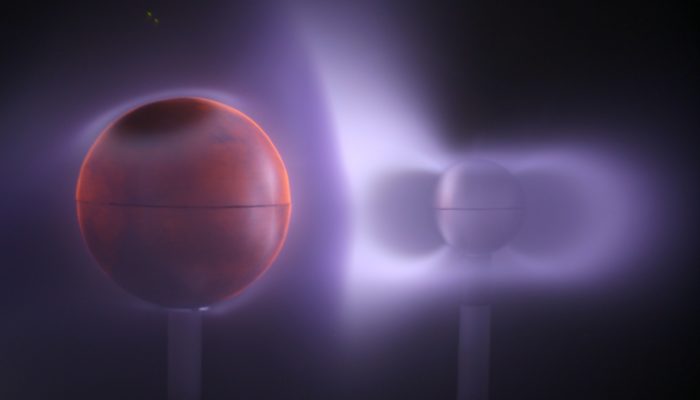
Imaggeo On Monday: Space plasma in a jar
Laboratory visualisation of solar wind interaction with Earth’s magnetic field. The Van Allen radiation belt, Earth’s magnetosphere, “bow shock” and a solar coronal hole can all be seen, and are emphasized with the ‘Planeterrella experiment‘, a vacuum chamber in the shape of a bell jar with the ‘Sun’ on the left (in the form of a large metallic sphere) and the ‘Earth& ...[Read More]
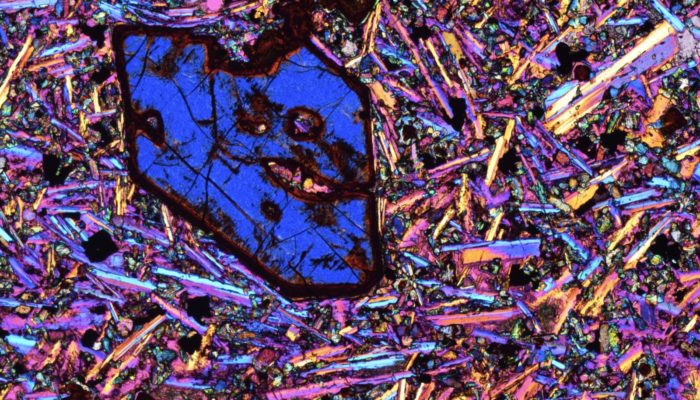
Imaggeo On Monday: Blue Olivine in an unusual basalt
Blue Olivine set in a matrix of pyroxene, magnetite and plagioclase in a basalt collected by the photographer, Bernardo Cesare, on the shore of the Sea of Galilee, Israel. Polarized light photomicrograph. Crossed polarizers and red tint plate. Width c. 2.7 mm. Who may have been throwing this stone a couple millennia ago? Description by Bernardo Cesare, after the description on imaggeo.egu.e ...[Read More]
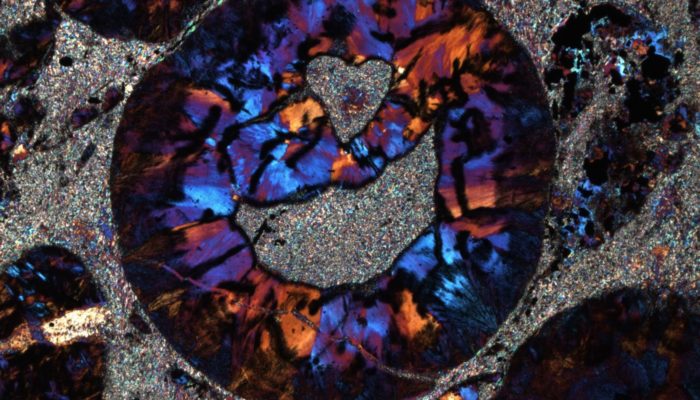
Imaggeo On Monday: Emoji from meteorites; impact spherule
This is a crossed polarized light photomicrograph of an impact spherule; a small mineralisation made when a meteorite hits the Earth and melts the rock at the point of impact, from Barberton Greenstone Belt, in South Africa. These spherules are the only remnants of Early Earth’s meteorite impact history, from between of 3.2 and 3.5 billion years ago. In this photo you can see the K-feldspar ...[Read More]