Advances in technology mean research that was unthinkable some years ago is now possible. For instance, geographically remote areas which were once out of reach have become more accessible through better (not always easier) transportation, so what we understand by ‘remote areas’ has changed significantly over time. The films in this edition of GeoCinema online are fascinating because they showcase ...[Read More]
Planetary and Solar System Sciences
The known unknowns – the outstanding 49 questions in Earth sciences (Part I)
Science is about asking questions, as much as it is about finding answers. Most of the time spent by scientists doing research is used to constrain and clarify what exactly is unknown – what does not yet form part of the consensus among the scientific community. Researchers all over the globe are working tirelessly to answer the unresolved questions about the inner workings of our planet, but inev ...[Read More]
GeoCinema Online: Saturn and its Icy Moon
It is day three of the General Assembly in Vienna, there are no sessions directly relevant to your research scheduled in the programme for this afternoon and you would really like to take a bit of a break from the hustle and bustle of the main scientific sessions. Where do you head? Down to the Basement (Blue Level) and to the GeoCinema, of course! GeoCinema has been a regular on the General Assem ...[Read More]
Imaggeo on Mondays: Light fantastic – flashing phenomena in Norway’s night sky
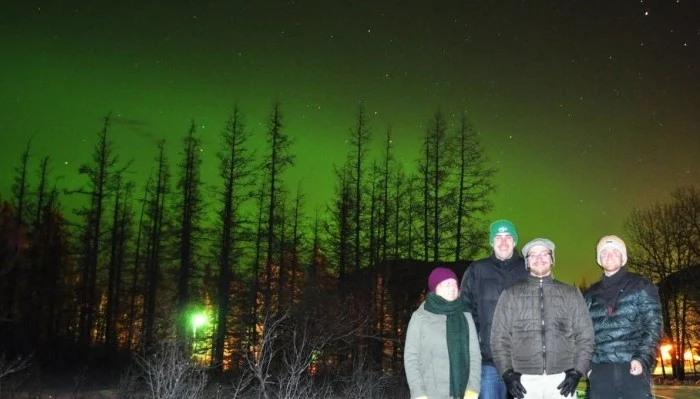
In this week’s Imaggeo on Mondays, Bjørn Gitle Hauge – from Østfold University College – opens our eyes to the astounding aurora borealis, and the unusual phenomena seen in Norway’s night sky… Hessdalen is a former mining district in the middle of Norway with huge ores of copper and mineshafts up to a kilometre deep. The climate here is sub-Arctic, with temperatures reaching as low as -50 de ...[Read More]
Capturing Cassini – 10 years of Saturnian science on camera
This year marks the 10th anniversary of the Cassini-Huygens mission to study Saturn and its moons. But what’s 10 years to us is only a fraction of the Saturnian calendar – in the decade we’ve been studying Saturn up close, the planet has been through only a third of its annual cycle. In that short time though, scientists have made a multitude of amazing and surprising discoveries about the system ...[Read More]
Imaggeo on Mondays: Pitter-patter of little paws in Patomsky crater
This week’s Imaggeo on Mondays is brought to you by Dmitry Demezhko, who describes how Patomsky crater may have formed and why it keeps scientists puzzling… Patomsky crater, also known as Patomskiy crater or the Patom cone, sits in the Irkutsk Region of Eastern Siberia. The site is a curious cone with a crater at the top and a small mound in the center. The cone totals some 39 metres in height and ...[Read More]
Geoscience under the tree
In a festive-themed post, EGU Media and Communications Manager Bárbara Ferreira selects a plethora of geoscience-inspired Christmas presents, which you could give to your favourite researcher. Please note that, with the exception of the last one, the items listed below are not necessarily recommended or endorsed by the EGU. For me Christmas is more about eating large amounts of food and celebratin ...[Read More]
Imaggeo on Mondays: That spot there? It’s 143,000 kilometres across
This week’s Imaggeo on Mondays highlights an amazing view of the night sky at new moon. Christian Klepp took this photo while at Waterton Glacier in the Rocky Mountains – it’s an incredible feat of determination to spend the night beside a glacial lake in the Rockies, let alone to capture such a photo! The centre of the Milky Way lies just over the horizon, shrouded by clouds of interstellar dust. ...[Read More]
Imaggeo on Mondays: Capturing the aurora
The northern lights, or aurora borealis, are created as charged particles interact with the Earth’s atmosphere. These electrons are part of the solar wind and as they pass through the Earth’s magnetic shield (the magnetosphere); the charged particles collide with those in our atmosphere, emitting light. In the southern hemisphere this phenomenon is known as the aurora australis, but both are caus ...[Read More]
Muon musings – how penetrating particles could let us peer beneath Mars’ surface
Muons are penetrating particles generated by cosmic rays. Muon radiography – or muography – is the large-scale equivalent of using x-rays to generate images. Except, instead of using x-rays to take a closer look at your broken arm, we can use showers of muons to take a look inside large geological structures – we’re talking several kilometres in size here! When cosmic rays meet the atmospher ...[Read More]