I grew up watching my dad come home covered in soot.
For most of his life, he worked as a firefighter in a natural reserve in Galicia, in northern Spain, a region of green mountains and steep terrain, almost Lord of the Rings in its landscape, but also a place where fire moves quickly and is notoriously difficult to control. Firefighting crews there are used to the fact that, to even begin work, there is often a hike first (sometimes a long one) just to reach the fire line.
In summer, fires were part of life. You expected them. You prepared for them. I was young, but I still remember seeing my dad leave for work and not really knowing whether he would be back eight hours later, or several days later. But there was a rhythm.
There was a fire season, outside of which crews had time to do what you might call the quieter (though still back-breaking) work: clearing vegetation, creating firebreaks, planting trees, reducing fuel loads in the landscape so that when summer came, the system was at least partially prepared for it. And during fire season itself, there was also structure in how the work unfolded. The more experienced crews often worked during the day, when conditions were harsher and fire behaviour more aggressive. Nights, in contrast, often provided a critical window for progress: lower temperatures and higher humidity meant fires could slow down enough for crews to advance. During the day, you defend. During the night, you attack. But fires have changed.
If you’ve paid any attention to the news in recent years, you’ve probably noticed that wildfires have become a near-constant presence. No longer confined neatly to the peak of summer, they now stretch across longer seasons, appear earlier, last longer, and reach places that did not use to burn.
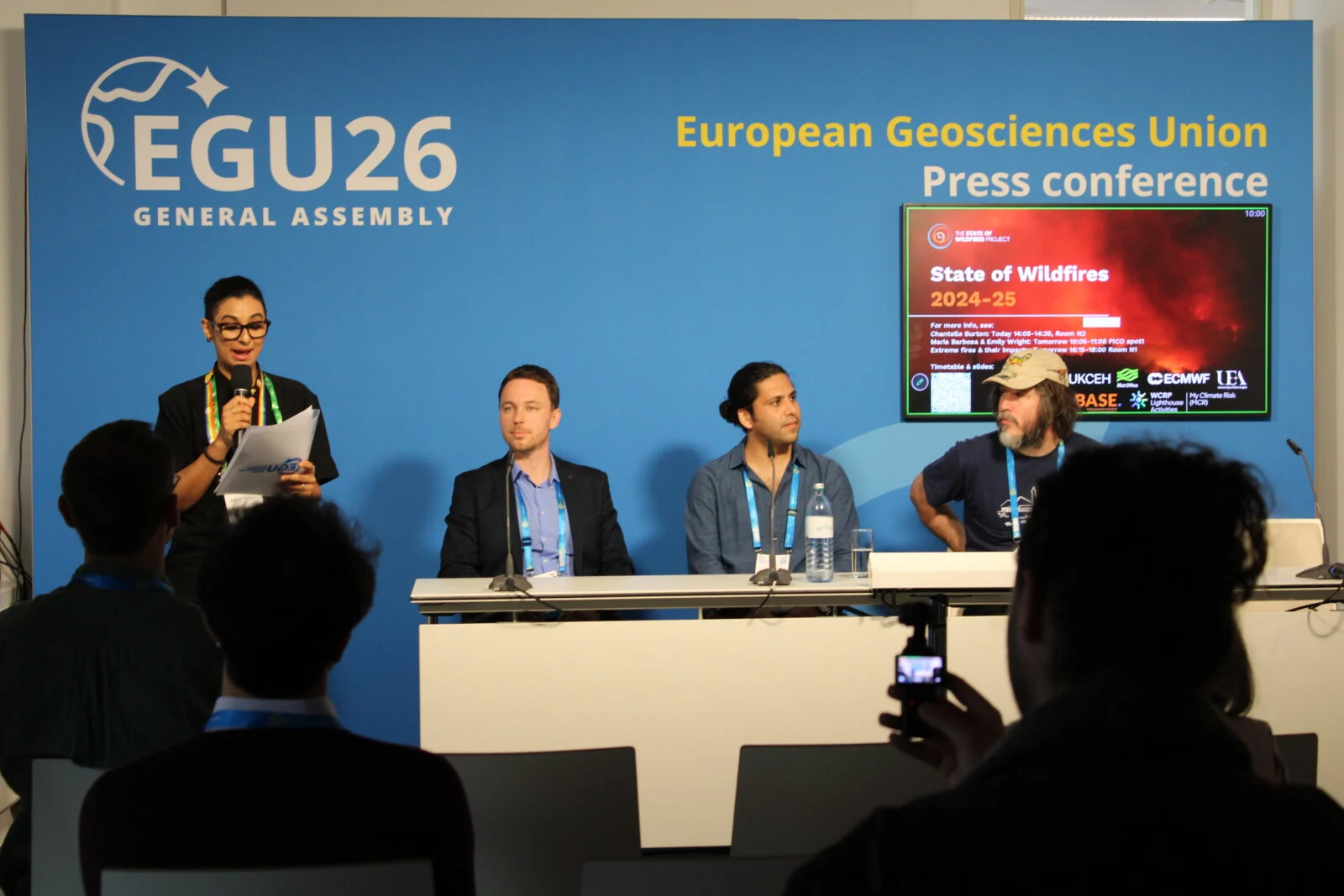
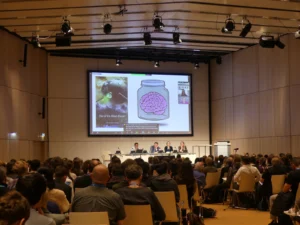
Fig. 1: Presenters at the “A trial by fire” press conference, at EGU26. Left to right: Lukas Dolak, Farzad Ghasamiazma, Douglas Ian Kelley,, Cyrielle Denjean (on screen). Credit: Kaisa Säkkinen
At the EGU General Assembly this year, I attended a press conference: Trial by fire: between preparedness, mitigation, and adaptation on a burning planet, which brought together scientists working on wildfire dynamics, prediction, and risk (Fig. 1).
I came into the session aware that there are more fires now. I came away realising that it’s not just that there are more – it’s that they are different. Fire, at its core, is simple. It needs fuel. It needs heat. It needs oxygen. And it responds to the environment around it. What is changing is not fire itself, but the world in which it lives.
Driven largely by climate change, the conditions that sustain fire are becoming more favourable across many regions. Longer dry periods leave vegetation more flammable. Higher temperatures dry fuels faster and for longer. Winds carry flames across landscapes that are already primed to burn. And crucially, these factors do not act independently.
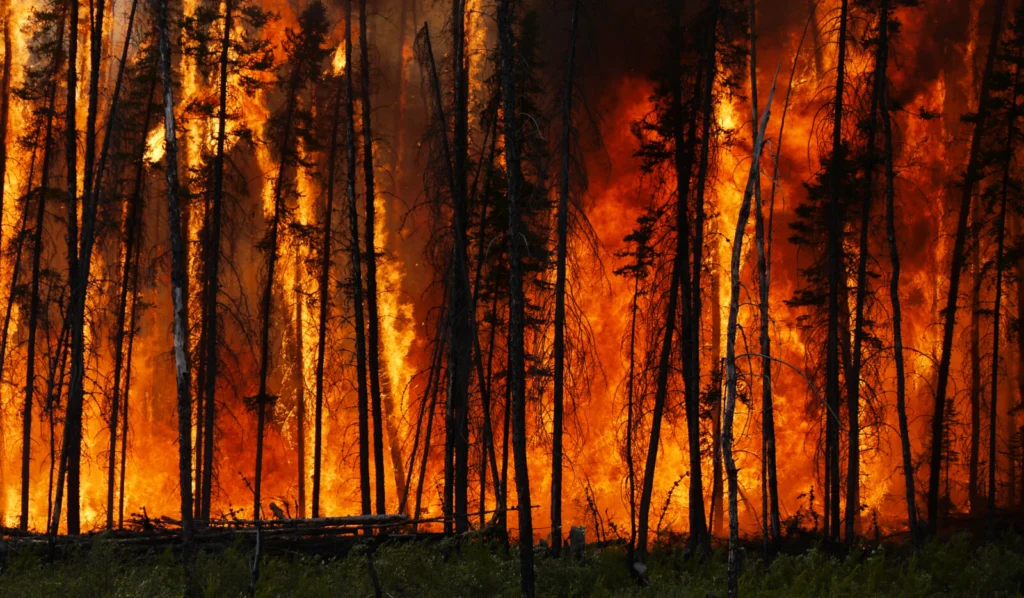
Recent work discussed at the press conference, highlighted that extreme wildfire events tend to emerge when multiple drivers align: prolonged drought, high temperatures, strong winds, and accumulated fuel loads: all conditions that are becoming more common in a warming world. On their own, each of these factors increases risk. Together, they can transform a fire into something far more difficult to control: a megafire (Fig. 2).
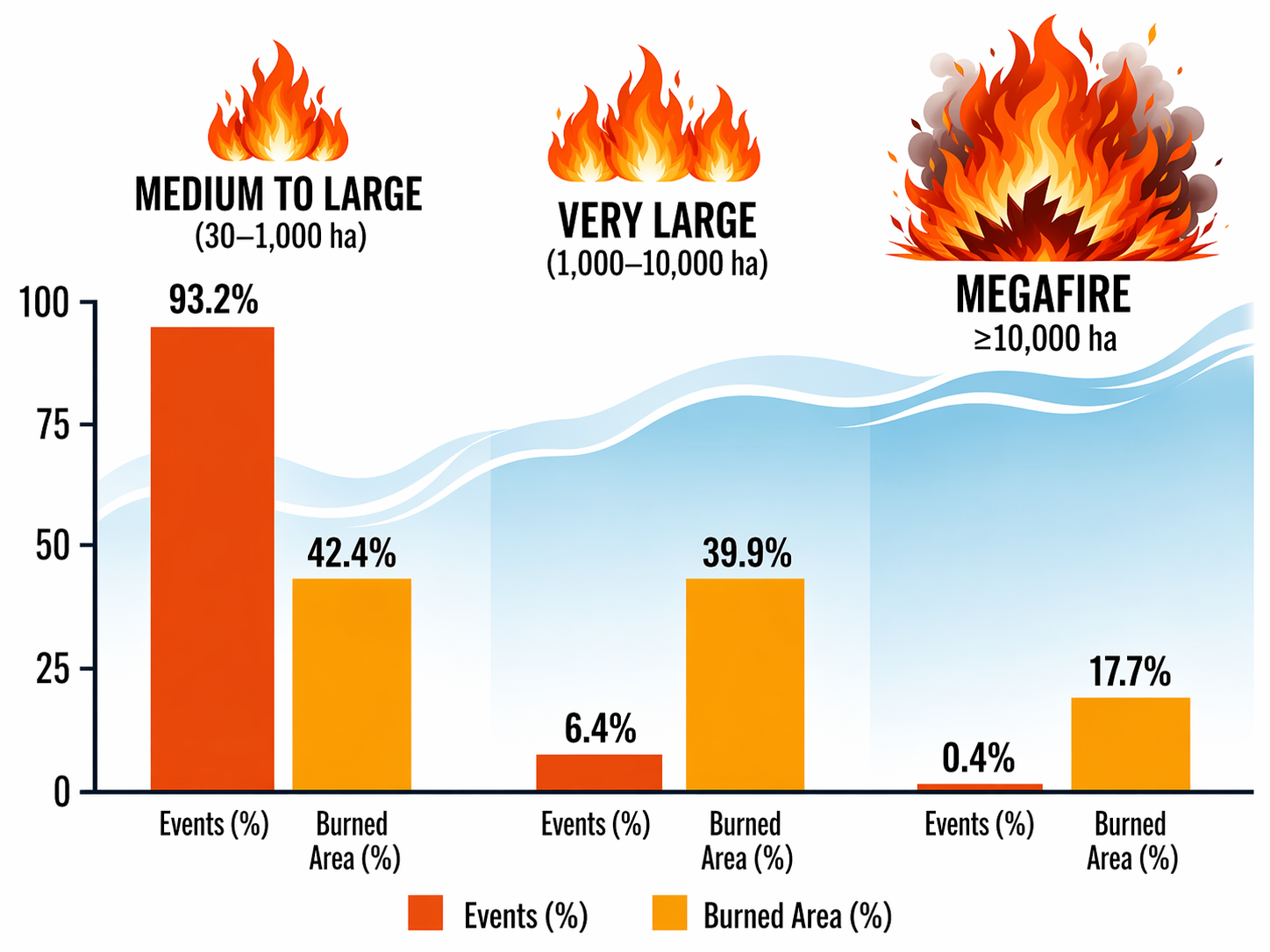
Credit: Farzad Ghasemiazma et al.; based on Ghasemiazma et al., npj Natural Hazards (2026), https://doi.org/10.1038/s44304-026-00197-5
These extreme events, resulting from a convergence of fire-favourable conditions, can grow faster, burn hotter, and persist longer than systems (both ecological and human) are equipped to handle.
“(Mega)fires are rare, but not random.” says Farzad Ghasemiazma from the University of Genoa, Italy.
There is a tendency, especially when discussing risk, to frame hazards as something we can prevent if we just understand them well enough. But many Earth system processes do not work that way. We do not prevent eruptions, but we monitor seismic activity, gas emissions, and ground deformation to anticipate them. We do not stop storms, but we track their trajectories and issue warnings in advance. We learn how these systems behave, we monitor their signals, and we try to reduce the damage they cause. Fire is increasingly part of that category.
Climate change is reshaping conditions in ways that make it easier for fires to ignite, spread, and grow more intense. In many regions, landscapes are shifting from ones that burn occasionally to ones that are periodically primed for fire.
As ecosystems that historically stored large amounts of carbon (such as forests and peatlands) begin to burn more frequently, they release significant amounts of greenhouse gases into the atmosphere. Fires are not only a consequence of a warming climate, but also contributors to it, reinforcing the cycle. This is not something that can be undone in the short term. It is something that we have no choice but to adapt to. We no longer have the luxury of simply responding to fires as and when they appear (which is what my impression was, speaking to my dad whilst he was working only a few years ago).
This is what the press conference made clear: alongside this increasingly challenging picture, our ability to read fire systems is improving (because it must, right?).
Prediction is becoming central; but not in the sense that we can say exactly when and where the next fire will ignite, but in the sense that we are getting better at identifying when conditions are aligning in ways that make fires more likely, and when those fires might be at their most dangerous. Temperature, humidity, soil moisture, wind patterns, vegetation dryness: these are not abstract variables. They are measurable signals of how ready a landscape is to burn.
Recent work in global wildfire monitoring is moving towards combining these signals to assess not just fire weather, but the likelihood of actual fire activity and its potential severity. That shift, from describing fires after the fact to identifying risk before they escalate, is key. It changes when action happens.
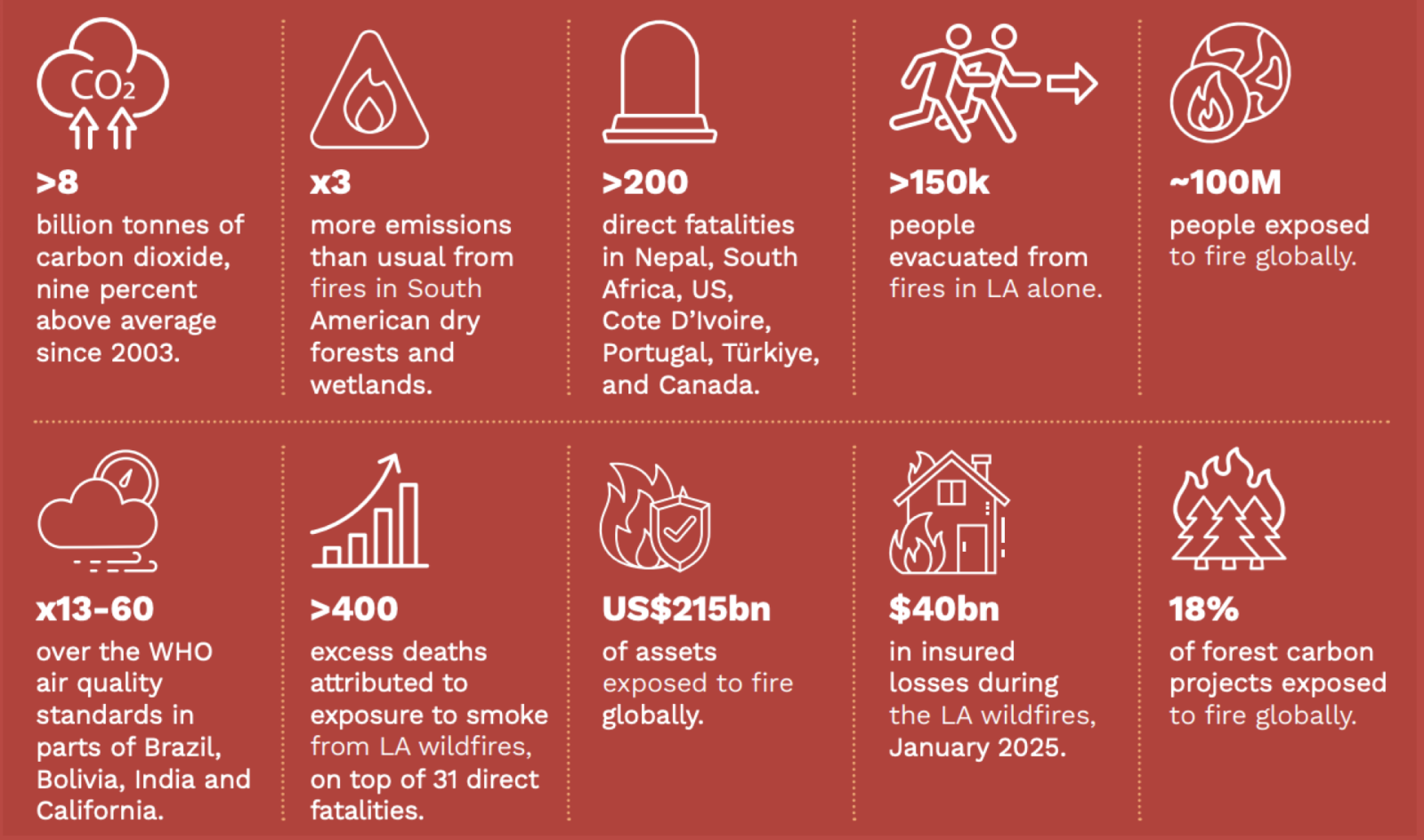
Fig. 3: The 2024-2025 fire season, in numbers (The State of Wildfires Project)
So yes, we are living in a world where fire is becoming a more persistent feature of the landscape, and that is unlikely to change in the near future, but we are also living in a time where we are beginning to understand it differently, as something that emerges from conditions we can increasingly observe, measure, and sometimes anticipate.
And that brings us back to a simple but powerful idea, one that came up during the press conference and that resonated with me:
Fires are rare, but not random. They respond to the world we create around them, and the better we understand their patterns, the better we can navigate what is, undoubtedly, a more flammable future.

Related Posts