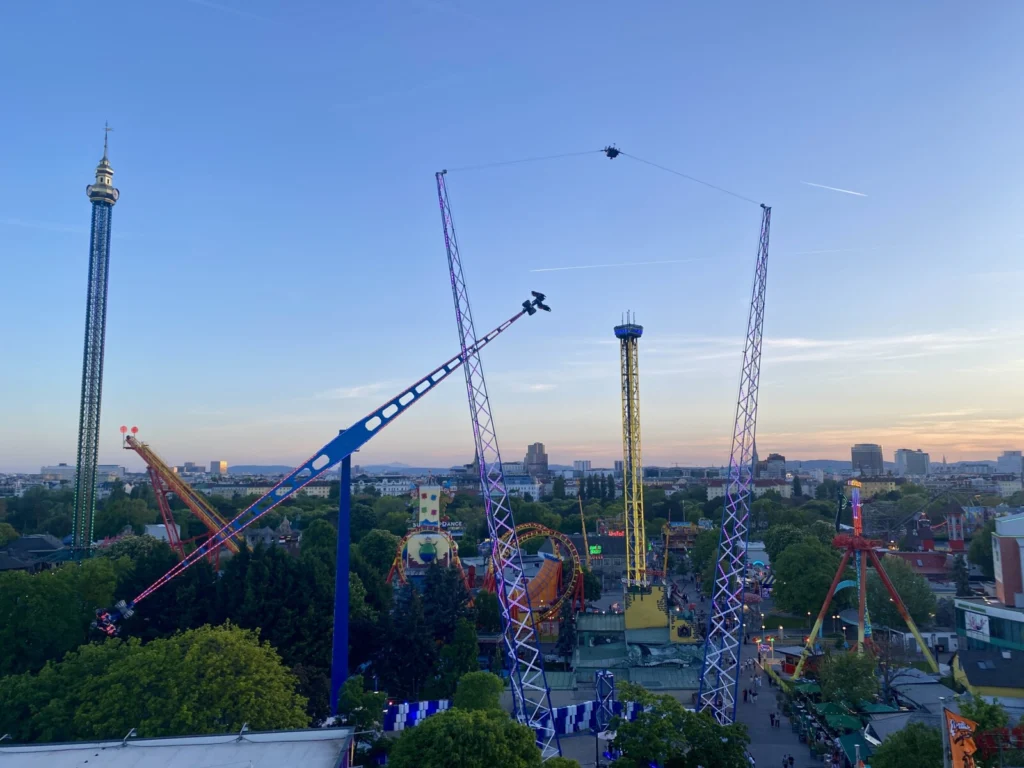
If you’ve ever been to Vienna’s Prater, you might know the ride.
I can see it from my hotel window while I am getting dressed to head to the Austria Center Vienna for EGU26.
It’s essentially a long, slightly questionable-looking couch, strapped on either side to cables that behave less like cables and more like very enthusiastic elastic bands. One flick of a switch and suddenly — whoooosh! you’re airborne. You shoot up into the sky, spin, bounce, and briefly wonder why you agreed to this in the first place. And then, almost as quickly, it’s over. Back on the ground, slightly disoriented, asking yourself what just happened.
It got me thinking about the EGU General Assembly. Being flung into the sky is not all that dissimilar to attending a large conference.
Before the conference starts, you’re too busy to think straight. You’re finishing slides, printing posters, checking your travel details for the fifth time. It’s all slightly chaotic, but with an undertone of excitement and anticipation, and all of a sudden, you’re there.
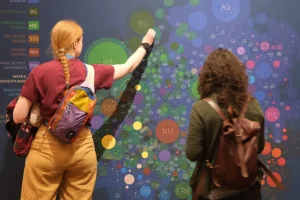
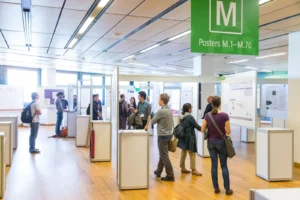
You walk into the ACV with probably a poster tube in your hand. Around you, people are greeting each other like long-lost friends. Conversations are already flowing. Everyone seems to know where they’re going. It may feel like you’ve arrived halfway through something that everyone else already understands. Your brain, very helpfully, begins to fill in the gaps.
What if I don’t know anyone here?
What if I spend the week slightly on the edge of everything?
What if I say something awkward to someone I really shouldn’t say something awkward to?
Well, too late. You are already sitting on the flying couch chair. There is no getting out now, so buckle up!
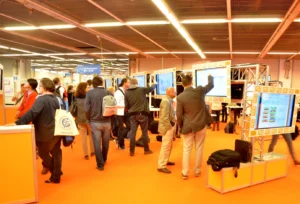
The conference is a whirlwind of sessions, coffee queues, and the constant fear of missing out. Amid the rush, your brain inevitably starts comparing: their results seem groundbreaking, their talks flawless. Then, the buzz vanishes. You’re back at your desk, swapping high-octane stimulation for total silence. This is the post-conference comedown, a disorienting shift from maximum input to zero.
So, as far as our brains are concerned, large conferences, are too, a kind of rollercoaster ride.
In this blog, I want to introduce you to some of the things my brain tells me during conference week, when it decides to creatively (and often wrongly) interpret its surroundings in the worst possible way. Not because they are particularly helpful, but because spotting them early can stop them from running the whole show.
Thought #1: “Everyone else has it together”
There is a very particular illusion that conferences create, and it is surprisingly convincing.
You sit in a talk and everything seems to work. The slides are clean, the figures make sense, the speaker sounds confident. You look at the final result and think: this is solid. Well thought through. Proper science. But you are basing your conclusion on an incomplete set of observations.
You do not see the earlier versions of the story that did not quite hold together, the results that complicated things (except, of course, in this session), or the parts the speaker is still unsure about. You also do not hear the internal commentary running alongside the talk: the mental notes about what they would rephrase, clarify, or cut if they had the chance, the nerves about what questions might come up, the “what ifs”.
For every presentation that looks seamless to you, there is almost certainly a presenter who can point to several things they would change.
In many ways, conferences are, let’s say, the social media platform of science: polished snapshots that leave out most of the process behind them. We know that, and yet we often inadvertently compare our full internal experience (struggles included) with someone else’s final, curated version. And then treating that comparison as fair – when it isn’t.
Thought #2: “Why did you do that?!”
At some point, something will not go perfectly.
A sentence comes out less clearly than intended. A figure takes longer to explain than expected. A question catches you slightly off guard and your answer is not as smooth as it sounded in your head.
These moments feel disproportionately large while they are happening. Your brain tends to zoom in on them and expand them into evidence of something broader: that you may be less prepared, less clear, less capable than others around you. But from the outside, these moments are rarely experienced the way they feel internally.
Most people do not register them at all. The ones who do tend to interpret them as normal variations in communication rather than signs of anything deeper. After all, they are too busy thinking about their own talks, their own posters, their own “why did I say it like that?” moments.
In other words: the spotlight is much dimmer than it feels.
Thought #3: “I shouldn’t go, I don’t know anyone”
Go anyway.
Networking events have a way of making you acutely aware of your own position in a room. You walk in, see groups already formed, conversations already flowing, and immediately feel like you are slightly out of sync with everything around you.
It is easy to assume that everyone else arrived with a plan or a network already in place. And, whilst some have (some of us have been attending EGU since what seems like the deep geological past), in reality a lot of people are doing the same quiet calculation as you: where to stand, how to join in, whether it is easier to wait or to approach. If you pause and look around, you will spot them.
Say hello. It may feel like a difficult step, but it can completely change the rest of someone’s evening, including your own. If nothing else, imagine the relief you would feel if someone did exactly that for you.
Thought #4: “I’d like to talk to them, but…”
You recognise someone’s work. You have read their papers, maybe cited them, maybe built your work on them. And then you realise they are here, physically present, and that in principle you could simply… talk to them, right?
And yet that step feels oddly difficult.
Intentionality transforms networking. A brief introductory email, where you state your interest and suggest a time, turns a vague hope into a concrete meeting. (The EGU programme’s email icons make this seamless.) This preparation clarifies your own goals, ensuring a more meaningful exchange than the dreaded opening line: “My supervisor said I should talk to you.”
Thought #5: “I’m missing out on everything”
At some point, you will look at the programme and realise you are missing things. And you will also imagine you are missing things. Not just a talk here and there, but entire sessions, discussions, ideas that seem interesting in hindsight, potential opportunities, the job of your life… (ok, calm down).
Trying to optimise your way out of that usually just adds stress. A more workable approach is to accept that you will only ever see a fraction of what is going on, and that this is not a problem to solve but a condition of the environment. Check out this blog for more on missing out at EGU.
Science does not happen solely during the 12-minute slot you missed while queueing for coffee. It spills over into papers, preprints, social media, personal blogs, and chats with others. The science ecosystem these days sprawls far beyond scientific meetings and journals. Make notes. Follow up. Let things unfold beyond the timetable.
So yes, conferences can mess with your head a bit.
They compress comparison, attention, and social interaction into a very dense period of time. They give you access to a huge amount of science, but mostly in its most polished form. And your brain, doing what it always does, fills in the gaps in ways that are not always helpful.
But once you start to recognise the patterns, the moments where your brain over-interprets, over-compares, or quietly escalates things, something shifts. The ride is still fast, slightly chaotic, and occasionally disorienting. But it becomes easier to stay on it without over-analysing every turn.
So, next time you find yourself in a crowded conference hall, hovering at the edge of a conversation or wondering whether you should have gone to a different session, you can pause for a second and think:
Ah! It’s that feeling again, isn’t it?
And that’s when you remind yourself to keep going. There’s a subtle peace in knowing that almost everyone around you is probably navigating the same inner noise, they’re just keeping it to themselves.
Enjoy your time at #EGU26!